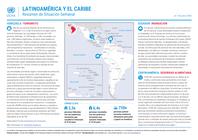
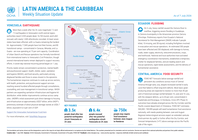
Countries: Venezuela (Bolivarian Republic of), Ecuador, Guatemala, Honduras, Nicaragua Source: UN Office for the Coordination of Humanitarian Affairs Please refer to the attached Infographic. KEY FIGURES 3.5K people dead after two powerful earthquakes struck Venezuela on 24 June 6.4K people rescued after two powerful earthquakes struck Venezuela on 24 June 750K people may require food assistance between June-August in Honduras VENEZUELA: EARTHQUAKE More than a week after the 24 June magnitude 7.2 and 7.5 earthquakes in Venezuela’s north-central region, authorities report 3,535 people dead, 16,740 injured, and 6,462 rescued, with nearly 1,000 aftershocks recorded. At least seven states have been affected, with La Guaira remaining the hardest hit. Approximately 17,845 people have lost their homes, and 80 transitional camps – concentrated in Caracas, Miranda, and La Guaira – are now operating at 73 per cent capacity. Coordination of Urban Search and Rescue operations has formally transferred from international teams to Venezuela’s Civil Protection, though several international teams remain deployed to support recovery efforts. A seven-day national mourning period began on 1 July. Priority needs remain concentrated in protection, mental health and psychosocial support, health, shelter, water, sanitation and hygiene (WASH), and food security, particularly among displaced families and those in areas closest to the epicentre. The humanitarian response continues to scale up across sectors, with health, protection, and psychosocial support services reaching several hundred affected people through consultations, counselling, and case management in transitional camps. WASH partners are expanding sanitation infrastructure and hygiene kit distribution, while shelter improvements continue across camp sites. UNDRR’s initial assessment puts direct damage to housing and infrastructure at approximately US$37 billion, while UNDP’s preliminary estimate of direct physical damage stands at US$6.7 billion, equivalent to 6 per cent of GDP. Support the Venezuelan Humanitarian Fund here For more information, visit: ReliefWeb Response ECUADOR: FLOODING On 3 July, heavy rainfall caused the Zamora River to overflow, triggering severe flooding in Guadalupe, in Zamora municipality in the Amazonian province Zamora Chinchipe. Preliminary reports from Ecuador’s National Secretariat for Risk Management (SNGR) indicate 5 people killed, 10 missing, and 38 injured, including firefighters involved in evacuation and rescue operations. An estimated 300 people have been affected and 200 displaced, with damage to homes, roads, water supply, electricity, telecommunications, crops, and livelihoods. National and local authorities have activated emergency coordination mechanisms, established a temporary shelter for displaced families, and are leading search and rescue operations, rapid needs assessments, and the delivery of humanitarian assistance. CENTRAL AMERICA: FOOD SECURITY FEWS NET forecasts below-average rainfall and persistent dry conditions across most of Central America through early July, despite increased rainfall in early June that failed to offset long-term deficits. Most basic grain-producing areas are expected to receive no more than 45 per cent of historical average rainfall between 16 June and 10 July, with the steepest deficits, up to 65 per cent, concentrated in Guatemala and Nicaragua. In Honduras, Crisis (IPC Phase 3) outcomes have already emerged across the Dry Corridor and the Pacific coastal department of Choluteca. FEWS NET estimates 500,000–749,999 people will need humanitarian food assistance nationally, with needs peaking between June and August. Regional meteorological services expect an extended canícula (mid-summer dry spell) to further affect the Dry Corridor, and forecast temperatures 2-4°C above average across the Pacific side of the region.

![world: global decarbonisation roadmap danish refugee council [en/es]](https://blhlfoundation.org/wp-content/uploads/2026/07/cd58eb1b-ec09-54e0-a20e-92e05e4304ea-OUykAA.png "World: Global Decarbonisation Roadmap - Danish Refugee Council [EN/ES]")