Uncategorized

guatemala: latinoamérica y el caribe resumen de situación semanal al 7 de agosto 2026

Guatemala: Latinoamérica y El Caribe Resumen de Situación Semanal al 7 de agosto 2026

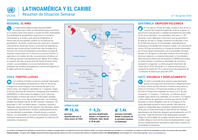
Countries: Guatemala, Chile, Haiti Source: UN Office for the Coordination of Humanitarian Affairs Please refer to the attached Infographic. CIFRAS CLAVE 16,4K personas damnificadas por el clima severo en Chile 4,2K personas desplazadas debido a la violencia en Artibonite, Haití, desde el 28 de julio 1,4K personas evacuadas debido al aumento de la actividad volcánica en Guatemala REGIONAL: EL NIÑO La Organización Meteorológica Mundial (OMM) pronostica que El Niño se intensificará hasta convertirse en un evento fuerte entre agosto y octubre de 2026, aumentando la probabilidad de temperaturas superiores a lo normal en Centroamérica, el Caribe y gran parte de Sudamérica, al tiempo que provoca grandes cambios en los patrones de precipitación. Se prevén condiciones más secas de lo normal en Centroamérica, partes del Caribe y el noroeste de Sudamérica, mientras que se pronostican condiciones más húmedas de lo normal en el sureste de Sudamérica, aumentando el riesgo de impactos relacionados con el clima en los recursos hídricos, la agricultura y los medios de vida. Las previsiones climáticas en el Caribe ya apuntan a precipitaciones por debajo de la media y un aumento del calor en gran parte del Caribe al menos hasta octubre. Las autoridades y los socios humanitarios están ampliando las medidas de preparación y acción anticipatoria en la región antes de los impactos. CHILE: FUERTES LLUVIAS Los sistemas frontales sucesivos continúan impulsando las necesidades humanitarias en Chile, en una de las emergencias meteorológicas más extensas del país en los últimos años, con impactos reportados en 11 regiones. Según el Servicio Nacional de Prevención y Respuesta ante Desastres (SENAPRED), el clima severo ha dejado a 16.417 personas damnificadas, mientras que más de 10.000 siguen aisladas, 13 han fallecido y cinco siguen desaparecidas. Las tormentas también han dañado más de 39.000 viviendas, incluyendo 120 destruidas y 3.491 con daños graves. Coquimbo, Atacama y Valparaíso siguen siendo de las regiones más afectadas, donde inundaciones, deslizamientos de tierra y desbordamientos de ríos han afectado comunidades, infraestructuras y servicios básicos. Las autoridades y los socios humanitarios continúan realizando evaluaciones de daños y apoyando los esfuerzos de respuesta y recuperación. GUATEMALA: ERUPCIÓN VOLCÁNICA El 3 de agosto, Volcán de Fuego, situado a unos 35 km al suroeste de Ciudad de Guatemala, entró en erupción, lo que provocó evacuaciones y medidas de preparación reforzadas en las zonas afectadas. Las autoridades evacuaron a 1.421 personas a cinco albergues e informaron que la exposición a la caída de cenizas y a riesgos volcánicos ha afectado a más de 29.000 personas en 18 comunidades, especialmente en Alotenango, la localidad más cercana al volcán. Las columnas de ceniza, los flujos piroclásticos y el riesgo de lahares provocados por la lluvia siguen amenazando a las comunidades cercanas, aunque, al 6 de agosto, la actividad volcánica ha comenzado a disminuir respecto a su máxima intensidad. La Coordinadora Nacional para la Reducción de Desastres (CONRED) permanece en alerta máxima y coordina las actividades de monitoreo, evacuación y respuesta. La última erupción importante del volcán fue en 2018, afectando a 1,7 millones de personas y causando la muerte de 178, lo que provocó una asignación de 1,6 millones de dólares por parte del CERF. HAITÍ: VIOLENCIA Y DESPLAZAMIENTO En Haití, la escalada de la violencia sigue generando graves preocupaciones de protección y desplazamientos. Un nuevo informe de ONU Derechos Humanos documentó al menos 613 muertes y 375 personas heridas en dos barrios de Puerto Príncipe entre mediados de marzo y el 31 de julio, incluyendo 111 mujeres y 77 menores. La violencia sexual también sigue siendo muy extendida, con al menos 176 mujeres y niñas víctimas de agresiones, mientras que más de 18.000 personas se vieron obligadas a huir de sus hogares en las zonas afectadas durante el mismo periodo. Más allá de la capital, la inseguridad sigue impulsando desplazamientos. El 28 de julio, la violencia armada en Saint-Michel de l’Attalaye, departamento de Artibonite, desplazó aproximadamente a 4.216 personas. Todas las familias recién desplazadas buscaron refugio en comunidades de acogida, mientras que la violencia también obligó al cierre de tres sitios de desplazamiento, lo que provocó desplazamientos secundarios adicionales y agravó las necesidades humanitarias.

Guatemala: Latinoamérica y El Caribe Resumen de Situación Semanal al 7 de agosto 2026 Read More »
guatemala: latin america & the caribbean weekly situation update as of 7 august 2026

Guatemala: Latin America & The Caribbean Weekly Situation Update as of 7 August 2026

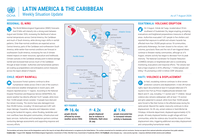
Countries: Guatemala, Chile, Haiti Source: UN Office for the Coordination of Humanitarian Affairs Please refer to the attached Infographic. KEY FIGURES 16.4K people directly affected by severe weather across Chile 4.2K people displaced due to violence in Artibonite, Haiti since 28 July 1.4K people evacuated due to increased volcanic activity in Guatemala REGIONAL: EL NIÑO The World Meteorological Organization (WMO) forecasts that El Niño will intensify into a strong event between August and October 2026, increasing the likelihood of above-normal temperatures across Central America, the Caribbean and much of South America, while driving major shifts in rainfall patterns. Drier-than-normal conditions are expected across Central America, parts of the Caribbean and northwestern South America, while wetter-than-normal conditions are forecast in southeastern South America, increasing the risk of climate-related impacts on water resources, agriculture and livelihoods. Climate outlooks in the Caribbean already point to below-average rainfall and increased heat across much of the Caribbean through at least October. Authorities and humanitarian partners are scaling up preparedness and anticipatory action measures across the region ahead of impacts. CHILE: HEAVY RAINFALL Successive frontal systems continue to drive humanitarian needs across Chile in one of the country’s most extensive weather emergencies in recent years, with impacts reported across 11 regions. According to the National Disaster Prevention and Response Service (SENAPRED), the severe weather has directly affected 16,417 people, while more than 10,000 people remain isolated, 13 people have died and five remain missing. The storms have also damaged more than 39,000 homes, including 120 destroyed and 3,491 with major damage. Coquimbo, Atacama and Valparaíso remain among the hardest-hit regions, where flooding, landslides and river overflows have disrupted communities, infrastructure and basic services. Authorities and humanitarian partners continue conducting damage assessments and supporting response and recovery efforts. GUATEMALA: VOLCANIC ERUPTION On 3 August, Volcán de Fuego, located about 35 km southwest of Guatemala City, began erupting, prompting evacuations and heightened preparedness measures in affected areas. Authorities evacuated 1,421 people to five shelters and reported that exposure to ashfall and volcanic hazards has affected more than 29,000 people across 18 communities, particularly Alotenango, the town closest to the volcano. Ash columns, pyroclastic flows and the risk of rain-triggered lahars continue to threaten nearby communities, although as of 6 August, volcanic activity has begun to decrease from its peak intensity. The National Coordinator for Disaster Reduction (CONRED) remains on heightened alert and is coordinating monitoring, evacuations and response efforts. The volcano last had a major eruption in 2018, affecting 1.7 million people and killing 178, prompting a US$1.6 million CERF allocation. HAITI: VIOLENCE & DISPLACEMENT In Haiti, escalating violence continues to drive severe protection concerns and displacement. A new UN human rights report documented at least 613 people killed and 375 injured in two Port-au-Prince neighbourhoods between mid-March and 31 July, including 111 women and 77 children. Sexual violence also remains widespread, with at least 176 women and girls subjected to assault, while more than 18,000 people were forced to flee their homes in the affected areas during the same period. Beyond the capital, insecurity continues to drive displacement. On 28 July, armed violence in Saint-Michel de l’Attalaye, Artibonite department, displaced approximately 4,216 people. All newly displaced families sought refuge with host communities, while the violence also forced the closure of three displacement sites, triggering additional secondary displacement and compounding humanitarian needs.

Guatemala: Latin America & The Caribbean Weekly Situation Update as of 7 August 2026 Read More »

mozambique: public health situation analysis (phsa)

Mozambique: Public Health Situation Analysis (PHSA)

Country: Mozambique Source: World Health Organization Please refer to the attached file. Mozambique continues to face recurrent public health and humanitarian challenges, driven by overlapping crises. The country is regularly affected by epidemics and extreme weather events and is currently experiencing widespread flooding and a cholera outbreak. Nearly nine years after armed conflicts erupted in Cabo Delgado, humanitarian needs remain severe. Around 1.1 million people across northern Mozambique require humanitarian assistance, including 919 000 people in the districts most affected by the conflict in Cabo Delgado. Despite ongoing relief efforts, less than half of those in need have been reached, while humanitarian funding remains critically insufficient. As a result, many vulnerable families continue to face limited access to health care, food, education and protection services. In 2026, humanitarian access in northern Mozambique remained highly constrained, primarily due to localized attacks, armed clashes and interference along key routes, compounded by damaged infrastructure and the impact of the rainy season, which continued to disrupt and complicate operations. More broadly, Mozambique is facing its most severe cholera outbreak in 25 years and is grappling with ongoing internal conflict that has resulted in a complex and multifaceted crisis with significant humanitarian implications, including high levels of internal displacement. Mozambique is classified as one of the countries in the world most affected by extreme weather events. In 2025, more than 724 000 people were affected by floods. At the peak of the emergency, over 100 000 people were hosted in approximately 100 accommodation centres.

Mozambique: Public Health Situation Analysis (PHSA) Read More »

The Republic of Korea contributes USD 30 million to WFP’s humanitarian assistance through REACH Phase II | World Food Programme

Countries: Republic of Korea, Afghanistan, Bangladesh, Myanmar, occupied Palestinian territory, Somalia, Sudan, Syrian Arab Republic Source: World Food Programme ROME – The United Nations World Food Programme (WFP) welcomes a USD 30 million contribution from the Republic of Korea (ROK) to launch the second phase of the ROK-WFP REACH initiative (Responding with Emergency Assistance for Conflict-affected Households), providing emergency food and nutrition assistance to vulnerable populations affected by conflict, displacement, and economic shocks. Building on the success of REACH Phase I (2025-2026), the renewed initiative will support WFP’s emergency response in Afghanistan, Bangladesh, Myanmar, Palestine, Somalia, Sudan, and Syria over a 12-month period. At a time of growing humanitarian needs, this contribution will help WFP deliver lifesaving assistance to families facing some of the world’s most severe crises. The initiative demonstrates ROK’s humanitarian leadership and commitment to global solidarity, playing a critical role in saving lives and bringing hope to vulnerable communities. Under REACH Phase II, WFP will provide emergency food assistance and nutrition support, including for vulnerable children, with the aim of reaching more than 1.2 million food-insecure people. The initiative’s strategic and flexible approach enables WFP to respond effectively to evolving needs and operational challenges across complex humanitarian settings. REACH Phase I supported WFP’s emergency response in Myanmar, Palestine, Sudan, and Syria, reaching nearly 1.9 million people with food and nutrition assistance. Building on these achievements, Phase II expands the initiative to three additional countries, further strengthening WFP’s ability to respond to humanitarian needs across multiple regions. In 2025, the Republic of Korea contributed over USD 200 million to WFP, becoming one of WFP’s top five government donors. Having received assistance from WFP more than 60 years ago, ROK has transitioned into a leading donor – an inspiring testament to progress in the fight against hunger. # # # About WFP The United Nations World Food Programme is the world’s largest humanitarian organization saving lives in emergencies and using food assistance to build a pathway to peace, stability and prosperity for people recovering from conflict, disasters and the impact of climate change. Follow us on X via @wfp_media and on Instagram via @worldfoodprogramme, @wfpkorea

The Republic of Korea contributes USD 30 million to WFP’s humanitarian assistance through REACH Phase II | World Food Programme Read More »

world: alertes de maladies épidémiques et émergentes en océanie le 04 août 2026

World: Alertes de maladies épidémiques et émergentes en Océanie le 04 août 2026

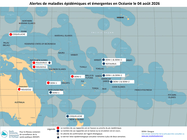
Countries: World, Australia, New Caledonia (France), New Zealand, Palau, Samoa, Tonga, United States of America, Vanuatu Source: Pacific Community Please refer to the attached Map. Éléments nouveaux/faits marquants intervenus depuis la diffusion de la carte précédente sur PacNet, le 28 juillet 2026 : Dengue • Nouvelle-Calédonie : entre le 1er janvier et le 27 juillet 2026, 2 228 cas de dengue ont été signalés, soit dix cas supplémentaires par rapport au dernier point de situation (2 218 cas), le dernier cas ayant été déclaré le 27 juillet 2026. La courbe épidémiologique a atteint son pic à approximativement 250 cas au cours de la semaine épidémiologique 17 et connaît depuis un déclin régulier. Il s’agit d’un recul logique compte tenu de la saison fraîche, qui s’accompagne généralement d’un ralentissement ou d’une interruption de la transmission. Le sérotype 1 (DENV-1) reste le seul en circulation. L’alerte bleue pour la dengue (DENV-1) est maintenue. – Source : La dengue | Direction des affaires sanitaires et sociales de Nouvelle-Calédonie, page consultée le 4 août 2026. • Samoa : la dengue a poursuivi sa décrue au cours de la semaine épidémiologique 29 (13–19 juillet 2026), avec 22 nouveaux cas signalés, ce qui correspond à une baisse de 31 % par rapport à la semaine précédente. Aucune hospitalisation, aucune admission en soins intensifs, ni aucun décès n’ont été notifiés au cours de la semaine considérée. Quatre nouveaux cas confirmés biologiquement ont été recensés. La co-circulation des sérotypes DENV-1 (54 %) et DENV-2 (46 %) se poursuit. La plupart des cas ont été signalés à Upolu (92 %) et les moins de 15 ans restent la tranche d’âge la plus touchée, avec 73 % des cas signalés. Depuis le 1er janvier 2025, 20 085 cas diagnostiqués cliniquement et 5 524 cas confirmés biologiquement ont été signalés, de même que neuf décès liés à la maladie. Les autorités sanitaires poursuivent leurs actions de proximité, leurs activités de prévention en milieu scolaire, ainsi que leurs campagnes de fumigation et de sensibilisation afin de limiter le développement des gîtes larvaires et de prévenir la transmission de la maladie. L’alerte bleue pour les sérotypes DENV-1 et DENV-2 est maintenue. – Source : Rapport de situation sur l’épidémie de dengue no 66 du ministère de la Santé du Samoa, semaine épidémiologique 29, communiqué au point de contact du Groupe de coordination du Réseau océanien de surveillance de la santé publique (ROSSP) le 29 juillet 2026. • Tonga : le 31 juillet 2026, le ministère de la Santé a officiellement déclaré la fin de l’épidémie de dengue. L’épidémie avait été déclarée le 17 avril 2026 et a duré un peu plus de trois mois, au cours desquels 29 personnes ont été hospitalisées et aucun décès n’a été recensé. Le dernier cas a été signalé le 9 juillet 2026, et aucune autre hospitalisation n’a eu lieu au cours des trois semaines qui se sont écoulées depuis cette date. Tongatapu a été la division la plus touchée, suivie de Ha’apai et ‘Eua, tandis qu’aucun cas n’a été signalé dans les divisions de Vava’u et Niuas. Initialement, l’épidémie touchait en premier lieu les 10–14 ans, et à la fin de l’épidémie, la tranche d’âge la plus touchée était celle des 15–19 ans. L’alerte pour le sérotype DENV-2 est levée. – Source : End of Dengue Fever Outbreak, communiqué de presse du ministère de la Santé du Royaume des Tonga (31 juillet 2026), communiqué au point de contact du Groupe de coordination du ROSSP le 3 août 2026. • Vanuatu : au 31 juillet 2026, l’épidémie de dengue se poursuit dans le sud-ouest de l’île d’Efate (province de Shefa), avec trois nouveaux cas recensés depuis le dernier point de situation, qui faisait état de 48 cas, portant le nombre cumulé de cas confirmés à 52. Le fait que des cas continuent d’apparaître montre que la transmission du virus de la dengue se poursuit. Neuf personnes ont été hospitalisées à ce jour sans qu’aucun décès lié à la maladie ne soit enregistré. Le sérotype 1 (DENV-1) est le seul à avoir été détecté à ce jour. L’alerte rouge pour la dengue (DENV-1) est maintenue. – Source : Point de situation sur la dengue, Direction de la santé de la province de Shefa, publié par le compte Facebook officiel de promotion de la santé dans la province de Shefa (31 juillet 2026), page consultée le 4 août 2026. Coqueluche • Nouvelle-Zélande : l’épidémie de coqueluche déclarée au niveau national en novembre 2024 se poursuit. Au cours de la semaine épidémiologique qui s’est achevée le 24 juillet 2026, 32 cas ont été recensés, un chiffre en hausse par rapport aux 25 cas signalés au cours de la semaine précédente (achevée le 17 juillet 2026), portant à 1 095 le nombre total de cas au 24 juillet 2026. L’alerte bleue pour la coqueluche est maintenue. – Source : Pertussis dashboard, PHF Science, page consultée le 4 août 2026. Autres informations : Arbovirose • États-Unis : le 4 août 2026, les Centres de lutte contre la maladie (CDC) des États-Unis avaient déclaré trois cas confirmés biologiquement d’infection à virus Zika, détectés chez des voyageurs américains ayant séjourné exclusivement aux Fidji. La première personne infectée a manifesté des symptômes le 20 mai 2025 après un séjour de trois semaines dans un complexe hôtelier du nord des Fidji. Les deux autres personnes infectées ont commencé à présenter des symptômes en mars et en juin 2026. Deux cas ont été confirmés par test PCR et un autre par sérologie (anticorps de type IgM ou neutralisants contre le virus Zika), et rien n’indiquait une co-infection au virus de la dengue. Une des personnes infectées présentait les symptômes suivants : fièvre, maux de tête, fatigue, éruption cutanée, conjonctivite, nausée, vomissement, diarrhée, myalgie et arthralgie. Les deux autres personnes présentaient un syndrome fébrile ; aucun autre détail clinique n’est disponible. Les systèmes de surveillance des Fidji n’ont à ce jour détecté aucun cas de la maladie à virus Zika. Le test PCR Triplex actuellement utilisé possède une

World: Alertes de maladies épidémiques et émergentes en Océanie le 04 août 2026 Read More »

world: crop monitor for early warning | no. 118 – august 2026

World: Crop Monitor for Early Warning | No. 118 – August 2026

Country: World Source: GEOGLAM Crop Monitor Please refer to the attached file. Overview In East Africa, persistent deficits this season are expected to result in failed yield outcomes in southern Somalia and poor outcomes in Ethiopia (Belg season), Burundi, Rwanda, northeastern Uganda, and Kenya. In West Africa, overall conditions remain favourable for main season cropping activities, except in conflict-affected areas. In the Middle East & North Africa, winter wheat harvesting finalized under favourable conditions following rainfall improvements from December 2025, except in northwestern Libya and southern Iraq. In Southern Africa, El Niño-induced dry spells could negatively impact the start of the 2026/27 season in September. Conditions remain favourable for winter wheat development. In Central & South Asia, overall conditions remain favourable for winter wheat harvesting and spring wheat development despite recent drought and heat waves in Kazakhstan. In Southeast Asia, conditions remain mostly favourable for rice and maize crops, except in Cambodia, Thailand, and southern Viet Nam where yields may be impacted by dry and hot weather outcomes. In Central America & the Caribbean, concern remains for Primera season maize and bean crops due to erratic and insufficient rains since the start of the season.

World: Crop Monitor for Early Warning | No. 118 – August 2026 Read More »

wfp zimbabwe country brief july 2026

WFP Zimbabwe Country Brief July 2026

Country: Zimbabwe Source: World Food Programme Please refer to the attached file. WFP launched the Youth Empowerment and Livelihoods Programme (YELP), securing commitments from Government, United Nations agencies and private-sector partners to scale up coordinated efforts that address youth unemployment, enhance skills development and create sustainable economic opportunities. WFP, in collaboration with other United Nations agencies, supports the Government of Zimbabwe in responding to the needs of South African returnees, strengthening coordinated reception and assistance efforts to ensure access to essential services, protection and dignified reintegration. WFP was selected to chair Zimbabwe’s new Humanitarian Inter-Sector Coordination Group, leading preparedness efforts for the projected Super El Niño.

WFP Zimbabwe Country Brief July 2026 Read More »

occupied palestinian territories (opt) situation analysis: [20/7/2026] [26/7/2026]

Occupied Palestinian Territories (oPt) Situation Analysis: [20/7/2026] – [26/7/2026]

Country: occupied Palestinian territory Source: Data Friendly Space Please refer to the attached file. Executive Summary The Occupied Palestinian Territories face a catastrophic humanitarian crisis marked by severe food insecurity, mass displacement, and the near-collapse of essential services. In Gaza, the majority of the population relies entirely on humanitarian assistance, with widespread destruction of housing, health facilities, water infrastructure, and educational institutions compounding the challenges faced by displaced families. Harsh winter conditions, repeated evacuation orders, and constrained humanitarian access continue to threaten the safety and well-being of civilians, with children, pregnant women, and other vulnerable groups bearing a disproportionate burden. In the West Bank, escalating military operations, settler violence, and movement restrictions have driven significant displacement and disrupted access to livelihoods, healthcare, and education. Economic contraction and rising unemployment have eroded household resilience, while demolitions and settlement expansion threaten further territorial fragmentation. Across both territories, humanitarian organizations are working to scale up food assistance, shelter support, health services, and protection programming, yet persistent access barriers, funding shortfalls, and ongoing hostilities continue to outpace the response, leaving Palestinians in urgent need of sustained international support and durable solutions. This analysis, produced through GANNET SituationHub’s AI-powered platform with human-in-the-loop verification, synthesizes data from thousands of humanitarian sources to provide actionable insights for decision-makers, field teams, and donors responding to the oPt crisis. The platform’s real-time monitoring capabilities enable rapid identification of emerging needs and coordination gaps critical for effective humanitarian response. SituationHub: https://analysis.gannet.ai/opt

Occupied Palestinian Territories (oPt) Situation Analysis: [20/7/2026] – [26/7/2026] Read More »

lebanon situation analysis: [13/7/2026] [19/7/2026]

Lebanon Situation Analysis: [13/7/2026] – [19/7/2026]

Country: Lebanon Source: Data Friendly Space Please refer to the attached file. Executive Summary This Lebanon SituationHub report provides comprehensive situational analysis and actionable intelligence for humanitarian decision-makers responding to the ongoing crisis in Lebanon. The humanitarian situation in Lebanon requires coordinated, evidence-based response strategies. This SituationHub analysis provides the critical intelligence necessary for effective decision-making, enabling humanitarian actors to respond faster, allocate resources more effectively, and ultimately deliver better outcomes for affected populations. This analysis, produced through GANNET SituationHub’s AI-powered platform with human-in-the-loop verification, synthesizes data from thousands of humanitarian sources to provide actionable insights for decision-makers, field teams, and donors responding to the Lebanon crisis. The platform’s real-time monitoring capabilities enable rapid identification of emerging needs and coordination gaps critical for effective humanitarian response. SituationHub: https://analysis.gannet.ai/lebanon

Lebanon Situation Analysis: [13/7/2026] – [19/7/2026] Read More »

sudan situation analysis: [20/7/2026] [26/7/2026]

Sudan Situation Analysis: [20/7/2026] – [26/7/2026]

Country: Sudan Source: Data Friendly Space Please refer to the attached file. Executive Summary The Sudan crisis continues to represent one of the world’s most severe humanitarian emergencies, with the conflict between the Sudanese Armed Forces (SAF) and Rapid Support Forces (RSF) driving unprecedented levels of displacement, violence, and suffering. This GANNET SituationHub report provides a comprehensive analysis of the operational environment and sectoral conditions affecting humanitarian response across Sudan. This analysis, produced through GANNET SituationHub’s AI-powered platform with human-in-the-loop verification, synthesizes data from thousands of humanitarian sources to provide actionable insights for decision-makers, field teams, and donors responding to the Sudan crisis. The platform’s real-time monitoring capabilities enable rapid identification of emerging needs and coordination gaps critical for effective humanitarian response. SituationHub: https://analysis.gannet.ai/sudan

Sudan Situation Analysis: [20/7/2026] – [26/7/2026] Read More »