Uncategorized

iom yemen dispatch july 2026: updates on the humanitarian crisis, people on the move and iom's response in yemen

IOM Yemen Dispatch July 2026: Updates on the humanitarian crisis, people on the move and IOM’s response in Yemen

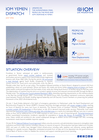
Countries: Yemen, Djibouti, Ethiopia Source: International Organization for Migration Please refer to the attached file. SITUATION OVERVIEW Frontlines in Yemen witnessed an uptick in reinforcements as government forces raised combat readiness and received ammunition and arms support from Saudi Arabia amidst heightened tensions with Ansar Allah (AA). During this period, AA announced a naval blockade against Saudi Arabia, threatening to interdict vessels bound for Saudi ports and potentially close the Bab al Mandeb under their ‘eye for an eye’ policy. This escalation followed airstrikes on Sana’a Airport, designed to prevent AA from establishing a direct air route between Tehran and Sana’a. AA missile and drone strikes targeting Saudi oil tankers and Saudilinked vessels continued throughout the final weeks of July, while also hitting Saudi Aramco oil facilities along the Red Sea coast. The deterioration of maritime security led to an increase in global oil prices and reduced commercial traffic through the Bab alMandeb strait. The UN Security Council adopted Resolution 2826, extending reporting requirements on AA maritime attacks in the Red Sea through January 2027. Concurrently, UN Special Envoy Hans Grundberg maintained continuous diplomatic travel between Muscat and Riyadh, briefing regional leadership and UN Security Council members on preserving the political framework of the 2022 UN-brokered truce. On July 1, Saudi Arabia delivered a first batch of emergency generators to Hadramawt under the Saudi Development and Reconstruction Program for Yemen (SDRPY). However, electricity shortages persisted, with power outages in Aden reaching six hours of blackout for every two hours of electricity. The General Union of Southern Workers’ Syndicates organized a protest outside UN headquarters in Khormaksar on July 20 to demand improved public services. Meanwhile, local media reported that food prices rose in Sana’a and other AA-controlled areas as a result of an estimated 400 per cent rise in customs duties on flour and an additional levy of YR 5,000 imposed on each carton or sack of imported goods. Torrential downpours further exacerbated humanitarian conditions, especially for populations in Sana’a, Ibb, Amran, Al Hodeidah, Taiz and other areas. Heavy rainfall and windstorms also caused widespread damage to shelters across IOM-managed IDP sites, increasing humanitarian needs beyond available response capacity. On July 20, the National Defense Council approved military, security, economic, and administrative measures to strengthen state institutions and boost state revenue, including a decision to resume oil exports. Oil production had been halted since October 2022, and years of conflict have damaged critical infrastructure including wells, pipelines and refineries, posing significant challenges to a speedy recovery. Regardless, anticipated proceeds from oil sales are to be deposited into the government-run Central Bank of Yemen in Aden to stabilize the currency and support essential government spending.
IOM Yemen Dispatch July 2026: Updates on the humanitarian crisis, people on the move and IOM’s response in Yemen Read More »

chad: dans le canton de donia (province du logone oriental), réfugiés et communautés hôtes construisent une nouvelle dynamique locale avec l’appui du hcr et de l’union européenne

Chad: Dans le canton de Donia (province du Logone Oriental), réfugiés et communautés hôtes construisent une nouvelle dynamique locale avec l’appui du HCR et de l’Union européenne

Country: Chad Source: UN High Commissioner for Refugees Please refer to the attached file. Par Aristophane Ngargoune Assistant Communications Officer • HCR N’Djaména Goré, 14 août 2026 – « Ces réfugiés sont nos frères. Nous partagions déjà les mêmes traditions. Je crois que leur présence dans notre village va booster notre économie locale » confie Silas, tout souriant un jeune Tchadien la trentaine, présent à l’arrivée des réfugiés centrafricains fin juin 2026 dans son village de Betembo, dans le canton de Donia après leur installation volontaire dans le cadre d’une initiative visant à favoriser leur autonomie et leur inclusion au sein des communautés hôtes. Les nouveaux arrivants ont été accueillis dans une ferveur suivant la tradition d’hospitalité profondément ancrées au Sud du Tchad, marquée par des salutations, l’ouverture et la disponibilité, le partage de nourriture et de boissons, l’assistance spontanée. L’installation volontaire des réfugiés centrafricains dans le canton de Donia, dans la province du Logone Oriental, s’inscrit dans le cadre du Projet d’Alternative aux Camps et de Résilience Agricole au Sud du Tchad (PACRAS) financé par l’Union européenne et lancé à Donia le 17 février 2026. Le projet vise à accompagner les réfugiés et les communautés hôtes vers une plus grande autonomie et une meilleure inclusion économique et des solutions moins dépendantes de l’aide humanitaire. Un premier groupe de 110 familles réfugiées a volontairement quitté les sites aménagés de Goré (Amboko, Gondje, Doholo et Dosseye) après avoir reçu du cash pour leur transport, pour aller s’installer dans les villages de Betembo et Doborote les 29 et 30 juin 2026. Dimanche Salomon, réfugié, venu du site aménage de Dossey (où il y était établi depuis 2007) et installé volontairement dans le village Betembo se réjouit de sa nouvelle vie hors du camp. « Nous serons respectueux des principes locaux. Ensemble, Tchadiens et réfugiés, nous travailleront pour cultiver les terres, accroître la production agricole et commercialiser les récoltes sur le marché local » confit-il. Pour accompagner cette dynamique, l’ONG Initiative Humanitaire pour le Développement Local (IHDL) partenaire du HCR, a organisé durant la dernière semaine de juin la distribution de matériels agricoles à la population autochtone de Donia. Cette distribution s’était aussi étendue aux réfugiés aussitôt installés dans les villages d’accueils. Des unités de culture attelée, des charrues et des jougs ont été remis aux producteurs locaux et réfugiés afin de renforcer leurs capacités de production, améliorer les techniques culturales et accroître les rendements agricoles dans les zones concernées par le projet. À l’issue de cette dotation, le chef de canton de Donia, sa majesté Takoral Rodrigue a réaffirmé sa satisfaction pour ce projet qui contribue aussi à promouvoir une agriculture plus productive et à favoriser l’autonomisation économique des deux communautés. « Nous avions toujours accueilli des réfugiés à Donia. La cohabitation pacifique et le vivre ensemble dans le respect réciproque seront des atouts pour ce projet qui sera très bénéfique pour le canton Donia » témoigne-t-il. En soutenant la génération de revenus et les activités économiques partagées, le projet contribuera au dynamisme de l’économie locale et à la promotion d’une coexistence pacifique. Ces deux activités ont vu une forte présence des autorités administratives et traditionnelles, des partenaires du projet ainsi que des réfugiés et la communauté hôte. Au-delà du soutien aux activités agricoles, PACRAS permettra de renforcer les services publics essentiels dans les cinq villages qui accueilleront les réfugiés. Les centres de santé, les écoles, les systèmes d’approvisionnement en eau et les infrastructures d’assainissement bénéficieront d’un appui afin de répondre aux besoins d’une population élargie.

Chad: Dans le canton de Donia (province du Logone Oriental), réfugiés et communautés hôtes construisent une nouvelle dynamique locale avec l’appui du HCR et de l’Union européenne Read More »

colombia: regional humanitarian pooled fund for latin america and the caribbean 2025 annual report

Colombia: Regional Humanitarian Pooled Fund for Latin America and the Caribbean – 2025 Annual Report

Countries: Colombia, Haiti Source: UN Office for the Coordination of Humanitarian Affairs Please refer to the attached file. In 2025, the Regional Humanitarian Pooled Fund for Latin America and the Caribbean (RHPF LAC) demonstrated its value as a flexible, strategic and locally driven financing mechanism in a year marked by escalating humanitarian needs across the region and a constrained funding environment. The Fund enabled timely, principled responses in Colombia and Haiti, where escalating conflict, violence, displacement and climate-related shocks pushed needs higher and constrained humanitarian access. One of the Fund’s most significant achievements was its continued commitment to localization. In both Colombia and Haiti, local and national organizations played a central role in identifying priorities, shaping responses and delivering assistance. Through dedicated funding, partnerships, rapid response mechanisms and greater inclusion in governance structures, the Fund strengthened the leadership of local actors, including women-led organizations (WLOs) and community-based groups. This not only improved access to affected communities but also ensured that local knowledge informed humanitarian action, grounding it in the realities people face every day. The Fund also demonstrated its adaptability. In Colombia, allocations supported innovative community-led protection and rapid response mechanisms in areas affected by conflict and disasters. In Haiti, the Fund balanced immediate life-saving assistance with investments in preparedness, helping vulnerable communities strengthen their resilience ahead of the hurricane season while responding to the impacts of armed violence and displacement. These efforts reinforced the Fund’s role in reaching people who are often beyond the reach of traditional humanitarian response. At the same time, 2025 reminded us that humanitarian action must constantly evolve. The scale and complexity of needs in both countries continued to outpace available resources. Access constraints, insecurity, operational risks and limited funding remained persistent challenges. We demonstrated that strengthening local partnerships is not only a localization objective, it is essential for sustaining humanitarian access and delivering effective assistance in increasingly volatile environments. We also learned that preparedness, particularly in contexts exposed to both conflict and climate-related risks, must remain a core investment rather than an afterthought. These achievements would not have been possible without the dedication of our humanitarian partners, local and national NGOs, WLOs, UN agencies, donors, advisory board members, community leaders and, most importantly, the affected communities themselves. Their commitment, expertise and willingness to work together continue to make the Fund a trusted mechanism for collective humanitarian action. As we look toward 2026, the humanitarian outlook remains deeply concerning. Humanitarian needs across the region are expected to remain high, while competition for resources continues to mount. Against this backdrop, our vision is clear: to further strengthen the Fund as a responsive, accountable and locally led financing mechanism that delivers assistance where it is needed most. We will continue to prioritize localization, enhance support for frontline responders, invest in preparedness and risk-informed programming and broaden partnerships with donors and stakeholders who share our commitment to humanitarian action. While the challenges ahead are considerable, so too is our collective determination. Together, we will continue to place affected people at the center of our efforts and ensure that the Fund remains a catalyst for timely, effective and principled humanitarian action across the region.

Colombia: Regional Humanitarian Pooled Fund for Latin America and the Caribbean – 2025 Annual Report Read More »

syria: the assad death sentence, israeli entrenchment in the south, and consolidation rather than stabilisation (3–9 august 2026)

Syria: The Assad Death Sentence, Israeli Entrenchment in the South, and Consolidation Rather Than Stabilisation (3–9 August 2026)

Country: Syrian Arab Republic Source: SARI Global Please refer to the attached file. 178 incidents and 20 confirmed fatalities, a low toll for the volume. An in-absentia death sentence against Bashar al-Assad drove a nationwide wave of at least 17 peaceful demonstrations, as Israeli forces sustained 17 operations in the south and rejected any withdrawal. Data Analysis 178 operational incidents and 20 fatalities were recorded across Syria from 7 to 13 August 2026, a low toll relative to the incident volume that reflects a week dominated by political mobilisation, policing and localised violence rather than large-scale armed conflict. The defining development was the issuance of an in-absentia death sentence against former President Bashar al-Assad and other senior former officials, which triggered a nationwide wave of at least 17 public demonstrations marking a major milestone in the postAssad transitional justice process. Israeli military activity in the south continued at a steady tempo, with 17 recorded incidents concentrated in Quneitra and Dar’a and comprising incursions, checkpoints and searches with zero Syrian fatalities, coinciding with an Israeli statement rejecting withdrawal from Syrian territory. Syrian security forces sustained a high tempo of law-enforcement and counter-narcotics operations and dismantled an ISIS-linked cell in Khan Arnabeh, Quneitra. Dar’a recorded the highest incident volume at 25, and 11 August was the peak day with 40 incidents.

Syria: The Assad Death Sentence, Israeli Entrenchment in the South, and Consolidation Rather Than Stabilisation (3–9 August 2026) Read More »

yemen: a sharp escalation in houthi strike lethality, and a widening cross border campaign (3–9 august 2026)

Yemen: A Sharp Escalation in Houthi Strike Lethality, and a Widening Cross-Border Campaign (3–9 August 2026)

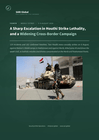
Country: Yemen Source: SARI Global Please refer to the attached file. 119 incidents and 102 confirmed fatalities. Two Houthi mass-casualty strikes on 6 August, against Nation’s Shield camps in Hadramawt and against Marib, killed some 45 and drove the week’s toll, as ballistic missiles and drones concentrated on the Marib and Hadramawt fronts. Data Analysis 119 operational incidents and 102 fatalities were recorded across Yemen from 3 to 9 August 2026, in a week marked by a sharp escalation in the lethality of the conflict. Ansar Allah, the Houthi movement, initiated 36 incidents causing 61 fatalities, and Yemeni Government forces of the Presidential Leadership Council initiated 32 incidents. The single deadliest event was a Houthi strike on camps of the Nation’s Shield Forces in Hadramawt on 6 August, which killed approximately 30, while a Houthi ballistic missile and drone strike on Marib the same day killed a further 15, making 6 August the deadliest day of the week with 49 fatalities. 8 August recorded the highest incident volume at 24. Ballistic missiles, drones and artillery were the dominant conflict modalities, concentrated on the Marib and Hadramawt fronts, and Houthi forces also conducted cross-border attacks against Saudi and maritime targets. Hazards, principally flooding and a declared public health emergency in Marib, caused a further 20 fatalities.

Yemen: A Sharp Escalation in Houthi Strike Lethality, and a Widening Cross-Border Campaign (3–9 August 2026) Read More »

colombia earthquake: situation report #3 (august 13, 2026)

Colombia Earthquake: Situation Report #3 (August 13, 2026)

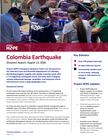
Country: Colombia Source: Project HOPE Please refer to the attached file. Project HOPE’s Emergency Response Team is on the ground in the Valle del Cauca and Risaralda departments of Colombia, distributing hygiene supplies and rapidly assessing needs after a 7.4-magnitude earthquake struck 150 miles west of Bogotá causing widespread damage, landslides, and impacted critical infrastructure across a large geographic area. Situational Context The full scale of the impact continues to be assessed since a 7.4-magnitude earthquake struck near San Jose del Palmar, Colombia, on Monday August 10, continued to be assessed. Damage extends across a wide geographic area, including urban and rural areas across a range of socio-economic levels. More than 395 municipalities across western Colombia were affected and connectivity and access issues continue to limit a full assessment. As of this morning, August 13, Colombia’s national disaster management agency (UNGRD) reports 273 dead, 3,824 injured, and 377 missing nationwide. Other sources state the number of missing at nearly 500. Approximately 75% of fatalities are concentrated in Quibdó, Pereira, and Valle del Cauca. Over 12,500 homes have been destroyed and nearly 75,000 homes have been damaged, and 172 structures collapsed. Search and rescue operations, led by the National Risk and Disaster Management System, are transitioning from active rescue to recovery in the hardest hit areas. Chocó’s SAR phase was formally closed yesterday after a family of four was located alive. In Pereira and Cali, teams report shifting to recovery of bodies as the window for finding and rescuing survivors narrows, though efforts continue. With 216 health centers sustaining damage, the need for hygiene, water, and medical support is significant. Access to more rural areas, especially Chocó, continues to be difficult. Chocó also sustained a 4.2 magnitude aftershock this morning, and officials stated the aftershock hindered utility restoration efforts.

Colombia Earthquake: Situation Report #3 (August 13, 2026) Read More »