Uncategorized

Somalia: Emergency WASH Response in Baydhaba Rural Areas

Country: Somalia Source: Agency for Technical Cooperation and Development PROJECT IN PICTURE A four-month emergency WASH response in rural Baydhaba. Between February and May 2026, Acted delivered safe water to drought-affected households while working with village committees to rehabilitate two solar-powered systems, securing access that is safe, inclusive and built to last​. Water Trucking 1,350,000 litres of safe water delivered to 500 households (3,000 people) over 60 days – Salbuy, Baydhaba arrow_back arrow_forward Distribution Water dispensed through a multi-tap gravity-fed distribution stand 135 water trucks of 10,000 L each, offloaded into storage tanks. Verification 500 households registered 10 enumerators trained 1 water-quality monitor Inclusion 5-member Village Relief Committee (VRC) ensures safe, inclusive and dignified water access for women and girls​. arrow_back arrow_forward VRC Training 20 VRC members trained in safe water handling, inclusive distribution and accountability (AFM) – Salbuy, Ashagow and Awdiinle (2026). arrow_back arrow_forward Consultation 3 assessments – safe and inclusive water access analysed with women and men separately in Salbuy, Ashagow and Awdiinle (April 2026)​. Rehabilitation 2 water systems rehabilitated in Slabuy and Ashagow – solar-powered, durable supply for 10,000 people (completed May 2026).

Somalia: Emergency WASH Response in Baydhaba Rural Areas Read More »

UNICEF Statement on the deaths of 14 newborns following hospital fire in Islamabad, Pakistan

Country: Pakistan Source: UN Children’s Fund UNICEF, the United Nations agency for children, works to protect the rights of every child, everywhere, especially the most disadvantaged children and in the toughest places to reach. Across more than 190 countries and territories, we do whatever it takes to help children survive, thrive, and fulfil their potential. Follow UNICEF on X, Facebook, Instagram and YouTube

UNICEF Statement on the deaths of 14 newborns following hospital fire in Islamabad, Pakistan Read More »

MSF South Sudan: When the River is the Only Road to Healthcare

Country: South Sudan Source: Médecins Sans Frontières 25th August 2026 – Limited healthcare facilities and growing violence throughout the states of Upper Nile and Jonglei have pushed residents to travel further distances to seek quality healthcare. Médecins Sans Frontières / Doctors Without Borders (MSF) has responded by building its outreach to towns along the Sobat River Corridor, where many displaced South Sudanese have relocated. MSF currently has more 18 community outreach team members at six sites, covering a population of around 50,000 people. Three more teams are being trained in August 2026 to provide care in Fashoda County. Each team consists of three community health workers chosen by the community and trained by MSF: a traditional birth attendant, a curative health worker and a preventative health worker. Curative health workers provide consultation, conduct simple diagnostic tests, and issue medication for illnesses such as malaria. The preventative component includes surveillance, monitoring, health promotion and education, and referrals from community to their local decentralised model of care (DMC) sites. Traditional birth attendants promote antenatal care, safe deliveries and postnatal care including routine infant vaccinations and refer complicated pregnancies to local primary healthcare units. ​ When 13-year-old Mamouch suffered a convulsive seizure at home one night, he fell into his family’s cooking fire in their village in Lankien, Jonglei State. Since the MSF hospital in Lankien was bombed and destroyed in February 2026, his family had to travel more than 50 kilometres to the nearest functioning healthcare facility supported by MSF in Chuil. Given the severity of Mamouch’s burns, he was referred by boat to Malakal Teaching Hospital for specialised treatment. The family had been displaced twice by violence, eventually moving from Lankien to Chuil. ​ “Life is very tough for us,” says Mamouch’s mother, Nyareu. “Some people in our community are dying from hunger, attacks by wild animals, by violence, and our children are being kidnapped. Those who arrived in Chuil are lucky to be alive.” Mother and son travelled for seven hours in an MSF boat to reach Malakal Teaching Hospital — the only possible mode of transport in an area where roads are inaccessible, particularly during the rainy season. Reaching remote communities Outreach teams and boats run by MSF are essential for communities living along the rivers in Upper Nile and Jonglei states to access lifesaving healthcare. ​ “We have been receiving many patients from different locations along the South Canal, Akoka, and Baliet routes within the Sobat River Corridor, due to gap in primary healthcare, particularly referral pathways,” says Prisca Okoro Orji, community engagement and health promotion manager. ​ Decentralised care is essential to open access to care to all those who need it in a wide and difficult-to-reach geographic area. “In some cases, we see the number of consultations is 10 times the population of a town, this shows us that people are coming from much further away to access care, medication and therapeutic food because the primary healthcare unit has nothing,” says Alim Halidou, MSF’s nursing activity manager for outreach in Malakal. When someone needs specialist care, MSF refers them to Malakal Teaching Hospital, where MSF teams together with the Ministry of Health, provide neonatal, paediatric, nutrition, emergency, chronic care, and surgical services including caesarean-section. Surgical care needed across the region Malakal is now the only secondary hospital with surgical capacity across large parts of Upper Nile and Jonglei states. In the male surgical ward, Dak* is recovery slowly from gunshot wounds. ​ When he and some others from the community started moving their families and their cattle from Lankien to Chuil in search of food, they arrived at a forest. There, they were attacked by armed men. Ten people of Dak’s group were killed, and six were shot and left to die in the forest. The attackers kidnapped many of the group’s children, including seven of his nieces and nephews. When his family came looking for him days later. They carried him on foot for seven hours to the MSF-supported facility in Chuil. When Dak was stable, he was transferred by MSF boat to Malakal Teaching Hospital for surgery. Surgeons were able to remove bullets from his chest, lower limbs and pelvis. ​ “I only have pain now in my upper body and around my heart,” he says. “I don’t feel my legs, and I can’t move my toes.” Dak will receive post-operative care as long as it’s needed, including mental health support. Boats bringing people to care For referrals to be possible, boats are needed to navigate the three river systems in the Upper Nile State. MSF teams have provided canoes to each outreach site so people can get to primary care locations. Outreach is having a positive impact. The teams have seen reduced mortality, and increased health knowledge. ​ ​ “It is really important that we have decentralised care activities running, because otherwise there is no treatment available for most of these patients. We are continuing to engage communities in these activities so we can build trust with families, and so that relatives will bring their loved ones to outreach locations when they need healthcare,” says Joana Pires Borges, an MSF paediatrician working in Malakal. Nyawarka, a three-month-old baby was transported by the MSF boat after she was bitten by a snake while sleeping in the family’s tukul [traditional thatched hut] one night in their village along the White Nile River. Nyawarka’s crying woke the neighbours, who came to help. First, they tried traditional medicine, but the next morning when she was no better, they contacted the MSF outreach team who sent a boat to pick up the little patient. “I am very happy the boat came,” says the mother, Nyanyuem. ​ Outreach activities and boat referrals are proving a lifeline for families along the rivers in Upper Nile and Jonglei states, but MSF teams cannot reach everyone. Primary healthcare services must be made functional and properly supported across Jonglei, Upper Nile, and the rest of South Sudan. This requires deploying enough healthcare

MSF South Sudan: When the River is the Only Road to Healthcare Read More »

yemen: violence against health care in conflict 2025 [en/ar]

Yemen: Violence Against Health Care in Conflict 2025 [EN/AR]

Country: Yemen Sources: Insecurity Insight, Safeguarding Health in Conflict Please refer to the attached files. Using data collected by Insecurity Insight, the Safeguarding Health in Conflict Coalition (SHCC) identified 48 incidents of violence against or obstruction of health care in Yemen in 2025. Among the incidents, 17 health workers were arrested, and health facilities were violently raided or searched 12 times and damaged on at least nine occasions. The report examines patterns of attacks affecting health workers, facilities, patients, and transport amid intensifying conflict between armed groups, and explores the consequences for access to health care, particularly in remote and conflict-affected regions. The report notes that the true scale of attacks is likely higher than documented due to underreporting in inaccessible areas and reduced humanitarian presence, including the impact of cuts to USAID funding on health service provision and monitoring. Key findings: Health worker arrests and detentions and health facility raids by Houthi forces increased from April onwards. Damage to and the destruction of health care facilities increased, and health worker killings and injuries continued. Conflict parties’ use of explosive weapons that impacted health care surged, with aircraft and drone strikes accounting for 26% of all reported incidents. This ended a 20 month period since July 2023 during which no air strikes affecting health facilities had been reported. Yemen’s health care system, already fragile before the escalation of the conflict, was under severe strain by 2025, with around 40% of health facilities partially functioning or not functioning due to shortages of staff, funding, electricity, medicines and equipment, while only one in five functioning facilities were able to provide maternal and child health care services, limiting access to essential and preventive care.

Yemen: Violence Against Health Care in Conflict 2025 [EN/AR] Read More »

amda emergency relief #8: earthquakes in venezuela 25 august 2026

AMDA Emergency Relief #8: Earthquakes in Venezuela – 25 August 2026

Country: Venezuela (Bolivarian Republic of) Source: Association of Medical Doctors of Asia Please refer to the attached file. On 15 August, AMDA concluded its medical relief activities for the earthquake victims in Caraballeda, one of the hardest-hit locations in La Guaira, Venezuela. The city was heavily devastated by two massive quakes (mag. 7.2 and 7.5) that struck the nation on 24 June. Nearly two months have passed since the disaster, signs of daily life are gradually returning. Around the temporary clinic where AMDA continued its relief work, people are enjoying their meals once again at local restaurants as they have started reopening. Likewise, local fishermen have resumed their work, all of which reassured the ground team of the steady progress in post-disaster recovery. In the immediate aftermath of the earthquake, people could be seen standing near collapsed buildings, waiting for relatives and acquaintances to be rescued. Such scenes have now disappeared. Instead, heavy machinery is stationed at demolition sites, ready to remove the rubble from dismantled buildings. Efforts are also being made to speed up the recovery process, including temporarily closing sections of major roads to allow trucks carrying debris to pass more easily. At the same time, construction work continues to leave the surrounding area dusty. Going forward, AMDA’s local partners are expected to take the lead in continuing the medical support at the temporary clinic. As plans are now underway to support the post-disaster recovery phase, AMDA will continue to work closely with local communities and respond to the needs on the ground.

AMDA Emergency Relief #8: Earthquakes in Venezuela – 25 August 2026 Read More »

venezuela (bolivarian republic of): earthquake response situation report #25 (21 to 24 august 2026)

Venezuela (Bolivarian Republic of): Earthquake Response Situation Report #25 (21 to 24 August 2026)

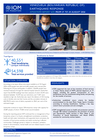
Country: Venezuela (Bolivarian Republic of) Source: International Organization for Migration Please refer to the attached file. Situation Report No. 25 provides an update on IOM’s response to the 24 June earthquakes in the Bolivarian Republic of Venezuela, covering the period from 21 to 24 August 2026. Highlights IOM supported the start of the transition of food services in César Nieves ahead of WFP’s planned departure on 31 August, including the gradual incorporation of new users into the institutional dining facility and planning for the transfer of services. Authorities established return criteria for families accommodated at the José María Vargas Sports Complex according to housing classification, strengthening the implementation of return processes and exit strategies. IOM strengthened access to health and protection services through 185 medical consultations, the activation of sexual and reproductive health services in Mare Abajo II, and Prevention of Sexual Exploitation and Abuse (PSEA) activities for community women leaders. IOM Activities IOM continued the management and co-management of the José María Vargas Sports Complex, César Nieves, Mare Abajo II and Campo de Golf temporary camps. In César Nieves, the Organization supported the transition of food services towards the institutional dining facility and maintained coordination of essential services for the accommodated population. In Mare Abajo II, IOM strengthened operational coordination with NRC, supported the activation of sexual and reproductive health services, and coordinated actions to reduce environmental and public health risks. In Campo de Golf, IOM updated population records, coordinated the installation of solar lamps in all tents and monitored rain-related impacts in Sector C. In addition, between 21 and 24 August, IOM distributed 362 collapsible jerrycans, 228 plastic tarpaulins and 98 tool kits to earthquake-affected families. In water, sanitation and hygiene (WASH), IOM coordinated the provision of safe water, sanitation and hygiene services together with sector partners and authorities. In César Nieves, 115,000 liters of safe water were supplied, 18 showers remained operational, and actions were implemented to improve safe water storage through community censuses and the installation of supports for communal water tanks. In Campo de Golf, IOM supported the provision of 20,000 liters of safe water, continued monitoring water quality and functionality, and coordinated the installation of hygiene infrastructure. In health, IOM continued medical and mental health outreach activities in César Nieves and at the José María Vargas Sports Complex, addressing primarily hypertension, non-communicable chronic diseases, respiratory infections and other priority health conditions. The Organization also initiated group psychological support activities for first responders and rescue personnel. In information management, the Displacement Tracking Matrix (DTM) team completed a round of household surveys across the four temporary camps, collecting information on needs, mobility and intentions regarding continued stay, return or relocation. At the same time, IOM continued updating population records and analysing information to support response planning. Protection activities included individual orientation, case management, psychological support and referrals to specialized services, as well as actions to strengthen coordination with authorities, security actors and community leaders. IOM also continued implementing Prevention of Sexual Exploitation and Abuse (PSEA) and community engagement activities in temporary camps. IOM Planned Response Complete the transition of food services in César Nieves before WFP’s planned departure. Maintain WASH, health, protection and camp management services, including follow-up on rain-related impacts and infrastructure improvements in Campo de Golf. Continue population monitoring, needs assessments and community settlement characterization activities to strengthen response planning. Strengthen coordination with authorities and organizations supporting return, relocation and service provision processes in temporary camps.

Venezuela (Bolivarian Republic of): Earthquake Response Situation Report #25 (21 to 24 August 2026) Read More »

venezuela (república bolivariana de): respuesta a terremotos reporte de situación #25 (21 al 24 de agosto 2026)

Venezuela (República Bolivariana de): Respuesta a Terremotos – Reporte de Situación #25 (21 al 24 de agosto 2026)

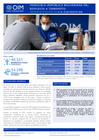
Country: Venezuela (Bolivarian Republic of) Source: International Organization for Migration Please refer to the attached file. El Reporte de Situación No. 25 presenta una actualización de la respuesta de la OIM a los terremotos del 24 de junio en la República Bolivariana de Venezuela, correspondiente al período del 21 al 24 de agosto de 2026. Aspectos destacados OIM acompañó el inicio de la transición de los servicios de alimentación en César Nieves ante la salida prevista del PMA el 31 de agosto, incluyendo la incorporación progresiva de nuevos usuarios al comedor institucional y la planificación de la transferencia de servicios. Las autoridades definieron criterios de retorno para las familias alojadas en el Polideportivo José María Vargas según la clasificación de las viviendas, fortaleciendo la implementación de procesos de retorno y estrategias de salida. OIM fortaleció el acceso a servicios de salud y protección mediante 185 consultas médicas, la habilitación de servicios de salud sexual y reproductiva en Mare Abajo II y actividades de Prevención de la Explotación y el Abuso Sexual (PEAS) dirigidas a lideresas comunitarias. Actividades de OIM La OIM mantuvo la gestión y cogestión de los campamentos transitorios Polideportivo José María Vargas, César Nieves, Mare Abajo II y Campo de Golf. En César Nieves, acompañó la transición de los servicios de alimentación hacia el comedor institucional y mantuvo la coordinación de servicios básicos para la población alojada. En Mare Abajo II, fortaleció la coordinación operativa con NRC, apoyó la habilitación de servicios de salud sexual y reproductiva y coordinó acciones para reducir riesgos ambientales y sanitarios. En Campo de Golf, actualizó registros poblacionales, coordinó la instalación de lámparas solares en todas las carpas y dio seguimiento a las afectaciones por lluvias en el sector C. Asimismo, entre el 21 y el 24 de agosto, OIM distribuyó 362 bidones plegables, 228 lonas plásticas y 98 kits de herramientas para familias afectadas. En agua, saneamiento e higiene (WASH), OIM coordinó la prestación de servicios de agua segura, saneamiento e higiene junto con socios sectoriales y autoridades. En César Nieves se abastecieron 115.000 litros de agua segura, se mantuvieron operativas 18 duchas y se promovieron mejoras en el almacenamiento de agua mediante censos comunitarios y la instalación de soportes para tanques. En Campo de Golf, la organización apoyó la provisión de 20.000 litros de agua segura, continuó el monitoreo de la calidad de los puntos de agua y coordinó la instalación de infraestructura para higiene. En salud, OIM mantuvo jornadas de atención médica y salud mental en César Nieves y el Polideportivo José María Vargas, atendiendo principalmente hipertensión arterial, enfermedades crónicas no transmisibles, infecciones respiratorias y otras condiciones prioritarias. También inició actividades grupales de apoyo psicológico para personal de respuesta y rescatistas. En gestión de información, el equipo de la Matriz de Seguimiento de Desplazamiento (DTM) completó una ronda de encuestas de hogares en los cuatro campamentos transitorios, recopilando información sobre necesidades, movilidad e intenciones de permanencia, retorno o reubicación. Paralelamente, continuó la actualización de registros poblacionales y el análisis de información para apoyar la planificación de la respuesta. Las actividades de protección incluyeron orientación individual, gestión de casos, apoyo psicológico y derivaciones a servicios especializados, así como acciones para fortalecer la coordinación con autoridades, actores de seguridad y liderazgos comunitarios. OIM también continuó implementando actividades de Prevención de la Explotación y el Abuso Sexual (PEAS) y fortalecimiento comunitario en los campamentos transitorios. Respuesta prevista de OIM Completar la transición de los servicios de alimentación en César Nieves antes de la salida prevista del PMA. Mantener la prestación de servicios de WASH, salud, protección y gestión de campamentos transitorios, incluyendo el seguimiento de las afectaciones por lluvias y las mejoras de infraestructura en Campo de Golf. Continuar el monitoreo de movimientos de población, las evaluaciones de necesidades y la caracterización de asentamientos comunitarios para fortalecer la planificación de la respuesta. Fortalecer la coordinación con autoridades y organizaciones para apoyar procesos de retorno, reubicación y provisión de servicios en los campamentos transitorios.

Venezuela (República Bolivariana de): Respuesta a Terremotos – Reporte de Situación #25 (21 al 24 de agosto 2026) Read More »

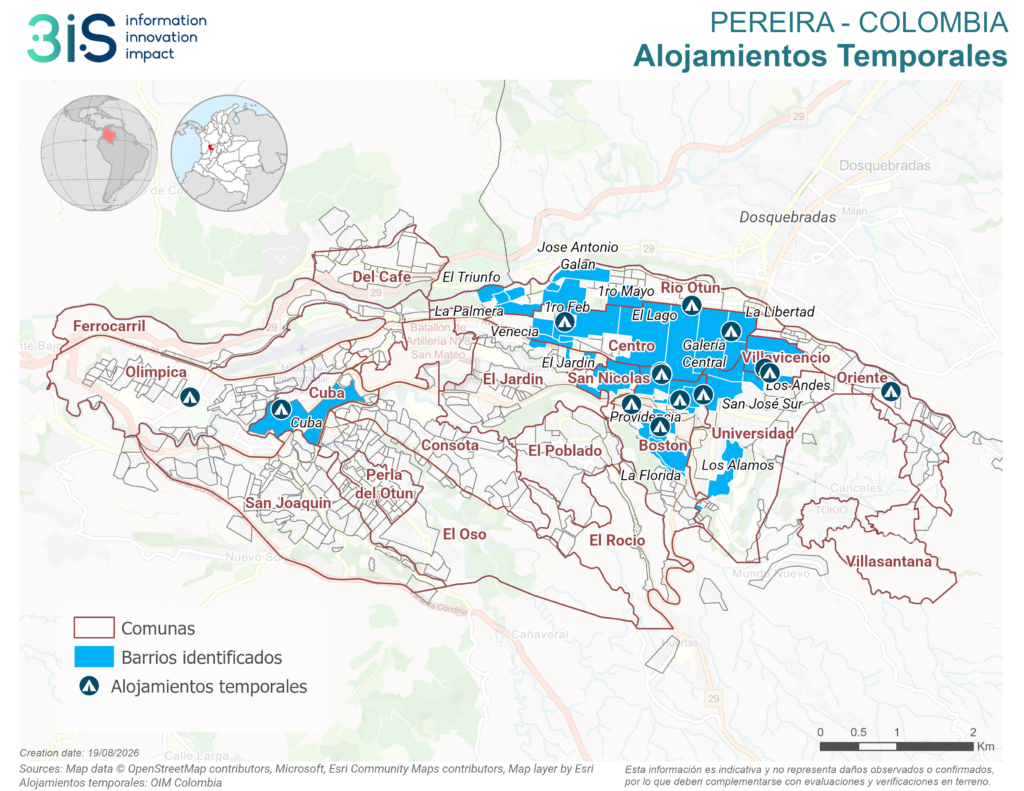
colombia: mapa urbano de pereira: alojamientos temporales terremoto 10 de agosto 2026

Colombia: Mapa urbano de Pereira: Alojamientos Temporales_Terremoto 10 de agosto 2026

Country: Colombia Source: 3iS Please refer to the attached Map. Mapa urbano de Pereira que muestra los alojamientos temporales activados en respuesta al terremoto ocurrido el 10 de agosto, con epicentro en San José del Palmar. Los puntos representan los alojamientos temporales identificados a partir de la información recopilada por OIM Colombia, con corte al 19/08/2026, y se incorporan al mapa como referencia espacial de la respuesta habilitada en la ciudad.

Colombia: Mapa urbano de Pereira: Alojamientos Temporales_Terremoto 10 de agosto 2026 Read More »