Uncategorized

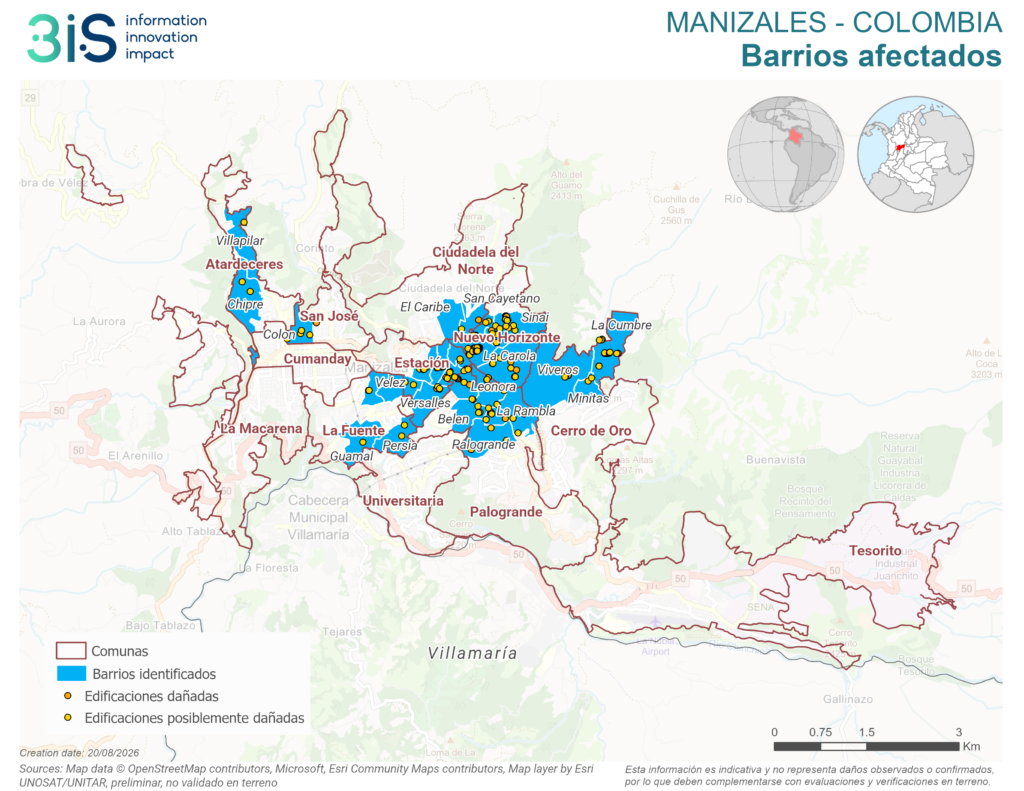
colombia: mapa urbano de manizales: barrios afectados terremoto 10 de agosto 2026

Colombia: Mapa urbano de Manizales: Barrios Afectados_Terremoto 10 de agosto 2026

Country: Colombia Source: 3iS Please refer to the attached Map. Mapa urbano de Manizales que muestra los barrios afectados por el terremoto ocurrido el 10 de agosto, con epicentro en San José del Palmar. Los puntos que representan edificaciones destruidas y dañadas provienen de los productos de evaluación de daños elaborados por UNOSAT/UNITAR y se incorporan al mapa como referencia espacial de las afectaciones identificadas.

Colombia: Mapa urbano de Manizales: Barrios Afectados_Terremoto 10 de agosto 2026 Read More »

colombia: mapa urbano de cali: barrios afectados terremoto 10 de agosto 2026

Colombia: Mapa urbano de Cali: Barrios Afectados_Terremoto 10 de agosto 2026

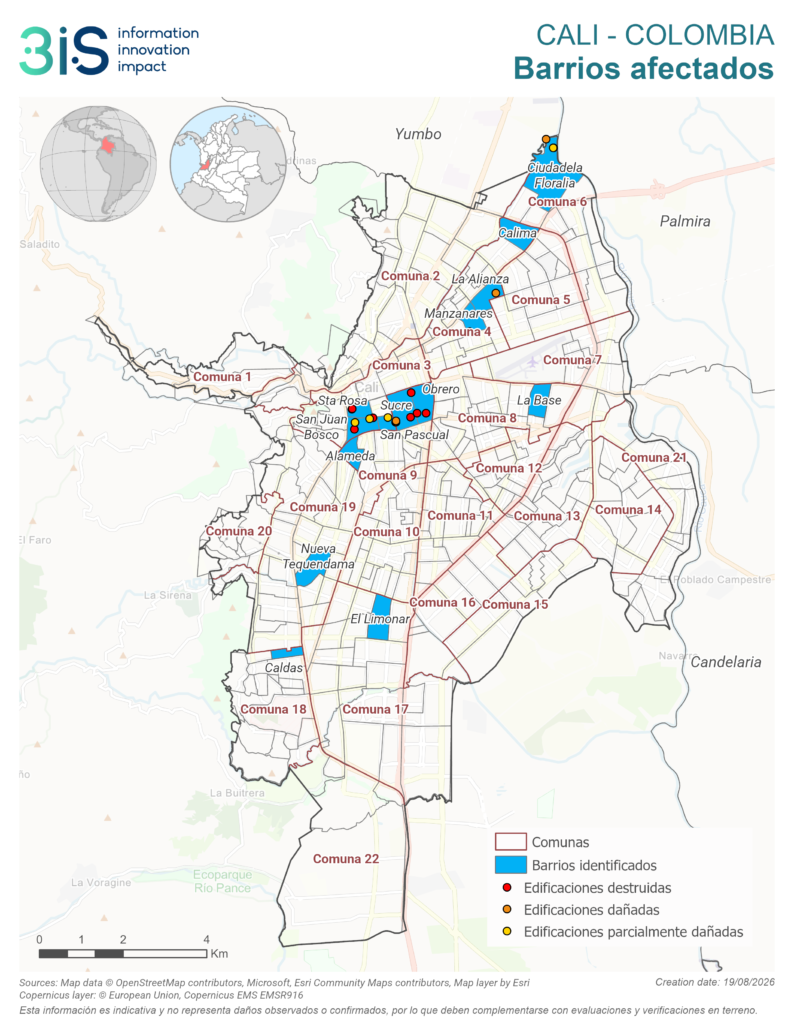
Country: Colombia Source: 3iS Please refer to the attached Map. Mapa urbano de Cali que muestra los barrios afectados por el terremoto ocurrido el 10 de agosto, con epicentro en San José del Palmar. Los puntos que representan edificaciones destruidas y dañadas provienen de los productos de evaluación de daños elaborados por Copernicus y se incorporan al mapa como referencia espacial de las afectaciones identificadas.

Colombia: Mapa urbano de Cali: Barrios Afectados_Terremoto 10 de agosto 2026 Read More »

unhcr afghanistan situation regional update july 2026

UNHCR Afghanistan Situation Regional Update July 2026

Countries: Afghanistan, Iran (Islamic Republic of), Pakistan Source: UN High Commissioner for Refugees Please refer to the attached file. Operational Update Afghanistan’s operating environment in July remained fluid, as large-scale returns from Pakistan and Iran continued alongside heightened regional tensions and insecurity in several parts of the country. Afghanistan–Pakistan tensions escalated during the first half of the month amid reported armed clashes, shelling and airspace violations along the border. Although major cross-border incidents eventually subsided, bilateral relations remained tense. Increased armed opposition activity, including clashes in Badakhshan and elsewhere, also raised concerns over further internal displacement. Administrative and operational constraints affected access and programme delivery, including changes to the delivery of women-focused activities in Herat that resulted in the temporary pause of some programmes. In Iran, increased deportations and returns of Afghan nationals continued alongside intensified enforcement against undocumented Afghans, documentation renewal challenges and deteriorating socioeconomic conditions. Military strikes and damage to transport and logistics infrastructure also disrupted access, supply chains and commercial activity. In Kerman, Sistan and Baluchestan, reinforced border security measures and risks along irregular routes heightened protection concerns, including for those attempting to cross under dangerous circumstances. Despite the volatile environment, UNHCR maintained its operational presence across Tehran, Mashhad, Shiraz, Kerman and the Dogharoun border, supporting protection monitoring, documentation and assistance. In Pakistan, enforcement against Afghan nationals without valid visas intensified from 10 July following a Government directive to accelerate implementation of the existing ‘Illegal Foreigners Repatriation Plan’ (IFRP). Arrests, detention, raids and deportations were reported while landlord pressure and evictions added to uncertainty among Afghan communities. Fear of these measures remained a key factor influencing decisions to leave. Afghan students with Proof of Registration cards were also reportedly arrested and deported despite advocacy. Enforcement by authorities was particularly pronounced in Balochistan and Sindh and concerns over possible removal persisted in Khyber Pakhtunkhwa and Islamabad/Rawalpindi where enforcement was less uniform. Security measures at Torkham and ongoing tensions between Pakistan and Afghanistan at the border also impacted cross-border movement and humanitarian access. ¹

UNHCR Afghanistan Situation Regional Update July 2026 Read More »

dr congo: ebola paquet minimum kit pci/wash pour les écoles

DR Congo: Ebola- Paquet minimum kit PCI/WASH pour les écoles

Country: Democratic Republic of the Congo Sources: Education Cluster, Save the Children, UN Children’s Fund Please refer to the attached file. Le Cluster a mené une démarche participative avec la contribution des acteurs des secteurs de l’Éducation, de la Protection de l’Enfance, du WASH ainsi qu’OCHA, avec l’appui technique des spécialistes de SCI, de l’UNICEF et du NRC pour mettre en place un paquet minimum consensuel pour les interventions dans le secteur de l’education pendant la Maladie à Virus Ebola (MVE). Ce travail a été fait en appui au PROVED et Cluster Education provincial d’Ituri qui avait déjà entamé la réflexion sur l’harmonisation des kits. L’élaboration de ce paquet minimum consensuel constitue une avancée importante pour harmoniser les interventions et assurer une réponse cohérente aux besoins des enfants et des communautés affectées par la (MVE). Cela servira assȗrement pour les crises sanitaires qui pourraient intervenir en RDC. Le paquet harmonisé PCI/ WASH qui est en lien avec le plan opérationnel de riposte à la MVE pour la préparation de la rentrée scolaire 2026–2027 a été validé par le Ministère de l’Education Nationale et Nouvelle Citoyenneté (Min EDU NC).

DR Congo: Ebola- Paquet minimum kit PCI/WASH pour les écoles Read More »

amda emergency relief #8: kumamoto earthquake, japan 25 august 2026

AMDA Emergency Relief #8: Kumamoto Earthquake, Japan – 25 August 2026

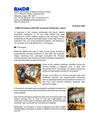
Country: Japan Source: Association of Medical Doctors of Asia Please refer to the attached file. In response to the massive earthquake that struck Japan’s Kumamoto Prefecture on 28 July 2026, AMDA has been continuing to provide medical support at the evacuation shelter established at Yatsushiro Municipal Daiyon Junior High School in Yatsushiro City, one of the hardest-hit locations. The following is the summary of its relief efforts from 17-24 August. ■17-24 August While the AMDA team kept its daily rounds going, its team of acupuncturists provided treatment to help ease the evacuees’ fatigue stemming from prolonged evacuation life. Physical exercise sessions and cleaning activities (voluntarily organized by evacuees themselves) continued as well. Some of the medical conditions identified during the rounds included a suspected case of deep vein thrombosis (DVT). Accordingly, the patient received an ultrasound examination during the consultation. As part of its efforts to connect evacuees with local healthcare services, the acupuncturists introduced them to specialized clinics during treatment sessions so that they could continue receiving treatment after leaving the shelter. Furthermore, evacuees were encouraged to gradually increase their level of physical activity while reviewing the exercises they had been doing regularly. Now that the emergency phase has been over, the ground team has started handing over its work to local aid organizations and authorities. As the project completion approaches, some of the team members have concluded their activities and departed. Meanwhile, on 24 August, a press conference was held at AMDA Headquarters in Okayama to report on AMDA’s Kumamoto activities thus far.

AMDA Emergency Relief #8: Kumamoto Earthquake, Japan – 25 August 2026 Read More »

mr. tom fletcher, under secretary general for humanitarian affairs and emergency relief coordinator – briefing to the security council on the humanitarian situation in sudan, 24 august 2026

Mr. Tom Fletcher, Under-Secretary-General for Humanitarian Affairs and Emergency Relief Coordinator – Briefing to the Security Council on the humanitarian situation in Sudan, 24 August 2026

Country: Sudan Source: UN Office for the Coordination of Humanitarian Affairs Please refer to the attached file. As delivered Thank you, Mr. President and Foreign Minister [of Denmark, Lars Løkke] Rasmussen. And it is also excellent to see the presence of [United States] Special Envoy [for Africa, Massad] Boulos with us there. I pay tribute to his work, and of course the work of [the Secretary-General’s] Personal Envoy [for Sudan, Pekka] Haavisto, and all those working for peace in Sudan. More than two-thirds of the people of Sudan are in desperate need of lifesaving support. And as [Under-Secretary-General for Political and Peacebuilding Affairs, Rosemary] DiCarlo has described, 1,400 civilian deaths in the first half of this year – the vast majority, more than 1,100, caused by drone strikes. In North Kordofan’s El Obeid, drones are striking markets, fuel stations, and vital power and water infrastructure. Fighting has driven 15,000 families into the city since mid-July, placing even more pressure on displacement sites and services already pushed to the breaking point. More air strikes southwest of city have taken place in the last 72 hours. Humanitarians are seizing every opportunity to reach those in need. But we need protection for civilians. We need de-escalation. In South Kordofan, Dilling and Kadugli have been among our key priorities. Both are now accessible, although road conditions are deteriorating as the rainy season takes hold. Similar challenges are reported in the eastern part of South Kordofan, which also hosts significant numbers of displaced people. I am also worried about West Kordofan, which has been the epicenter of a recent cholera outbreak, and where our presence remains limited. In the Nuba Mountains, in the southern part of South Kordofan, intensifying violence is severing communities from help in an area already plagued by chronic food insecurity. Our humanitarian facilities have been breached and looted, and many aid workers detained. Access remains disrupted by the fighting. Further east, renewed fighting in Blue Nile has displaced thousands in the last two weeks, just as heavy rains batter the region. Blue Nile now hosts more than 370,000 displaced people. Some have fled into Ethiopia – a stark reminder of how this war is spilling across Sudan’s borders. There have been renewed attacks on the border towns of Geissan and Kurmuk. Our Humanitarian Coordinator was able to visit the state capital, Ed Damazine, in late July. Meanwhile, ground fighting and drone strikes continue to cripple humanitarian access in the north-western part of North Darfur State, while the rains make critical routes even more difficult to access. Elsewhere in Darfur, hundreds of thousands who fled the atrocities in El Fasher last year remain in desperate need in places like Tawila – a reality I witnessed firsthand on my recent visit. Mr. President, Across Sudan, our teams navigate front lines, drone attacks, insecurity, and bureaucratic red tape. Despite these challenges, humanitarians continue to push through. By mid-year, we had reached nearly 11 million people with at least one form of help, 52 per cent of our prioritized target. We are on track with our effort to reach 11.4 million people with food, but off track on education, health, shelter and water. A key part of the Humanitarian Reset has been the prioritisation of people experiencing the highest levels of intersectoral need and responding in a more integrated way. So, I want to thank the humanitarians involved in the collective, coordinated effort who have reached 1.7 million people in the catastrophic intersectoral severity category – what we call Category Five – exceeding the 1.5 million targeted, with particular progress in Tawila and Kadugli. We have expanded humanitarian air services and shifted more capacity from Port Sudan to Khartoum, bringing our operations closer to those we serve. We have removed duplication and bureaucracy. I am also pleased to report that we have made real, sustained progress, since I last briefed you, in reducing bureaucratic obstacles to our operations. I thank all those involved. I thank the Sudanese authorities too and the Government of Chad for keeping the crucial Adre crossing open, enabling us to reach millions across Darfur. We will continue to work hard with the authorities to streamline bureaucracy and increase access throughout Sudan. The challenges remain immense, but we are staying. And we are delivering. Mr. President, We were heartened by the pledges at the Berlin Conference in April and we are grateful to the donors backing the coordinated response, including through the Sudan Humanitarian Fund. Our top ten donors are the US, with almost half of the funding, the EU, Africa Development Bank, UK, Canada, Germany, Netherlands, Switzerland, France and Norway. But two thirds of the way through the year, we have received just over 40 per cent of the $2.87 billion required to our hyper-prioritized plan, focused exclusively on the most urgent, life-saving work. Funding for the Regional Refugee Response Plan is even lower – only 17 per cent of the $1.59 billion needed to support seven neighbouring countries has been met. Refugees and those displaced inside Sudan are also being squeezed by these shortfalls. Despite immense pressure, Sudan continues to keep its doors open to those seeking safety. Mr President, I usually end these briefings with three asks: uphold international humanitarian law, fund the response, and help end the conflict. But today I won’t because this Council has heard those asks again and again. Instead, the ask is that we not have another meeting where the Council simply describes the problem. Sudan does not suffer from a lack of analysis. It suffers from a lack of action. The people of Sudan need food, water and medicine. Yet the world sends drones, weapons and mercenaries. The people of Sudan need sustained, courageous diplomacy. Yet the world is too often indifferent and distracted. The people of Sudan need peace and dignity. Yet others use Sudan’s land and people as pieces in a regional struggle for power, gold and pride. This Council is not powerless. The international community is not powerless. The

Mr. Tom Fletcher, Under-Secretary-General for Humanitarian Affairs and Emergency Relief Coordinator – Briefing to the Security Council on the humanitarian situation in Sudan, 24 August 2026 Read More »

dr congo: rapport de mission de suivi conjoint du projet ecw dans les zones d’intervention du territoire de rutshuru

DR Congo: Rapport de mission de suivi conjoint du projet ECW dans les zones d’intervention du territoire de Rutshuru

Country: Democratic Republic of the Congo Sources: Education Cluster, Save the Children, UN Children’s Fund Please refer to the attached file. Mission conjointe d’évaluation organisée par le Cluster Education dans le cadre de la mise en œuvre du projet « Réponse intégrée à l’Éducation d’urgence dans l’Est de la RDC», financé par Education Cannot Wait (ECW) et mis en œuvre par le consortium composé de War Child Alliance, World Vision et Village d’Espoir dans les territoires de Rutshuru, Masisi et Kalehe. Cette mission s’est concentrée sur les activités mises en oeuvre dans les zones de santé de Rwanguba et Rutshuru en territoire de Rutshuru, avec visée d’évaluer l’état d’avancement des activités, apprécier la qualité des interventions réalisées, recueillir les perceptions des bénéficiaires et des parties prenantes, identifier les contraintes susceptibles d’affecter les résultats du projet et formuler des recommandations pour renforcer l’impact et l’efficacité des actions entreprises.

DR Congo: Rapport de mission de suivi conjoint du projet ECW dans les zones d’intervention du territoire de Rutshuru Read More »