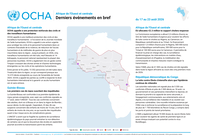
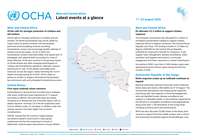
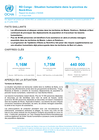
Countries: Democratic Republic of the Congo, Benin, Burkina Faso, Cabo Verde, Cameroon, Central African Republic, Chad, Congo, Côte d’Ivoire, Equatorial Guinea, Gabon, Gambia, Ghana, Guinea, Guinea-Bissau, Liberia, Mali, Mauritania, Niger, Nigeria, Sao Tome and Principe, Senegal, Sierra Leone, Togo Source: UN Office for the Coordination of Humanitarian Affairs Please refer to the attached Infographic. West and Central AfricaOCHA calls for stronger protection of civilians and aid workers OCHA calls for stronger protection of civilians and aid workers: On World Humanitarian Day, OCHA called for urgent action to protect civilians and humanitarian personnel amid escalating violence, shrinking humanitarian access and increasingly deadly methods of warfare across the region. So far in 2026, five humanitarian workers have been killed, nine injured and 14 kidnapped, with national staff accounting for most of those affected. OCHA also warned of the growing impact of armed drones and other emerging technologies on civilians and humanitarian operations. Between January and the end of July, 15,352 people were killed amid insecurity across the region, nearly matching the 16,419 deaths recorded during all of 2025. OCHA called on parties to conflict to respect international humanitarian law and ensure safe and unimpeded humanitarian access. Guinea BissauFirst mpox outbreak raises concerns Guinea-Bissau is facing its first recorded mpox outbreak, with seven confirmed cases reported as of 17 August, according to UNICEF. All confirmed cases are adults, including six in Bissau and one in Biombo region, with no deaths reported. However, 23 of the 46 suspected cases involve children under 15, including 16 children under five, raising concerns over their higher risk of severe complications. UNICEF warned that the country’s fragile disease surveillance system could result in cases going undetected and that the reopening of schools in September could increase transmission among children. West and Central AfricaEU allocates €2.3 million to support cholera response The European Commission has allocated €2.3 million in emergency humanitarian funding to support cholera response efforts in Nigeria, Cameroon, the Central African Republic and Chad. The funding includes €1.5 million for Nigeria, €500,000 for the Central African Republic, €200,000 for Chad and €100,000 for Cameroon. It will support case management, disease surveillance, water, sanitation and hygiene interventions, community engagement and other measures to contain transmission. According to WHO, more than 61,000 cholera cases were reported across the African region during the first five months of 2026. Democratic Republic of the CongoEbola response scales up as outbreak continues to expand National authorities reported more than 5,200 confirmed Ebola cases and nearly 2,500 deaths as of 18 August. The Government and partners are scaling up the response, prioritizing safe care capacity, community engagement, safe and dignified burials, disease surveillance and support to vulnerable people. A new initiative supported by the UN aims to strengthen surveillance and preparedness along more than 1,700 kilometres of the Congo River, including at priority ports and transit points. WHO has also allocated 70,000 doses of the Ebola Zaire vaccine to support front-line health workers and a clinical trial assessing its potential against the Bundibugyo virus.

![myanmar: violence against health care in conflict 2025 [en/my]](https://blhlfoundation.org/wp-content/uploads/2026/08/fd34db7e-5d24-42f0-acab-75a7b19d454b-2Gbry4.png "Myanmar: Violence Against Health Care in Conflict 2025 [EN/MY]")