Uncategorized

3ea2ce3e 0e55 4c36 B5bf Ff2edcd8afe6 7SuyNn

Haiti: Latinoamérica y El Caribe Resumen de Situación Semanal al 24 de abril 2026

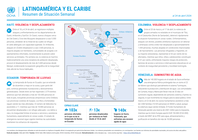
Countries: Haiti, Colombia, Ecuador, Venezuela (Bolivarian Republic of) Source: UN Office for the Coordination of Humanitarian Affairs Please refer to the attached file. CIFRAS CLAVE 103K personas afectadas en lo que va de la temporada de lluvias en Ecuador 13K personas desplazadas por violencia en Haití desde el 18 de abril 140K hogares en Sucre, Venezuela, que enfrentan una escasez aguda de agua HAITÍ: VIOLENCIA Y DESPLAZAMIENTO Entre el 18 y el 24 de abril, se registraron múltiples ataques y enfrentamientos en los departamentos de Ouest, Artibonite y Sud-Est. En Ouest, nuevos choques cerca de Cité Soleil y Croix-des-Bouquets desplazaron a casi 5.000 personas, alrededor de la mitad de las cuales se refugió en siete albergues con capacidad superada. En Artibonite, ataques en L’Estère desplazaron a casi 2.600 personas, la mayoría alojada con familiares, comunidades de acogida o en asentamientos informales, incrementando la presión sobre servicios ya limitados. Por primera vez, la violencia en Sud-Est, tradicionalmente una zona receptora de población desplazada, provocó el desplazamiento de más de 5.600 personas desde Marigot, evidenciando la expansión geográfica de la inseguridad más allá de los focos habituales. ECUADOR: TEMPORADA DE LLUVIAS La temporada de lluvias en Ecuador, que se extiende de diciembre a mayo en la costa y gran parte del país, continúa generando inundaciones y deslizamientos generalizados. Desde enero se han registrado 2.579 eventos adversos que han afectado a más de 103.000 personas en todo el país, incluyendo provincias amazónicas como Orellana. Las provincias costeras de Guayas, Los Ríos y Esmeraldas siguen siendo las más afectadas. El número de fallecidos ha ascendido a 17, mientras que más de 18.800 personas se encuentran desplazadas o sin refugio adecuado. Los daños a vías y la inseguridad limitan el acceso a servicios y asistencia humanitaria, especialmente en zonas rurales. El estado de emergencia nacional sigue vigente mientras las autoridades mantienen los esfuerzos de respuesta. COLOMBIA: VIOLENCIA Y DESPLAZAMIENTO Entre el 20 de marzo y el 17 de abril, la violencia de grupos armados no estatales en el municipio de Tibú, en el Catatumbo (Norte de Santander), deterioró rápidamente la situación humanitaria en zonas rurales. Enfrentamientos, ataques con drones, posibles artefactos explosivos sin detonar y amenazas contra civiles han desplazado a aproximadamente 1.044 personas, muchas alojadas en condiciones improvisadas o de hacinamiento. Las personas refugiadas y migrantes, en su mayoría venezolanas, representan el 42 por ciento de los afectados, mientras que niños, niñas y adolescentes constituyen el 41 por ciento, enfrentando mayores riesgos de protección, barreras de acceso a servicios e interrupciones educativas en un contexto de inseguridad persistente y movilidad restringida. VENEZUELA: SUMINISTRO DE AGUA Más de 140.000 hogares en el estado de Sucre enfrentan una emergencia hídrica prolongada tras un sismo el 22 de febrero que obstruyó parcialmente el sistema Turimiquire, reduciendo la producción y distribución de agua. Las comunidades de Cumaná, Araya y Manicuare llevan más de 20 días sin suministro regular, dependiendo de camiones cisterna y fuentes no seguras, lo que incrementa los riesgos para la salud pública. Entre marzo y el 22 de abril, los socios humanitarios asistieron a más de 2.000 familias (10.925 personas) en WASH y salud, aunque la cobertura sigue siendo limitada. El Fondo Humanitario de Venezuela aprobó una reserva de US$1 millón para la respuesta, mientras que la Unión Europea aportó EUR 150.000 ($163.000) a través del DREF de la IFRC para agua, almacenamiento y purificación en beneficio de más de 18.000 personas.

Haiti: Latinoamérica y El Caribe Resumen de Situación Semanal al 24 de abril 2026 Read More »
21f31b34 Ea98 4f2b 9a2d 0622df129a37 NX4CDL

Haiti: Latin America & The Caribbean Weekly Situation Update as of 24 April 2026

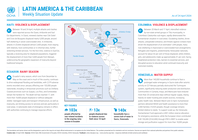
Countries: Haiti, Colombia, Ecuador, Venezuela (Bolivarian Republic of) Source: UN Office for the Coordination of Humanitarian Affairs Please refer to the attached file. KEY FIGURES 103K people affected by rain-related incidents in the ongoing rainy season in Ecuador 13K people displaced due to violence across Haiti since 18 April 140K households face a severe lack of water in Sucre, Venezuela HAITI: VIOLENCE & DISPLACEMENT Between 18 and 24 April, multiple attacks and clashes were reported across the Ouest, Artibonite and Sud Est departments. In Ouest, renewed clashes near Cité Soleil and Croix de Bouquets displaced nearly 5,000 people, around half sheltering in seven overcrowded sites. In Artibonite, attacks in L’Estère displaced almost 2,600 people, most staying with relatives, host communities or in informal sites, further stretching limited services. For the first time, violence in Sud-Est, typically a receiving area for displaced populations, triggered the displacement of more than 5,600 people from Marigot, underscoring the geographic expansion of insecurity beyond traditional hotspots. ECUADOR: RAINY SEASON Ecuador’s rainy season, which runs from December to May on the coast and in much of the country, continues to drive widespread flooding and landslides, with 2,579 adverse events recorded since January affecting over 103,000 people nationwide, including in Amazonian provinces such as Orellana. Coastal provinces such as Guayas, Los Ríos, and Esmeraldas remain the hardest hit. The death toll has reached 17, with more than 18,800 people displaced or without adequate shelter. Damaged roads and transport infrastructure, as well as insecurity, are limiting access to services and aid, particularly in rural areas. A nationwide state of emergency remains in effect, with authorities continuing to manage response efforts. COLOMBIA: VIOLENCE & DISPLACEMENT Between 20 March and 17 April, intensified violence by non-state armed groups in Tibú municipality, in Colombia’s Catatumbo sub-region, rapidly deteriorated the humanitarian situation in rural areas. Escalating clashes, drone attacks, unexploded ordnance, and threats against civilians have driven the displacement of an estimated 1,044 people, many now sheltering in improvised or overcrowded host arrangements. Refugees and migrants, predominantly Venezuelan nationals, account for about 42 per cent of those displaced, while children, girls, and adolescents make up approximately 41 per cent, facing heightened protection risks, barriers to essential services, and disrupted access to education amid continued insecurity and restricted mobility. VENEZUELA: WATER SUPPLY More than 140,000 households continue to face a prolonged water emergency in Sucre state after seismic activity on 22 February partially obstructed the Turimiquire system, significantly reducing water production and distribution. Communities in Cumaná, Araya, and Manicuare have endured more than 20 consecutive days without regular supply, relying heavily on water trucking and unsafe sources, increasing public health risks. Between March and 22 April, humanitarian partners delivered WASH and health assistance to more than 2,000 families (10,925 people), though coverage remains limited relative to needs. To support scale-up, the Venezuela Humanitarian Fund approved a US$1 million reserve allocation for emergency assistance, while the European Union contributed EUR 150,000 ($163,000) through IFRC’s DREF to enable water storage and purification support for more than 18,000 people.

Haiti: Latin America & The Caribbean Weekly Situation Update as of 24 April 2026 Read More »

9acae974 1c05 4db5 A1c7 E6b3e8352040 PFgs4A

Ukraine: Health Cluster Bulletin #3 (March 2026)

Country: Ukraine Source: Health Cluster Please refer to the attached file. Ukraine saw an escalation in aerial attacks compared to the first two months of the year, with over 3,500 air and drone strikes recorded in March alone by ACLED. Between 23 and 24 March, 948 drones were launched in a single 24-hour period – the largest such attack since February 2022, according to ACLED. Civilian casualties in March 2026 rose sharply, with 211 killed and 1,206 injured. The UN HRMMU reported a 49 percent increase from the previous month and the highest toll since July 2025. Overall, the first quarter of 2026 saw civilian casualties rise 20 percent compared to the same period in 2025. As of 31 March 2026, 9 health partners reported reaching more than 500 people with primary health care and MHPSS and prepositioned medical supplies to cover the treatment of 200 patients. WHO SSA verified 42 attacks on health care in March, including a drone strike on a clearly marked vehicle to a health partner’s mobile medical team operating in a frontline area. In a separate incident, an evacuation minibus was struck by an FPV drone while evacuating civilians in Donetska oblast, killing two people and injuring two others. Attacks on energy infrastructure continued to disrupt electricity, heating and water supply, affecting both health service delivery and humanitarian operations. UN HRMMU also reported an increase in strikes targeting railroads and other transport infrastructure. Despite these challenges, the October 2025 – March 2026 winter response concluded at the end of March with 17 Health Cluster partners providing winter-specific assistance to 66,017 people, reaching 67 percent of the 98,058 target. Based on an ACAPS scenario analysis for Ukraine in 2026, there are three possible trajectories: continued war, partial de-escalation, and escalation, each associated with consistent high health risks. Across all scenarios, infrastructure damage, weakened health system capacity, and reduced international funding are expected to widen the gap between needs and response, particularly in frontline and hard-to-reach areas.

Ukraine: Health Cluster Bulletin #3 (March 2026) Read More »

World: Acute food insecurity and malnutrition remain alarmingly high as crises deepen, UN, EU and partners warn in new report

Countries: World, Afghanistan, Bangladesh, Democratic Republic of the Congo, Myanmar, Nigeria, occupied Palestinian territory, Pakistan, South Sudan, Sudan, Syrian Arab Republic, Yemen Sources: European Commission, Food and Agriculture Organization of the United Nations, Government of Germany, Government of the United Kingdom, International Fund for Agricultural Development, UN Children’s Fund, UN High Commissioner for Refugees, World Bank, World Food Programme Over the past decade acute hunger numbers have doubled, while funding retreats to 2016 levels 24/04/2026 JOINT NEWS RELEASE EU/BMZ/FCDO/g7+/DAFM/FAO/IFAD/WFP/UNHCR/UNICEF/WB Brussels/Berlin/London/Dili/Dublin/Rome/Geneva/New York/Washington D.C. – Acute food insecurity and malnutrition levels remain alarmingly high and deeply entrenched, with crises increasingly concentrated in a core group of countries, according to the Global Report on Food Crises (GRFC) 2026, released today by an international alliance. In its tenth edition, the GRFC shows that acute hunger has doubled over the past decade, with two famines declared last year for the first time in the report’s history. The report from the Global Network Against Food Crises reveals that acute food insecurity remains highly concentrated. Ten countries — Afghanistan, Bangladesh, the Democratic Republic of the Congo, Myanmar, Nigeria, Pakistan, South Sudan, Sudan, Syrian Arab Republic, and Yemen — accounted for two-thirds of all people facing high levels of acute hunger. Afghanistan, South Sudan, Sudan, and Yemen experienced the largest food crises both in terms of the share and absolute number of people facing high levels of acute food insecurity. At the most extreme end, famine was identified in Gaza Governorate and parts of Sudan in 2025 by the Integrated Food Security Phase Classification (IPC) system. This marks the first time since the GRFC began reporting that famine has been confirmed in two separate contexts in the same year. This signals a sharp escalation in the most extreme forms of hunger and malnutrition, driven primarily by conflict and restricted humanitarian access, and exacerbated by forced displacement. In total, 266 million people in 47 countries/territories experienced high levels of acute food insecurity in 2025, representing almost 23 percent of the analysed population – a proportion that is marginally higher than in 2024 and nearly double the share recorded in 2016. In 2025, the severity of acute food insecurity was the second highest on record, with the share of people facing extreme hunger remaining at one of the most critical levels seen in the past two decades. The number of people facing catastrophic hunger (IPC Phase 5) is nine times higher than it was in 2016. At the same time, acute malnutrition remains a critical and growing concern. In 2025 alone, 35.5 million children were acutely malnourished, including nearly 10 million suffering from severe acute malnutrition. Nearly half of food-crisis contexts also faced nutrition crises, reflecting the combined effects of inadequate diets, disease burden, and breakdowns in essential services. In the most severe contexts, including Gaza, Myanmar, South Sudan and Sudan, these compounded shocks have resulted in extreme levels of malnutrition and elevated risks of mortality. In addition, forced displacement continued to exacerbate food insecurity. More than 85 million people were forcibly displaced across food-crisis contexts in 2025, including internally displaced people, asylum-seekers and refugees with people forced to flee consistently facing higher levels of acute hunger than host communities. “Conflict remains the primary driver of acute food insecurity and malnutrition for millions around the world, with outright famine emerging in two conflict-affected areas in the same year — an unprecedented development,” said United Nations Secretary-General António Guterres in the foreword to the report. “This report is a call to action urging global leaders to summon the political will to rapidly scale up investment in lifesaving aid, and work to end the conflicts that inflict so much suffering on so many.” Outlook for 2026 remains bleak Looking ahead, the report warns that severe levels of acute food insecurity remain critical in multiple contexts in 2026. Ongoing conflicts, climate variability and global economic uncertainty — including risks to food markets — are likely to sustain or worsen conditions in many countries. In particular, while a full assessment is premature, the escalation of the conflict in the Middle East – in addition to causing further displacement in a region already hosting millions of forcibly displaced and returnees – exposes countries/territories with food crises to both direct and indirect risks of global agrifood market disruptions. Immediate food security implications are mainly regional, given the Middle East’s dependence on food imports, but are having immediate impacts on the purchasing power of already-vulnerable communities as energy and logistics costs rise. At the same time, Gulf countries are major energy and fertilizer exporters, and continued transport disruptions could create wider spillover risks for global agrifood markets, the report warns. Declining funding threatens response capacity A major concern highlighted in this year’s report is the sharp decline in humanitarian and development financing for food crises. Funding for food crises responses and for food security and nutrition has fallen back to levels last seen nearly a decade ago, limiting the ability of governments and humanitarian actors to respond effectively. Data collection has also been impacted, with fewer countries able to produce reliable and disaggregated food security and nutrition estimates. Critical data gaps The apparent decline in the number of people facing high levels of acute food insecurity is largely a reflection of declining data availability rather than a real improvement. The 2026 GRFC features the lowest number of countries with data meeting technical requirements in a decade. In 2025, 18 countries and territories lacked comparable data, including several major crises such as Burkina Faso, the Republic of Congo and Ethiopia, which alone accounted for more than 27 million acutely food-insecure people in need of urgent assistance in 2024. This is reflected in the total number of people facing acute food insecurity detailed in the report. While this number is lower than the number in last year’s report, it does not necessarily reflect an improvement in food security contexts, but rather an absence and lack of access to reliable data. Call to action The Global Network Against Food

World: Acute food insecurity and malnutrition remain alarmingly high as crises deepen, UN, EU and partners warn in new report Read More »

Somalia: Près de 62 000 personnes déplacées par la sécheresse en Somalie face à l’intensification des chocs climatiques

Country: Somalia Source: International Organization for Migration Genève/Mogadiscio, 24 avril 2026 – Près de 62 000 personnes ont été déplacées par la sécheresse dans cinq districts de Somalie depuis le début de l’année. Les données de l’Organisation internationale pour les migrations (OIM) indiquent que la sécheresse est désormais à l’origine de trois nouveaux déplacements sur quatre, soit une augmentation de 22 % par rapport à l’année dernière, ce qui souligne la gravité croissante des chocs climatiques. Bien que la saison des pluies de Gu (avril-juin) apporte des précipitations normales ou supérieures à la normale, près de 125 000 personnes supplémentaires devraient être déplacées par la sécheresse au cours du deuxième trimestre 2026, selon la matrice de suivi des déplacements de l’OIM. « La sécheresse contraint déjà des dizaines de milliers de personnes à quitter leur foyer, et beaucoup d’autres pourraient être déplacées dans les mois à venir », a déclaré Manuel Pereira, Chef de mission de l’OIM en Somalie. « Lorsque l’eau disparaît, que les récoltes sont mauvaises et que les moyens de subsistance s’effondrent, le déplacement devient la dernière option. Sans une action rapide, la sécheresse continuera à déplacer des communautés, à aggraver la faim et à accroître la vulnérabilité dans toute la Somalie, notamment pour les plus vulnérables ». Les districts de Baidoa, Dayniile, Kahda, Diinsoor et Doolow comptent parmi les plus durement touchés, car l’intensification de la sécheresse entraîne des récoltes désastreuses et l’effondrement des moyens de subsistance, exacerbant la famine et exerçant une pression croissante sur des infrastructures déjà limitées. Cette vague de déplacements liés au changement climatique fait suite à des précipitations inférieures à la moyenne pendant la saison Deyr 2025, aggravée par une période sèche Jilaal exceptionnellement rude. Les sources d’eau se sont taries, les conditions de pâturage se sont détériorées et la production agricole a été sévèrement réduite dans certaines parties du pays, forçant des milliers de personnes à quitter leurs foyers à la recherche d’eau, de nourriture et d’aide. Les projections de la matrice de suivi des déplacements (DTM) de l’OIM indiquent que les mouvements de population liés à la sécheresse, notamment au sein des communautés pastorales et agricoles, devraient encore s’intensifier dans les mois à venir si les conditions pluviométriques ne s’améliorent pas. Cette situation fait craindre une intensification des pressions migratoires dans des régions déjà vulnérables, les ménages déplacés se dirigeant vers les villes où ils espèrent accéder à une aide ou à des services de base. Cependant, ces centres urbains ne sont pas en mesure d’absorber rapidement une croissance démographique soudaine, ce qui oblige de nombreuses familles nouvellement déplacées à s’installer dans des zones informelles ou mal desservies où l’accès aux services de base et aux infrastructures reste extrêmement limité. Les conclusions d’une récente évaluation pilote de l’OIM sur la mobilité pastorale dans la région de Gedo soulignent que bon nombre de ménages ont déclaré avoir parcouru de longues distances pour atteindre des points d’eau, tandis que des pertes de bétail liées à la sécheresse et à la chaleur extrême ont été largement signalées pendant la période de suivi. Lorsque les troupeaux diminuent, les ménages perdent leur principale source de revenus, de nourriture et de résilience face aux chocs futurs. Grâce à son mécanisme de soutien rapide, l’OIM et ses partenaires sont en mesure d’apporter une réponse rapide aux chocs émergents et de fournir une aide vitale aux familles nouvellement déplacées, notamment des abris d’urgence, de l’eau, des produits non alimentaires et une aide essentielle. Toutefois, l’ampleur et le rythme des déplacements et de l’insécurité alimentaire liés à la sécheresse épuisent rapidement les ressources disponibles. Dans les sites de déplacement et les campements informels, les familles sont confrontées à des conditions de surpeuplement, à un accès limité à l’eau potable et à l’assainissement, ainsi qu’à des abris inadéquats, ce qui ajoute aux besoins humanitaires déjà criants. Face à la persistance prévisible de la sécheresse, l’OIM lance un appel à un soutien urgent et soutenu pour faire face à ses impacts croissants. Il est essentiel de renforcer l’aide humanitaire vitale, parallèlement à des investissements accrus dans les infrastructures hydriques, la résilience face à la sécheresse et des moyens de subsistance résilients au changement climatique qui aident les communautés à résister aux chocs futurs. Pour plus d’informations, veuillez consulter le Centre des médias de l’OIM.

Somalia: Près de 62 000 personnes déplacées par la sécheresse en Somalie face à l’intensification des chocs climatiques Read More »

C3452fbd C358 4425 B539 Ee8ebfd3bb6d Sr0qAS

Sudan: Alkarama 9 IDPs Site Factsheet 23 April 2026

Country: Sudan Sources: CCCM Cluster, Protection Cluster, UN High Commissioner for Refugees Please refer to the attached file. Al Karama 9, located in Ed Damazin locality, Blue Nile State, hosts Sudanese returnees (former refugees) from camps in South Sudan. Most returnees reported leaving under concerning circumstances due to reduced humanitarian assistance, lack of basic services, and pressure to repatriate, with significant risks during the return journey, including exposure to fighting, health threats, and loss of livelihoods. Site management support is provided by BDMO. Living conditions remain difficult, with major gaps in protection, shelter, health, wash, and education services. Protection risks are high due to insecurity, inadequate lighting, lack of civil documentation, family separation, child labour, lack of education services , and lack of birth certificates and educational documentsand heightened risks for women and children. Most households live in shelters made from locally available materials, in addition to recently distributed 326 tents from the Turkish Donation through Human Appeal while access to safe water and sanitation remains insufficient.

Sudan: Alkarama 9 IDPs Site Factsheet 23 April 2026 Read More »

1dd905a7 9473 49ec A4e9 30865a2f6059 BG27oG

Colombia: Flash update – Emergencias humanitarias en Tibú – Norte de Santander (23 de abril de 2026)

Countries: Colombia, Venezuela (Bolivarian Republic of) Sources: El Equipo Humanitario País Colombia, Grupo Interagencial sobre Flujos Migratorios Mixtos, UN Office for the Coordination of Humanitarian Affairs Please refer to the attached file. Entre el 20 de marzo y el 17 de abril de 2026, zonas rurales del municipio de Tibú, subregión del Catatumbo en Norte de Santander, siguen enfrentando un deterioro de la situación humanitaria por la intensificación de accionar de los grupos armados no estatales (GANE), escenarios previamente advertidos por la Defensoría del Pueblo en la Alerta Temprana de Inminencia No.017-2025. La materialización de los hechos se ha documentado en alertas de situación humanitaria que han dado cuenta de la escalada de acciones de violencia armada y conflicto. La persistencia de enfrentamientos entre GANE y combates de estos con la Fuerza Pública, ataques con vehículos aéreos no tripulados (VANT o drones) con artefactos explosivos (AE) y presencia de posibles municiones sin explotar (MSE), sumado a amenazas y otras acciones de violencia contra civiles ha incrementado significativamente los riesgos para la población civil. En este contexto, el 13 de abril se reportó el desplazamiento masivo de al menos 170 familias (510 personas) veredas Cerro Madera y La Selva del corregimiento Campo Dos, quienes llegaron al corregimiento Campo Tres. Las personas de la vereda La Selva se alojaron en un refugio improvisado con condiciones limitadas, mientras que las personas desplazadas de Cerro Madera se alojaron en redes de apoyo con condiciones de habitabilidad precarias. En abril, también se reportaron desplazamientos de 65 familias (180 personas) del corregimiento de Pacelli (veredas Buenos Aires, San Martin y San Luis), quienes actualmente están alojadas en redes de apoyo configurando hacinamiento y presión sobre recursos de las personas que las alojaron. Considerando los reportes entre marzo y abril, se cuenta con un acumulado de al menos 359 familias (cerca de 1.044 personas) desplazadas en eventos masivos. Dentro de la población afectada se identifican aproximadamente 435 personas refugiadas y migrantes, en su mayoría de nacionalidad venezolana, quienes enfrentan barreras de acceso a servicios especialmente en salud, asociadas a su estatus migratorio. Se estima afectación de aproximadamente 430 niños, niñas y adolescentes (NNA) un 42% del total de personas afectadas. En los eventos donde se cuenta con desagregación de información (vereda P30 y los sectores Km 16 y Km 19), se identificaron 150 NNA de las 354 personas afectadas, con posibles interrupciones en el acceso a la educación. No obstante, se prevé que esta cifra sea mayor, considerando que no se dispone de desagregación completa para el resto de las nuevas emergencias (La Selva, Cerro Madero y Pacelli). Los múltiples eventos reportados dan cuenta del desplazamiento masivo de 94 familias (272 personas) en los sectores Km 16–Km 19 en Tibú y el desplazamiento masivo de 30 familias (82 personas) de la vereda P30, zona rural d Tibú, de las cuales 35 son niños, niñas y adolescentes (NNA). En algunos casos las familias se han desplazado hacia el casco urbano de Tibú y corregimientos como Pacelli, en otros —particularmente desde La Selva y Cerro Madero- lo hacen de manera interverdal. Se evidencia la adopción de dinámicas de movilidad pendular por parte de las familias desplazadas — incluyendo también movimientos intraveredales entre zonas rurales y centros poblados— alternando entre sus viviendas, refugios improvisados y espacios comunitarios o la escuela comunitaria El Milagro- como mecanismo de autoprotección; así mismo, se evidencian limitaciones económicas, restricciones de acceso y condiciones de seguridad adversas, que impiden sostener la movilidad en la zona.

Colombia: Flash update – Emergencias humanitarias en Tibú – Norte de Santander (23 de abril de 2026) Read More »

E8a045b5 06e6 452c B0f8 B722c4a397ce VnUTZV

Iran: WFP Middle East Regional Escalation Emergency Response External Situation Report #8, 23 April 2026

Country: Iran (Islamic Republic of) Source: World Food Programme Please refer to the attached file. IN NUMBERS 611,200 displaced people assisted in Lebanon with food and cash to date. 112,576 displaced people received date bars at Syria crossings. 33,500 refugees in settlement supported with food and cash assistance in Iran. KEY HIGHLIGHTS Despite the ceasefire, nearly two months into the escalation in the Middle East, sustained supply chain disruptions, port congestion, and transport delays continue to drive up delivery costs and timelines for food, energy, fertilizers, and other essential commodities, along with straining humanitarian operations, disproportionately affecting the world’s poorest and most vulnerable populations, both within the region and beyond. In Iran, WFP assistance continues uninterrupted, reaching 33,424 refugees across 20 settlements, with plans to expand to additional refugees referred by the authorities to support evolving needs. In Lebanon, despite deteriorating security conditions, the Logistics Cluster, with the support of WFP, has facilitated 12 convoys so far, assisting 59,900 affected people in hard-to-reach areas. Ensuring safe, reliable humanitarian access, including effective deconfliction, is urgent to respond effectively to growing humanitarian needs. In Syria, WFP continues its emergency response, distributing date bars to over 112,000 people transiting through Jousieh and Jdeidet Yabous border points amid continued displacement and movement pressures.

Iran: WFP Middle East Regional Escalation Emergency Response External Situation Report #8, 23 April 2026 Read More »