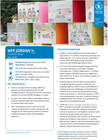
WFP Jordan Country Brief, May 2026
Country: Jordan Source: World Food Programme Please refer to the attached file.
WFP Jordan Country Brief, May 2026 Read More »

Country: Jordan Source: World Food Programme Please refer to the attached file.
WFP Jordan Country Brief, May 2026 Read More »
Country: occupied Palestinian territory Source: UN Office of the High Commissioner for Human Rights Please refer to the attached files. Summary This report provides an overview of the human rights situation and key trends and developments in the Occupied Palestinian Territory encompassing Gaza and the West Bank, including East Jerusalem, between 7 October 2023 and 31 May 2025, complements other OHCHR reports covering overlapping periods of time by including information not previously covered.
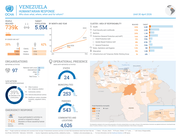
Country: Venezuela (Bolivarian Republic of) Source: UN Office for the Coordination of Humanitarian Affairs Please refer to the attached Infographic.
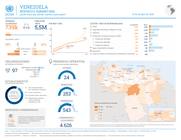
Country: Venezuela (Bolivarian Republic of) Source: UN Office for the Coordination of Humanitarian Affairs Please refer to the attached Infographic.
Countries: Democratic Republic of the Congo, Uganda Source: UN Children’s Fund NEW YORK/KAMPALA/KINSHASA, 18 May 2026 – “UNICEF is deeply concerned by confirmed Ebola outbreaks in the Democratic Republic of the Congo (DRC) and Uganda, and the growing risk to children and vulnerable communities across the region – a situation the World Health Organization has now declared a Public Health Emergency of International Concern. “A total of 246 suspected cases have been reported so far, with 80 suspected deaths recorded in Ituri Province, eastern DRC, and Uganda has also reported two cases, with one death. The figures underscore the urgency of supporting the governments as they lead rapid outbreak response measures to contain further spread with the involvement of communities and relevant stakeholders and ensuring cross-border coordination. “This version of the Ebola virus, the Bundibugyo strain, is less common than the Zaire strain. There is currently no approved vaccine or treatment. It is believed that circulation of this particular Ebola virus might have started in late April. “The volatile security environment, ongoing access constraints, and high population mobility are increasing the risk of rapid transmission across affected and neighbouring areas. Children are especially vulnerable to the impacts of Ebola outbreaks, including disruptions to essential services, loss of parents and caregivers, stigma, psychosocial distress, and increased protection risks. “UNICEF has already mobilized nearly 50 tonnes of infection prevention and control supplies, such as disinfectants and soaps, personal protective equipment, and water purification tablets and water tanks to Bunia. A multidisciplinary Emergency Rapid Response team is also arriving imminently to provide technical assistance in priority areas, including support for risk communication and community engagement activities aimed at amplifying communication to help families understand how Ebola is transmitted and how to reduce the risk of infection. Over 2,000 community health workers are already in place, but additional capacity and resources are urgently needed to ensure effective coverage, particularly in hard-to-reach areas. “In response to the outbreak, UNICEF has activated its highest emergency classification (a Level 3 Corporate Emergency) to support an organization-wide scale-up of preparedness and response efforts across affected and at-risk areas. The activation enables the immediate allocation of flexible funding, accelerated deployment of emergency personnel, simplified operational procedures to country offices, and enhanced coordination across regional and headquarters levels to support children and families affected by the outbreak. UNICEF works collaboratively with partners, including WHO and Africa CDC, in support of government lead responses. “Every Ebola outbreak places children at risk – not only from the virus itself, but from the wider disruption to health, nutrition, education and protection systems. UNICEF is calling for immediate, safe and sustained humanitarian access to affected communities, particularly in eastern DRC, to enable us to reach vulnerable children and families. “Rapid action, trusted community engagement, and sustained support to frontline responders and community health workers – who also face significant risks, will be critical to protecting children and preventing further spread.” ##### Media contacts Brian Keeley UNICEF Innocenti Email: bkeeley@unicef.org Halimatou Amadou Communication Specialist UNICEF Office West and Central Africa Tel: +221 787 003 555 Email: hamadou@unicef.org Sara Alhattab UNICEF New York Tel: +1 917 957 6536 Email: salhattab@unicef.org Dheepa Pandian Chief of Communication UNICEF East and Southern Africa Regional Office Email: dpandian@unicef.org
Country: Haiti Source: UN Office for the Coordination of Humanitarian Affairs Please refer to the attached file.
Haiti: IMAWG Haïti : Compte rendu de réunion, en ligne, 14 mai 2026 [Meeting Minutes] Read More »
Country: World Sources: World Bank, World Health Organization Expert group tasked with global monitoring warns pandemic risk is outpacing investments Geneva, 18 May 2026 | A decade after Ebola exposed dangerous gaps in outbreak preparedness – and six years after COVID-19 turned those gaps into a global catastrophe – the evidence is clear: the world is not safer from pandemics. A new report from the Global Preparedness Monitoring Board (GPMB), A World on the Edge: Priorities for a Pandemic‑Resilient Future, finds that as infectious disease outbreaks become more frequent they are also becoming more damaging, with widening health, economic, political and social impacts, and less capacity to recover from them. The Board warns that a decade of investment has not kept pace with rising pandemic risk. New initiatives have improved aspects of preparedness, but overall these efforts are being offset by the growing effects of rising geopolitical fragmentation, ecological disruption, and global travel, especially as development assistance falls to levels not seen since 2009 . The report analyses a decade of Public Heath Emergencies of International Concern (PHEICs), from Ebola in West Africa to COVID-19 to mpox, assessing their impacts on health systems, economies and societies. On key measures – such as equitable access to diagnostics, vaccines and therapeutics – the world is moving backwards. Mpox vaccines reached affected low-income countries almost two years after the outbreak began – even slower than the 17 months it took for COVID-19 vaccines. And the escalating toll of such emergencies extends far beyond health and economic impacts: both Ebola and COVID-19 damaged trust in government, civil liberties and democratic norms, amplified by politicized responses, attacks on scientific institutions and polarization that have outlasted the crises, leaving societies less resilient to the next emergency. The report emphasizes that the real, near term risk of another pandemic would strike a world more divided, more indebted and less able to protect its people than it was a decade ago, exposing all countries to potentially greater health, social and economic impacts. The report highlights the potential of AI and digital technologies to improve preparedness, especially for monitoring pandemic threats, but emphasizes that without effective governance and safeguards they could actually reduce health security and accelerate the access gaps that defined COVID-19. “The world does not lack solutions”, said GPMB Co-Chair, H.E. Kolinda Grabar-Kitarovic. “But without trust and equity, those solutions will not reach the people who need them most. Political leaders, industry and civil society can still change the trajectory of global preparedness – if they turn their commitments into measurable progress before the next crisis strikes.” The GPMB – which will conclude its mandate in 2026 – identifies 3 concrete priorities for political leaders to reverse these trends: establish a permanent, independent monitoring mechanism to track pandemic risk; advance equitable access to life-saving vaccines, tests and treatments by concluding the Pandemic Agreement; and secure robust financing for both preparedness & ‘Day Zero’ response activities. “If trust and cooperation continue to fracture, every country will be more exposed when the next pandemic strikes. Preparedness is not only a technical challenge — it is a test of political leadership” said GPMB Co-Chair Joy Phumaphi. The report concludes by highlighting that that leadership will be tested this year, as governments work to finalize the WHO Pandemic Agreement and to agree a meaningful United Nations political declaration on pandemic prevention, preparedness and response. The 2026 GPMB report is launching today in the margins of the 79th World Health Assembly. Note to editors: The Global Preparedness Monitoring Board (GPMB) is an independent monitoring and accountability body established in 2018 by WHO and the World Bank to strengthen preparedness for global health crises. Composed of political leaders, agency principals, and world-class experts, the Board provides independent, authoritative assessments of global progress in building and sustaining the capacity to prevent, detect, and respond to disease outbreaks, epidemics, pandemics, and other health emergencies. The 2026 report draws on the GPMB Monitoring Framework, which takes a multisectoral perspective and features 90 indicators grouped into three dimensions: Risk; Prevention, Preparedness and Resilience; and Impact. This year’s report focuses on the Impact dimension. The report will be made available on the GPMB website. Media contact: Shagun Khare khares@who.int mediainquiries@who.int
The world is on the edge of even greater pandemic damage Read More »
Country: Mali Source: UN Office for the Coordination of Humanitarian Affairs Please refer to the attached file.
Country: Mali Source: UN Office for the Coordination of Humanitarian Affairs Please refer to the attached file.
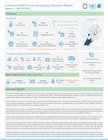
Country: Lebanon Sources: Health Cluster, World Health Organization Please refer to the attached file.
Lebanon Health Sector Emergency Situation Report Issue #11 – May 18, 2026 Read More »