Uncategorized

world: beyond the breaking point: the continuing impact of funding cuts on women’s organizations in humanitarian settings

World: Beyond the breaking point: The continuing impact of funding cuts on women’s organizations in humanitarian settings

Country: World Source: UN Women Please refer to the attached file. The publication presents new evidence on how sustained reductions in humanitarian funding are affecting women-led and women’s rights organizations—and the women and girls who depend on them. Building on UN Women’s 2025 assessment of the initial impacts of funding reductions, the report draws on a global survey of 855 predominantly local and national women-led and women’s rights organizations operating across 52 countries and contexts, complemented by interviews with women civil society leaders and crisis-affected women. The findings show that humanitarian needs continue to rise while organizations are being forced to reduce services, lay off staff, and scale back their geographic reach. As a result, women and girls face declining access to essential services, including gender-based violence prevention and response, safe spaces, psychosocial support, and livelihoods assistance, while protection risks continue to increase. The report also highlights the growing financial and operational pressures facing women-led organizations, the erosion of core organizational systems, and the implications for gender equality, localization, and humanitarian reform. The report concludes with priority actions for donors, humanitarian actors, and development partners to protect essential services, strengthen women-led and women’s rights organizations, reform humanitarian financing, and advance more equitable, locally led, and gender-responsive humanitarian action.

World: Beyond the breaking point: The continuing impact of funding cuts on women’s organizations in humanitarian settings Read More »

central african republic: overview of incidents affecting humanitarian workers (january june 2026)

Central African Republic: Overview of incidents affecting humanitarian workers (January – June 2026)

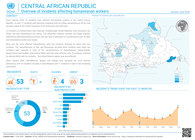
Country: Central African Republic Source: UN Office for the Coordination of Humanitarian Affairs Please refer to the attached file. CONTEXT Since January 2026, 53 incidents have affected humanitarian workers in the Central African Republic. In June, 17 incidents were reported, compared with six in May, representing an 89 per cent increase, linked to the conflict dynamics in the south-east and north-east. 14 incidents of criminal nature were reported, including eight armed robberies, three intrusions, two thefts, and one humanitarian aid looting. The remaining incidents involved one illegal taxation, interference with humanitarian activities, and one case of abduction of a humanitarian staff. At least one humanitarian worker was injured. Birao was the most affected sub-prefecture, with five incidents, followed by Zémio with four incidents. The sub-prefectures of Obo and Bossangoa recorded three incidents each, while two incidents were reported in each of the sub-prefectures of Nana-Bakassa, Bangui-Rapide, Bangui-Fleuve and Ouadda. International NGOs were the most affected, with 10 incidents, followed by national NGOs with six incidents. One United Nations agency was also affected. Since January 2026, Haut-Mbomou, Bangui, and Vakaga have remained the most affected prefectures, with 14 incidents recorded in Haut-Mbomou and 11 incidents in each of the remaining prefectures.

Central African Republic: Overview of incidents affecting humanitarian workers (January – June 2026) Read More »

car: république centrafricaine : aperçu des incidents ayant affecté les travailleurs humanitaires (janvier juin 2026)

CAR: République centrafricaine : Aperçu des incidents ayant affecté les travailleurs humanitaires (janvier-juin 2026)

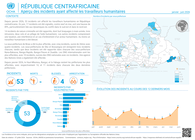
Country: Central African Republic Source: UN Office for the Coordination of Humanitarian Affairs Please refer to the attached file. CONTEXTE Depuis janvier 2026, 53 incidents ont affecté les travailleurs humanitaires en République centrafricaine. En juin, 17 incidents ont été signalés, contre neuf en mai, soit une hausse de 89%, particulièrement liée aux dynamiques du conflit dans le sud-est et dans le nord-est. 14 incidents de nature criminelle ont été rapportés, dont huit braquages à main armée, trois intrusions, deux vols et un pillage de l’aide humanitaire. Les autres incidents comprennent une taxation, une interférence et un cas d’enlèvement d’un acteur humanitaire. Au moins un travailleur humanitaire a été blessé. La sous-préfecture de Birao a été la plus affectée, avec cinq incidents, suivie de Zémio avec quatre incidents. Les sous-préfectures de Obo et Bossangoa ont enregistré trois incidents chacune, tandis que deux incidents ont été rapportés dans chacune des sous-préfecture Nana-Bakassa, Bangui-Rapide, Bangui-Fleuve et Ouadda. Les ONG internationales sont les plus affectées, avec 10 incidents, suivies des ONG nationales avec six incidents. Une agence des Nations Unies a également été affectée. Depuis janvier 2026, le Haut-Mbomou, Bangui, et la Vakaga restent les préfectures les plus affectées, avec respectivement 14, et 11 incidents dans chacune des deux dernières préfectures.

CAR: République centrafricaine : Aperçu des incidents ayant affecté les travailleurs humanitaires (janvier-juin 2026) Read More »

venezuela earthquake: flash update #2 (9th july 2026)

Venezuela Earthquake: Flash Update #2 (9th July 2026)

Country: Venezuela (Bolivarian Republic of) Source: ChildFund International Please refer to the attached file. Two weeks after the 24 June seismic doublet (magnitude 7.2 and 7.5, 39 seconds apart), Venezuela’s emergency has shifted from acute search and rescue into sustained, multi-sector humanitarian operations, even as rescuers occasionally still find survivors and already-weakened buildings continue to collapse. The official death toll stands at 3,535, with 16,740 people injured and nearly 18,000 displaced. Authorities now report more than 940 aftershocks. Buildings damaged are reported between 856 (government) and 2,501 (OCHA/ partner tracking), including 190 confirmed collapses. More than 55,000 people remain unaccounted for on the national missing-persons platform, of which 123 are children. Authorities report 80 operational transitional camps supporting the displaced population. Independent satellite-based analysis (ANOVA Policy Research, with Microsoft AI for Good) suggests population exposure in La Guaira’s coastal corridor may be up to three times higher than official figures capture, due to outdated census frameworks and under-counted floating population. Of an estimated 403,784 residents across seven La Guaira parishes, roughly 73,500 lived in structures with observable damage, and 37,600 in structures with severe damage or collapse — the group most likely to need transitional or permanent housing. The UNDRR assessment estimates approximately USD 37 billion in direct damage economy-wide, of which roughly USD 24 billion is concentrated in housing, businesses, schools, hospitals, and public facilities, alongside a separate preliminary UNDP estimate of USD 6.7 billion, equivalent to 6% of GDP.

Venezuela Earthquake: Flash Update #2 (9th July 2026) Read More »

world: un wfp annual performance report 2025 delivering faster and smarter despite compounding crises

World: UN WFP Annual Performance Report 2025 _ Delivering faster and smarter despite compounding crises

Country: World Source: World Food Programme Please refer to the attached files. In 2025, hunger was driven by violent conflicts, natural disasters, and economic shocks, compounded by severe constraints on humanitarian access, which limited food availability for those most in need. More than 1.4 million people lived in famine-like conditions across six WFP operations – Haiti, Mali, the State of Palestine (Gaza), South Sudan, the Sudan and Yemen. This is fifteen times the figure reported prior to the COVID-19 pandemic. For the first time this century, two simultaneous famines were confirmed in Gaza and the Sudan. Beyond these contexts, millions more experienced acute food insecurity across multiple hotspot countries. Humanitarian space continued to narrow as violence against civilians – and the humanitarian workers who sought to assist them – intensified. Over the last three years, more than 1,000 humanitarian workers have been killed, including 334 in 2025 alone. In 2025, as needs increased, WFP operated under exceptional pressure because of sharply declining resources. WFP raised USD 6.5 billion, yet covering only 41 percent of operational requirements, resulting in a substantial funding gap and requiring significant reprioritization of activities and delivery. Within these constraints, WFP and its partners delivered assistance at scale, reaching 121 million people, with women and children accounting for the majority of beneficiaries, and distributing 2.3 million metric tons of food and USD 2.2 billion in cash and vouchers. However, these figures do not fully capture the level of assistance provided. As WFP former Executive Director, Cindy McCain highlighted “WFP could not meet every need. We were forced to make impossible choices, and this report accounts honestly for those choices.” Under severe funding constraints, WFP made difficult trade-offs between reaching populations in need and maintaining adequate levels of assistance. This resulted in reduced ration sizes, shorter assistance duration, tighter targeting and, in some cases, the scaling down or suspension of operations. Overall, only 47 percent of planned food and cash-based transfers were delivered. These constraints had a significant impact on the intensity of assistance provided and on nutritional outcomes of the beneficiaries. At the same time, WFP strengthened efficiency and performance management to maximize the impact of scarce resources. Cost-containment measures, improved prioritization and efficiency gains were applied across operations to safeguard life-saving assistance and maintain operational continuity in a constrained environment. These efforts, coupled with the resetting of WFP regional offices and enhanced country office support, align with broader UN80 reforms, and well-position WFP to lead on integrated supply chains. WFP efficiency gain initiatives improved efficiency, reduced duplication and strengthened collective impact across the United Nations system, reinforcing disciplined use of resources and stronger delivery in complex operating environments. Through WFP’s shared services, other UN agencies have saved over USD 8 million as efficiency. The Annual Performance Report 2025 provides a transparent account of the extremely difficult trade-offs between reach, adequacy and continuity of assistance in a highly constrained operating environment. It presents aggregated results on WFP’s global performance, describing who was assisted, how assistance was delivered, how resources were mobilized and used and what results were achieved, while underscoring the importance of predictable and flexible funding to sustain both the scale and the adequacy of life-saving assistance. Other complementary products, including the Snapshot, annexes and the dashboard, can be found here WFP Annual Performance Report (APR) | WFPgo

World: UN WFP Annual Performance Report 2025 _ Delivering faster and smarter despite compounding crises Read More »

dr congo: analyse des risques communautaires liés à l’eas et à l’aap dans la réponse à la maladie à virus ebola (mve) en ituri – juin 2026

DR Congo: Analyse des risques communautaires liés à l’EAS et à l’AAP dans la réponse à la Maladie à Virus Ebola (MVE) en Ituri – Juin 2026

Country: Democratic Republic of the Congo Sources: PSEA Network DRC, UN Country Team in DR Congo Please refer to the attached file. Évaluation des risques communautaires en matière d’Exploitation et Abus Sexuels (EAS) et de Redevabilité envers les Populations Affectées (AAP) dans le cadre de la réponse à la MVE en Ituri – Juin 2026

DR Congo: Analyse des risques communautaires liés à l’EAS et à l’AAP dans la réponse à la Maladie à Virus Ebola (MVE) en Ituri – Juin 2026 Read More »