Uncategorized

venezuela: latinoamérica y el caribe resumen de situación semanal al 10 de julio 2026

Venezuela: Latinoamérica y El Caribe Resumen de Situación Semanal al 10 de julio 2026

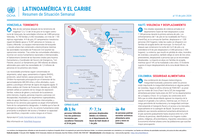
Countries: Venezuela (Bolivarian Republic of), Colombia, Haiti Source: UN Office for the Coordination of Humanitarian Affairs Please refer to the attached Infographic. CIFRAS CLAVE 3,9K personas fallecidas tras dos poderosos terremotos que sacudieron Venezuela el 24 de junio 7,1K personas desplazadas debido a la violencia en el departamento de Ouest de Haití desde el 1 de julio 4M de personas podrían necesitar asistencia alimentaria entre junio y enero en Colombia VENEZUELA: TERREMOTO Más de dos semanas después de los terremotos de magnitud 7,2 y 7,5 del 24 de junio en la región centro-norte de Venezuela, las autoridades informan de 3.889 personas fallecidas, 16.740 heridas y 6.462 rescatadas, con más de 1.100 réplicas registradas. Al 9 de julio, 87 campamentos transitorios siguen brindando apoyo a 16.891 personas en Caracas, La Guaira y Miranda. Los equipos internacionales de búsqueda y rescate urbano han comenzado a desmovilizarse mientras las autoridades nacionales de Protección Civil asumen las operaciones restantes. Tras visitar las comunidades afectadas y reunirse con socios humanitarios nacionales e internacionales, el Subsecretario General de las Naciones Unidas para Asuntos Humanitarios y Coordinador del Socorro de Emergencia, Tom Fletcher, anunció un llamamiento por 298 millones de dólares adicionales para cubrir las necesidades de 1,3 millones de personas en los próximos seis meses. Las necesidades prioritarias siguen concentradas en alojamiento, salud, agua, saneamiento e higiene (WASH), protección, salud mental y apoyo psicosocial. Save the Children ha expresado preocupación por el bienestar de los aproximadamente 680.000 niñas y niños afectados, cuyos padres y psicólogos informan de signos de angustia aguda. El último análisis del Clúster de Protección, liderado por ACNUR, también señala un aumento de los riesgos de separación familiar, violencia de género y exclusión de la asistencia entre menores, mujeres, personas mayores y personas con discapacidad, impulsados por alojamientos superpoblados, redes de apoyo familiares y comunitarias interrumpidas, y brechas en los servicios para quienes se alojan informalmente fuera de los campamentos designados. A medida que la fase de emergencia va llegando a su fin, los actores humanitarios están priorizando la ampliación del acceso y fortalecer la capacidad para identificar y responder a estos riesgos en el futuro. Apoya aquí al Fondo Humanitario Venezolano Para más información, visita: ReliefWeb Response HAITÍ: VIOLENCIA Y DESPLAZAMIENTO Dos oleadas separadas de violencia armada en el departamento Ouest de Haití desplazaron a unas 7.168 personas durante la primera semana de julio. Los enfrentamientos del 1 de julio en las localidades de Pinso y Grand-État, en la comuna de Ganthier, desplazaron a 1.328 personas (262 hogares), todas las cuales se refugiaron con familias de acogida dentro del municipio. En Kenscoff, los ataques que comenzaron la noche del 4 al 5 de julio y se extendieron el 8 de julio desplazaron a 5.840 personas (1.836 hogares). La violencia, que resultó en pérdida de vidas, incendios de viviendas y secuestros, también obligó al cierre de tres sitios preexistentes, desplazando a personas que ya se encontraban desplazadas. La mayoría se aloja con familias de acogida, mientras que el 14% se ha trasladado a dos sitios. El incidente supone el mayor desplazamiento de la zona desde febrero de 2025. COLOMBIA: SEGURIDAD ALIMENTARIA Una combinación de choques meteorológicos, inseguridad localizada y presiones sobre los precios están impulsando la inseguridad alimentaria en algunas partes de Colombia. Según el último informe de FEWS NET, se prevé que los niveles de Crisis (Fase 3 de la CIF) de inseguridad alimentaria persistan hasta enero de 2027 en los departamentos de La Guajira y Chocó. En La Guajira, las condiciones de El Niño que se están desarrollando agravan los impactos de la sequía en el ganado y los cultivos, mientras que, en Chocó, el riesgo persistente de inundaciones y la inseguridad continúan interrumpiendo el transporte fluvial y el acceso a los mercados, especialmente en la subregión de Baudó. Se prevé que la población que necesita asistencia humanitaria alimentaria en el país aumente gradualmente hasta situarse entre 4,0 y 4,99 millones de personas, identificándose a los hogares rurales pobres, indígenas, afrocolombianos, migrantes venezolanos y de la economía informal urbana como las poblaciones que suscitan mayor preocupación.

Venezuela: Latinoamérica y El Caribe Resumen de Situación Semanal al 10 de julio 2026 Read More »
venezuela earthquakes — un women humanitarian update

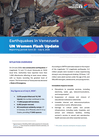
Venezuela Earthquakes — UN Women Humanitarian Update

Country: Venezuela (Bolivarian Republic of) Source: UN Women Please refer to the attached file. This humanitarian update examines the differentiated impact of the earthquakes in Venezuela on women and girls and identifies the key priorities for integrating the gender dimension into the humanitarian response. The report highlights risks such as gender-based violence, the increased burden of unpaid care work, barriers to accessing health services, and the impacts on mental health and livelihoods. It also outlines the actions led by UN Women in collaboration with women-led organizations, the United Nations system, and other partners, and calls for strengthened funding and coordination to support an inclusive recovery that addresses the specific needs of women and girls. To learn more about UN Women’s response, please visit Venezuela Earthquakes — Humanitarian Update | Publications | UN Women – Americas and the Caribbean

Venezuela Earthquakes — UN Women Humanitarian Update Read More »

colombia: instructivo para reporte en el sistema 5w –planes de respuesta hnrp y rmrp–

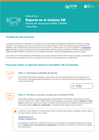
Colombia: Instructivo para Reporte en el sistema 5W –Planes de respuesta HNRP y RMRP–

Country: Colombia Sources: El Equipo Humanitario País Colombia, Grupo Interagencial sobre Flujos Migratorios Mixtos, UN Office for the Coordination of Humanitarian Affairs Please refer to the attached file. La finalidad de este documento es fortalecer la eficiencia y coherencia en el reporte de las actividades de respuesta humanitaria, teniendo en cuenta el primer ciclo de reporte que inició a partir de marzo de 2026, dirigido a todas las organizaciones socias del EHP, GIFMM y/o del GTM Nacional, quienes comenzaron a reportar su información en una única plataforma: ActivityInfo (5W). Esta herramienta permite reportar las actividades de respuesta correspondientes a los Planes de Respuesta vigentes (HNRP y RMRP) evitando el uso de múltiples sistemas y reduciendo duplicidades durante el reporte. Este instructivo ha sido elaborado para facilitar ese proceso, ofrecer claridad sobre los pasos a seguir y garantizar que la información reportada sea precisa, consistente y alineada con los requerimientos establecidos.

Colombia: Instructivo para Reporte en el sistema 5W –Planes de respuesta HNRP y RMRP– Read More »

cameroon: violence against health care in conflict 2025

Cameroon: Violence Against Health Care in Conflict 2025

Country: Cameroon Sources: Insecurity Insight, Safeguarding Health in Conflict Please refer to the attached file. Repeated Violence and Insecurity Continued to Affect the Functioning of Health Services in Cameroon in 2025 Safeguarding Health in Conflict Coalition (SHCC) Using data collected by Insecurity Insight, the Safeguarding Health in Conflict Coalition (SHCC) identified 30 incidentsof violence against or obstruction of health care in Cameroon in 2025. 18 health workers were kidnapped and nine arrested. The report examines patterns of attacks affecting health workers, facilities, patients, and transport amid intensifying conflict between armed groups, and explores the consequences for access to health care, particularly in remote and conflict-affected regions. The report notes that the true scale of attacks is likely higher than documented due to underreporting in inaccessible areas and reduced humanitarian presence, including the impact of cuts to USAID funding on health service provision and monitoring. The report forms part of SHCC’s annual report‘Care in the Crosshairs’. Key findings: For the second consecutive year, reported health worker kidnappings in Northwest region increased, with Ambazonian separatists and Bui Unity Warriors often named as perpetrators. Gendarmerie forces in Northwest and Southwest regions continued to arrest health workers, accusing them of links to opposition groups. Health workers were mostly harmed while on their way to or from work, at home, or pursuing a private activity, highlighting how their vulnerability is heightened in their non-working lives within the community. Lockdowns enforced by non-state armed groups and movement restrictions linked to armed clashes limited health workers’ and patients’ ability to travel to obtain health care and disrupted routine preventive health care activities. Insecurity, movement restrictions, and access constraints during lockdown periods forced humanitarian partners to suspend or adapt field operations, resulting in operational delays and reduced capacity to implement activities in certain areas and constraining the delivery of medical assistance. Full report available in English and French. Insecurity Insight updates data continuously and numbers may change if new information is made publicly available. For the latest available figures, see Insecurity Insight’s global map on attacks on health care since 2016. Other resources Drawing on a decade of systematically collected data, Still Under Attackdocuments the scale, patterns, and consequences of attacks on health care in conflict-affected settings worldwide since the adoption of UN Security Council Resolution 2286 in 2016: Based exclusively on Insecurity Insight’s data collection, it highlights how violence against health care is becoming normalised, with serious consequences for civilians, disease response and health systems. The report provides detailed analysis of perpetrators, methods of attack and emerging risks, including the growing role of new technologies in conflict environments. It also offers recommendations for governments, international organisations, humanitarian actors and the diplomatic community aimed at strengthening the protection of health care and improving accountability for violations. Published every two weeks, the Attacks on Health News Brief comprises threats and violence as well as protests and other events affecting the delivery of and access to health care around the world.

Cameroon: Violence Against Health Care in Conflict 2025 Read More »

earthquakes in venezuela: situation report #16 (09 july 2026, time: 09:00 pm)

Earthquakes in Venezuela: Situation Report #16 (09 July 2026, Time: 09:00 pm)

Country: Venezuela (Bolivarian Republic of) Source: UN Office for the Coordination of Humanitarian Affairs Please refer to the attached file. Situation Report No. 16Earthquakes in Venezuela09 July 2026Time: 9:00 pm Highlights Following the 24 June earthquakes of magnitude 7.2 and 7.5 (18:00 local time), authorities report more than 1,100 aftershocks. Official toll: 3,889 people dead and 16,740 injured. A total of 6,462 people have been rescued. Tom Fletcher, the United Nations’ humanitarian chief, met with nationaland international humanitarian organizations supporting the earthquake response. An additional appeal for US$298 million was launched to scale up the earthquake response and address the multisectoral needs of 1.3 million people over the next six months. The United Nations system and its partner organizations, in coordination with the Government, are responding with multisectoral actions and will continue to scale up assistance to affected people. Situation overview Venezuela is facing a national emergency following two consecutive high-magnitude earthquakes (7.2 and 7.5) that struck on 24 June (18:00 local time) in the north-central region, with the epicentre located along the San Felipe–Yumare–Montalbán axis (Yaracuy/Carabobo). Authorities report 1,142 aftershocks. More than a week after the earthquakes, authorities report a toll of 3,889 people dead, 16,740 injured, and 6,462 rescued since the onset of the emergency. Authorities also reported that approximately 17,907 people lost their homes. The Government response remains focused on search and rescue operations, the preparation and expansion of transitional camps and assistance to affected populations. The United Nations and its partner organizations, in coordination with the authorities, are implementing multisectoral response activities and will continue to scale up assistance to affected people. United Nations Under-Secretary-General for Humanitarian Affairs and Emergency Relief Coordinator Tom Fletcher continued his visit to Venezuela. He met with national and international organizations, as well as other counterparts, to strengthen joint efforts with the sole objective of supporting those most in need.

Earthquakes in Venezuela: Situation Report #16 (09 July 2026, Time: 09:00 pm) Read More »

terremotos en venezuela: reporte de situación #16 (09 de julio de 2026, hora: 09:00 pm)

Terremotos en Venezuela: Reporte de situación #16 (09 de julio de 2026, Hora: 09:00 pm)

Country: Venezuela (Bolivarian Republic of) Source: UN Office for the Coordination of Humanitarian Affairs Please refer to the attached file. Reporte de situación N.º 16Terremotos en Venezuela9 de julio de 2026Hora: 9:00 pm Destacados Tras los sismos de magnitud 7,2 y 7,5 del 24 de junio (18:00 hora local), las autoridades reportan más de 1.100 réplicas. Balance oficial: 3.889 personas fallecidas y 16.740 heridas. 6.462 personas han sido rescatadas. Tom Fletcher, jefe humanitario de las Naciones Unidas, se reunió con organizaciones humanitarias nacionales e internacionales queapoyan la respuesta a los terremotos. Se lanzó un llamamiento adicional por US$298 millones para ampliar la respuesta a los terremotos y atender las necesidades de 1,3 millones de personas durante los próximos seis meses. El Sistema de Naciones Unidas y sus organizaciones socias, en coordinación con el gobierno, responden con acciones multisectoriales y continuarán ampliando la asistencia a las personas afectadas. Situación general Venezuela enfrenta una emergencia nacional tras dos sismos consecutivos de gran magnitud (7,2 y 7,5) ocurridos el 24 de junio (18:00, hora local) en la región centro-norte, con epicentro sobre el eje San Felipe – Yumare – Montalbán (Yaracuy/Carabobo). Las autoridades reportan 1.142 réplicas. A más de una semana de los terremotos, las autoridades reportan un balance de 3.889 personas fallecidas, 16.740 personas heridas y 6.462 personas rescatadas desde el inicio de la emergencia. Asimismo, las autoridades reportan que unas 17.907 personas quedaron sin vivienda. La respuesta gubernamental mantiene el foco en las labores de búsqueda, la preparación de los campamentos transitorios y la atención de las personas afectadas. Naciones Unidas y sus organizaciones socias, en articulación con las autoridades, realizan acciones multisectoriales para las personas afectadas y continuarán ampliando la respuesta. El Subsecretario General de las Naciones Unidas para Asuntos Humanitarios y Coordinador del Socorro de Emergencia, Tom Fletcher, continuó su visita a Venezuela. En esta oportunidad, se reunió con organizaciones nacionales e internacionales, así como otras contrapartes, para fortalecer el trabajo conjunto con el único objetivo de apoyar a quienes más lo necesitan.

Terremotos en Venezuela: Reporte de situación #16 (09 de julio de 2026, Hora: 09:00 pm) Read More »

World: At least one million women and girls lose access to critical support as aid cuts dismantle women’s organizations working in humanitarian crises

Countries: World, Afghanistan, Democratic Republic of the Congo, Haiti Source: UN Women New York/Geneva, 10 July 2026 – As armed conflicts reach highest levels in 80 years, organizations providing life-saving services to women and girls are running out of money. Beyond the Breaking Point, a new UN Women report published today on the impact of aid cuts, finds that at least one million women and girls have lost access to critical support since January 2025. The report is based on responses from 855 women-led and women’s rights organizations across 52 crisis-and conflict-affected countries. “The women’s organizations at risk of being shut down are on the frontlines of the world’s most severe humanitarian crises. In countries including Afghanistan, the Democratic Republic of the Congo, and Haiti, they operate where international actors cannot and stay long after global attention has moved on. Every dollar withdrawn from women’s organizations is a dollar withdrawn from survivors of conflict-related sexual violence, displaced mothers, girls forced from school, and communities struggling to survive”, said Sofia Calltorp, UN Women Chief of Humanitarian Action. The collapse of women’s organizations is happening as needs reach historic levels. Some 120 million women and girls require humanitarian assistance and protection worldwide [1] and 84 per cent of women’s organizations surveyed report that demand for their services has increased since January 2025. Nearly nine in 10 say they can no longer meet current levels of need. Two in five organizations surveyed expect to shut down, temporarily or permanently, within the next year. To keep life-saving services afloat, women leading or working in the organizations surveyed are paying with their own labour, income, and wellbeing. Many are crisis-affected themselves. Sixty-five per cent of women-led organizations report staff working without pay to keep services running. As organizations slip into survival mode, 48 per cent – nearly half – report rising burnout among their staff, while 88 per cent say the mental health of the women and girls they serve is deteriorating. Beyond the breaking point: The continuing impact of funding cuts on women’s organizations in humanitarian settings Read more Download The consequences of the funding cuts are already visible. Half of women’s organizations have introduced waiting lists or are turning away women and girls in need. Ninety-two per cent of organizations report increasing levels of poverty among the women they serve, while 82 per cent report seeing more girls dropping out of school. Conflict-related sexual violence doubled in 2025, just as the systems designed to protect survivors are collapsing. Eighty-six per cent of women’s organizations report an increase in gender-based violence in the communities they serve. 62% of organizations report that safe spaces are no longer available or have been significantly reduced. Behind these numbers are devastating consequences. A woman seeking refuge from violence might show up at the door of a shelter that has shut down; a pregnant woman may have to walk for hours to reach a health clinic; or a mother may be denied food for her children. The women and girls left behind first are those with the fewest alternatives: women and girls in remote, conflict-affected and hard-to-reach communities. Nearly two-thirds, or 63 per cent, of organizations have already cut services in those areas. The report warns that the consequences extend far beyond humanitarian response. The dismantling of women’s organizations is not happening in a vacuum but against a global backlash on the rights of women and girls. One in five organizations has already suspended work advancing women’s leadership and gender equality. More than half are already witnessing declining participation of women in community leadership and local decision-making. UN Women is calling for sustained investment in women’s organizations as indispensable first responders, defenders of women’s rights, and the foundation of peace and recovery. “Without immediate action, the organizations that have kept women and girls alive through the world’s worst crises risk becoming another casualty of war”, concluded Calltorp. UN Women works with and invests in women-led organizations as essential partners in humanitarian action – providing funding, technical support, and advocacy to strengthen their leadership, expand access to life-saving services, and advance inclusive, locally led humanitarian responses that meet the needs of women and girls. [[1]](https://reliefweb.int/#_ednref1) UN Women estimate according to 2026, [OCHA Humanitarian Needs Overview](https://www.unocha.org/publications/report/world/ocha-2026) All information provided is reported by respondents and has not been independently verified by UN Women unless otherwise specified. About UN Women UN Women exists to advance women’s rights, gender equality and the empowerment of all women and girls. As the lead United Nations entity on gender equality, we shift laws, institutions, social norms and services to close the gender gap and build an equal world for all women and girls. We keep the rights of women and girls at the centre of global progress – always, everywhere. Because gender equality is not just what we do. It is who we are. Contact For more information or to interview UN Women experts, please contact [ Click to reveal ] Your action powers real change Thirty years ago, world leaders promised equal rights for women and girls. Today, that promise remains unfulfilled. In nearly 70% of countries, women face greater barriers to justice than men. Four billion women still live in countries where the law does not fully protect them. Where justice fails, impunity takes hold. Abuse goes unpunished, and perpetrators walk free. Survivors are told to wait. Protection disappears. Accountability fades. Your donation helps turn rights into reality. It strengthens justice systems, expands access to legal support, and supports women-led organizations working to protect survivors and hold perpetrators accountable. Donate

World: At least one million women and girls lose access to critical support as aid cuts dismantle women’s organizations working in humanitarian crises Read More »