Uncategorized

dr congo: rd congo : situation humanitaire dans la province du nord kivu – rapport de situation #7, 20 juillet 2026

DR Congo: RD Congo : Situation humanitaire dans la province du Nord-Kivu – rapport de situation #7, 20 juillet 2026

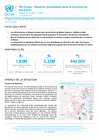
Country: Democratic Republic of the Congo Source: UN Office for the Coordination of Humanitarian Affairs Please refer to the attached file. Ce rapport est produit par OCHA RDC en collaboration avec les partenaires humanitaires. Il couvre la période du 1ᵉʳ au 30 juin 2026. FAITS SAILLANTS • Les affrontements et attaques armées dans les territoires de Masisi, Rutshuru, Walikale et Beni continuent de provoquer des déplacements de population et d’accentuer les besoins humanitaires ; • Plus de 29 000 personnes déplacées ont été assistées en articles ménagers essentiels dans le territoire de Masisi ; • La progression de l’épidémie d’Ebola due au virus Bundibugyo au Nord-Kivu fait peser des risques supplémentaires sur une situation humanitaire déjà préoccupante dans les territoires de Beni et Lubero. CHIFFRES CLÉS 1,83M personnes déplacées internes au 31 mai 2026 (Source : CMP Nord-Kivu, 09 juin 2026) 2,32M personnes retournées au 31 mai 2026 (Source : CMP Nord-Kivu, 09 juin 2026) 440 000 personnes ont reçu une assistance en matière d’eau, d’hygiène et d’assainissement au Nord-Kivu au mois de mai 2026 (Source : Cluster EHA) APERÇU DE LA SITUATIONTerritoire de Rutshuru Au cours du mois de juin, les affrontements armés et les incursions de groupes armés dans plusieurs localités de la chefferie de Bwito se sont poursuivis, provoquant des déplacements de populations. Depuis le 17 juin, des combats signalés dans les environs de Kyasenda (groupement Mutanda) ont entraîné d’importants mouvements de populations vers les agglomérations de Nyanzale, Kikuku, Kyahala, Katsiru et Mweso. Selon les partenaires humanitaires locaux, des violences auraient également fait au moins deux morts et une dizaine de blessés à Kibirizi-Centre, Rubare et Biruma. La persistance de l’insécurité limite considérablement l’accès des populations aux terres agricoles et aux autres moyens de subsistance, faisant craindre une baisse de la production agricole et une dégradation de la sécurité alimentaire dans les zones affectées. Par ailleurs, l’insécurité routière demeure préoccupante sur l’axe Kiwanja–Rwindi–Kanyabayonga, où au moins sept incidents de braquage visant des voyageurs civils ont été signalés au cours du mois de juin, entravant davantage la mobilité des populations et les opérations humanitaires.
DR Congo: RD Congo : Situation humanitaire dans la province du Nord-Kivu – rapport de situation #7, 20 juillet 2026 Read More »

haiti: haЇti aperçu des contraintes d’accès humanitaire de mars à juin 2026

Haiti: HAЇTI – Aperçu des contraintes d’accès humanitaire de mars à juin 2026

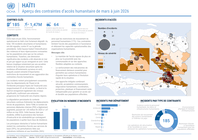
Country: Haiti Source: UN Office for the Coordination of Humanitarian Affairs Please refer to the attached Infographic. Entre mars et juin 2026, l’environnement opérationnel en Haïti s’est fortement dégradé. Au total, 185 incidents sécuritaires et humanitaire sont été signalés, contre 91 sur la période précédente. Cette hausse traduit l’intensification des violences et leurs répercussions croissantes sur les populations ainsi que sur les acteurs humanitaires. Toutefois, une diminution significative des incidents a été observée en maiet juin par rapport au pic enregistré en avril. Cette baisse s’explique notamment par une accalmie relative de la situation sécuritaire après les nombreux affrontements survenus en avril, lesquels avaient entraîné d’importantes restrictions de mouvement et une aggravation des contraintes d’accès humanitaire.

Haiti: HAЇTI – Aperçu des contraintes d’accès humanitaire de mars à juin 2026 Read More »

eritrea project highlights: emergency support to vulnerable pastoralists and agropastoralists in response to lumpy skin disease outbreaks in the gash barka, debub, anseba and maekel regions

Eritrea Project Highlights: Emergency support to vulnerable pastoralists and agropastoralists in response to lumpy skin disease outbreaks in the Gash Barka, Debub, Anseba and Maekel regions

Country: Eritrea Source: Food and Agriculture Organization of the United Nations Please refer to the attached file. Objective To strengthen the resilience of pastoralist and agropastoralist livelihoods by improving the control of lumpy skin disease (LSD) through targeted vaccination, enhanced surveillance and community awareness in high-risk areas. Activities implemented • Procured 500 000 doses of LSD vaccine and implemented targeted vaccination campaigns in hotspot and riverine areas. • Vaccinated approximately 530 000 cattle, representing more than 25 percent of the national livestock population. • Trained 60 field veterinarians and animal health officers on disease surveillance, biosafety, sample shipment, vaccination procedures and community awareness. • Distributed communication materials and conducted digital outreach activities to raise awareness and enhance community engagement. • Strengthened coordination with the Ministry of Agriculture and aligned interventions to ensure efficient vaccine deployment and response operations.

Eritrea Project Highlights: Emergency support to vulnerable pastoralists and agropastoralists in response to lumpy skin disease outbreaks in the Gash Barka, Debub, Anseba and Maekel regions Read More »

bangladesh: situation report: june 2026 who cox’s bazar: rohingya emergency response

Bangladesh: Situation Report: June 2026 WHO Cox’s Bazar: Rohingya Emergency Response

Countries: Bangladesh, Myanmar Source: World Health Organization Please refer to the attached file. 1. Overview In June 2026, WHO supported disease surveillance, outbreak response, and essential health services for approximately 1.7 million refugees and host community members, while advancing measles control, dengue preparedness, routine immunization, and emergency readiness. However, critical funding gaps continue to threaten key public health functions and service delivery. 2. Coordination and Leadership WHO, as Health Sector lead, continued to coordinate the health response for Rohingya refugees and host communities, supporting strategic planning, partner alignment, and evidence-based decision-making. Key updates:  Analysis of the 2026 Joint Response Plan (JRP) funding status identified major gaps in critical health interventions. WHO faces a 64% funding gap in its Health Sector coordination and leadership functions. From September 2026, this gap will reduce WHO’s capacity to coordinate partners and lead the Health Sector response. Funding shortfalls will also affect infectious disease surveillance, outbreak detection, and response activities (P1) from July 2026. This will weaken early warning, health-risk monitoring, data analysis, and operational decision-making in a densely populated and vulnerable setting.  The WHO-led Health Sector and UNICEF-led Nutrition Sector completed a joint assessment of all 42 Primary Health Centres (PHCs) to inform a phased integrated of health and nutrition service delivery. The assessment provides the evidence base to determine facility readiness for integration, establish realistic implementation timelines, and support coordinated planning between both sectors.  Regular coordination mechanisms continued to strengthen partner alignment on public health priorities, preparedness, operational planning, and response activities, supporting coordinated health service delivery across all camps.  The Health Sector sustained strategic engagement with donors, government counterparts, and partners to advocate for additional resources, address critical funding gaps, and maintain continuity of life-saving health services.  Health Sector information products (4W, HeRAMS, Early Warning, Alert and Response System (EWARS) reports, and epidemiological updates) continued to support planning, monitoring, and resource allocation: https://rohingyaresponse.org/sectors/coxs-bazar/health/

Bangladesh: Situation Report: June 2026 WHO Cox’s Bazar: Rohingya Emergency Response Read More »

wfp venezuela earthquakes response situation report 19 july 2026

WFP Venezuela Earthquakes Response Situation Report 19 July 2026

Country: Venezuela (Bolivarian Republic of) Source: World Food Programme Please refer to the attached file. Situation Update • Twenty-five days after the twin earthquakes of 24 June, authorities report 5,208 deaths and 16,740 injuries. Following search and rescue operations, national authorities have shifted the efforts toward relocating displaced populations to transitional camps. • According to authorities, 107 transitional camps have been established, with 23,828 people currently accommodated. As part of the UN-coordinated response, WFP is supporting three camps with two hot meals daily. • WFP Acting Executive Director Carl Skau spoke with Venezuela’s Acting President, Delcy Rodríguez, and reaffirmed the organization’s commitment to continuing its support to authorities and humanitarian partners in meeting immediate food needs and assisting affected families in their recovery.

WFP Venezuela Earthquakes Response Situation Report 19 July 2026 Read More »

ukraine cash working group: deduplication quick reference for frontline assistance: uct 1,2,3 and in kind food [en/uk]

Ukraine Cash Working Group: Deduplication Quick Reference for Frontline Assistance: UCT 1,2,3 and In-kind Food [EN/UK]

Country: Ukraine Source: Ukraine Cash Working Group Please refer to the attached files. Ukraine Cash Working Group Deduplication Quick Reference for Frontline Assistance: Unified Cash Transfers 1, 2, and 3, and In-kind food, developed to guide local authorities and frontline registration workers. The deduplication rules are not about limiting support. They exist to make sure the total value of assistance people receive is fair and consistent – and that resources reach as many people as possible. When a cash amount already includes a food component, providing food parcels would create an unequal distribution across households.

Ukraine Cash Working Group: Deduplication Quick Reference for Frontline Assistance: UCT 1,2,3 and In-kind Food [EN/UK] Read More »