Uncategorized

dr congo: west and central africa: latest events at a glance (14–20 july 2026)

DR Congo: West and Central Africa: Latest Events at a glance (14–20 July 2026)

Countries: Democratic Republic of the Congo, Benin, Central African Republic, Côte d’Ivoire, Ghana, Mali, Nigeria, Togo Source: UN Office for the Coordination of Humanitarian Affairs Please refer to the attached Infographic. Central African RepublicCERF allocates $1 million to contain cholera outbreak The Emergency Relief Coordinator has allocated $1 million from CERF to support the urgent cholera response in the Central African Republic, where more than 400 suspected cases and 36 deaths have been recorded. Children under 10 account for 44 per cent of cases. The outbreak has spread to all districts of Bangui, with transmission compounded by the rainy season and limited access to safe water and sanitation. The funding will support health, community engagement and WASH interventions. UNICEF has provided treatment supplies and helped expand the national cholera treatment centre from 40 to 70 beds. Democratic Republic of the CongoViolence hampers response to major Ebola outbreak Escalating violence in eastern DRC is disrupting humanitarian access and efforts to contain the world’s third-largest recorded Ebola outbreak. At least 2,124 cases have been confirmed across five provinces, including in 16 displacement sites hosting more than 270,000 people in Ituri. Recent attacks in Beni territory have reportedly killed at least 22 people and displaced civilians. Authorities and humanitarian partners are strengthening surveillance, testing, treatment and community engagement, while UN peacekeepers reinforce protection. OCHA calls for safe humanitarian access, protection of civilians and health workers, and increased funding for the $2.3 billion appeal targeting 10.7 million people. MaliMalaria, measles and dengue remain major public health concerns Malaria remains Mali’s leading public health concern, with nearly 888,000 confirmed cases reported between 1 January and 5 July, a slight increase compared with the same period in 2025. Measles remains the most significant epidemic, with 215 confirmed cases reported across 17 health districts, including Bamako, Mopti and Tombouctou, indicating continued transmission and risk of spread. Dengue cases also increased, with 12 confirmed cases reported during the week ending 5 July, up from six the previous week, mainly in Bandiagara and Bamako. So far no yellow fever or cholera cases has been reported this year. Health authorities continue to prioritize surveillance, monitoring and data quality. Gulf of GuineaClimate change increases flood risk along the Gulf of Guinea Severe rainfall caused widespread flooding across Côte d’Ivoire, Ghana, Togo, and Nigeria between 20 to 22 June 2026, killing more than 90 people, displacing hundreds and damaging infrastructure and livelihoods. According to World Weather Attribution, comparable three-day rainfall events now occur every two to four years, with observations indicating a 23 per cent rise in intensity since records began. Rapid urbanization, inadequate drainage, and rising sea levels are compounding the risk, underscoring the need for stronger early-warning systems, safer housing and improved drainage and sanitation.

DR Congo: West and Central Africa: Latest Events at a glance (14–20 July 2026) Read More »
colombia: briefing departamental cordoba, enero a diciembre de 2025

Colombia: Briefing Departamental Cordoba, enero a diciembre de 2025

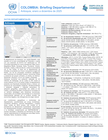
Country: Colombia Sources: El Equipo Humanitario País Colombia, UN Office for the Coordination of Humanitarian Affairs Please refer to the attached file. Crisis humanitaria persistente y multidimensional: Durante 2025, Córdoba continuó enfrentando una combinación de dinámicas asociadas al conflicto armado, restricciones de acceso humanitario y eventos hidrometeorológicos recurrentes. Mientras el sur del departamento concentra riesgos de protección relacionados con la presencia y control territorial de grupos armados, las inundaciones y otros eventos climáticos afectaron a más de 55.000 personas, profundizando las condiciones de vulnerabilidad de comunidades rurales, indígenas y población con necesidades humanitarias preexistentes. El sur de Córdoba concentra las principales afectaciones de protección y acceso humanitario: Municipios como Tierralta, Puerto Libertador, Montelíbano y San José de Uré continúan registrando los mayores niveles de afectación por desplazamiento forzado, restricciones a la movilidad, amenazas y riesgo por artefactos explosivos. Más de 21.000 personas enfrentaron limitaciones de acceso humanitario durante 2025, en un contexto de control territorial ejercido por grupos armados que restringe el acceso a servicios, medios de vida y mecanismos de protección. Persisten riesgos críticos para niñas, niños, mujeres y liderazgos sociales: Las dinámicas de reclutamiento y utilización de NNAJ, las violencias basadas en género, las amenazas contra líderes sociales y las afectaciones a comunidades indígenas continúan evidenciando un deterioro sostenido de las condiciones de protección. Estas situaciones se ven agravadas por el subregistro, las barreras para la denuncia y la limitada capacidad institucional para garantizar acceso oportuno a protección, justicia y atención integral, especialmente en zonas rurales dispersas.

Colombia: Briefing Departamental Cordoba, enero a diciembre de 2025 Read More »

colombia: briefing departamental antioquia, enero a diciembre de 2025

Colombia: Briefing Departamental Antioquia, enero a diciembre de 2025

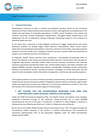
Country: Colombia Sources: El Equipo Humanitario País Colombia, UN Office for the Coordination of Humanitarian Affairs Please refer to the attached file. Antioquia continúa siendo uno de los principales escenarios de afectación humanitaria del país debido a la convergencia entre conflicto armado, control territorial de GANE, restricciones a la movilidad, desplazamientos masivos y eventos de origen natural, especialmente en Bajo Cauca, Nordeste, Norte y Urabá. Las restricciones al acceso humanitario, los confinamientos, el uso de MAP/MUSE/AEI y las nuevas dinámicas de violencia, incluido el uso de drones para ataques con explosivos, evidencian una transformación del conflicto armado que incrementa los riesgos para comunidades rurales, indígenas, afrodescendientes y población civil. Niños, niñas y adolescentes (NNA), mujeres, comunidades étnicas y liderazgos sociales continúan enfrentando riesgos críticos de protección asociados al reclutamiento, la violencia basada en género, los desplazamientos, las amenazas y los homicidios en territorios con presencia de actores armados. Las inundaciones, movimientos en masa y otros eventos de origen natural continúan agravando vulnerabilidades preexistentes y superando las capacidades de respuesta institucional en municipios afectados simultáneamente por conflicto armado y condiciones de acceso limitado.

Colombia: Briefing Departamental Antioquia, enero a diciembre de 2025 Read More »

wfp somalia

WFP Somalia

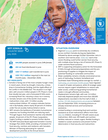
Country: Somalia Source: World Food Programme Please refer to the attached files. Somalia is facing one of the most complex hunger crises in recent years, driven by drought, insecurity, a sharp drop in humanitarian funding, and the ripple effects of the conflict in the Middle East. The situation is on high alert, with around 2 million people in IPC Phase 4, more than double last year, and a forecasted El Niño event increasing flood risk, indicating a sharp rise in severity. Somalia remains one of the world’s most severe malnutrition crises, with 1.9 million acutely malnourished children. IPC analysis indicates famine risk in Burhakaba, where nearly 40 percent of children under five are acutely malnourished or worse. WFP remains the backbone of Somalia’s humanitarian response, but funding shortfalls are reducing reach. Through August, food assistance reaches only 644,000 people, 34 percent of the IPC Phase 4 population. Urgent funding is needed to prevent further decline. The WFP Executive Board approved Somalia’s Country Strategic Plan (2026–2030), providing a framework for food security, nutrition and resilience, with Somalia’s Minister of Planning advocating for national development priorities at the Annual Session.

WFP Somalia Read More »

yemen operational community feedback q2, 2026

Yemen Operational Community Feedback Q2, 2026

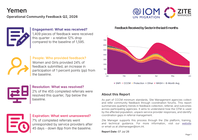
Country: Yemen Source: International Organization for Migration Please refer to the attached file. Throughout Q2 2026, with support from ECHO, IOM maintained operations in 17 priority displacement sites hosting more than 137,000 individuals, while extending advocacy support to 74 IOM phased-out sites. Despite these scale-down measures, IOM continued to provide CFM services and advocacy across both active and phased-out sites, reaching more than 227,000 displaced and host community members. This helped uphold accountability and sustain communication with affected communities during the period. What Feedback was Received? This quarter, 1,409 feedback entries were received – a relative 12% drop from the baseline and decrease from the 1,655 received last quarter. Marib Al Wadi recorded the biggest change in total feedback volume when compared to the baseline with a relative increase of 187%. Feedback was largely related to ‘HH Water Tanks’ and’Tent &/or NFI Kits’. All other districts recored higher requests for Shelter & NFI assistance when compared to other sectors. Who Provided Feedback? Most feedback this quarter came from the Information Desk (36%), CCCM Staff (31%), and the Hotline (29%), with feedback received through CCCM Staff down a notable 13 percentage points from the baseline. People with disabilities, compared with those without disabilities, relied more heavily on the Information Desk, with 87% of their feedback submitted through this channel. The majority of people (90%) gave feedback on behalf of their household, while a smaller proportion represented someone else (10%) when providing feedback. Women and Girls provided 24% of feedback submitted, compared to 76% submitted by Men and Boys. The top sectors and referral requests were consistent across demographic groups (SNFIs and WASH). Notable differences included vulnerable households and women and girls, who had a higher proportion of protection-related requests (cash and protection referrals), while men and boys were comparatively more likely to request CCCM support. What Referrals were Resolved? Of the 455 completed referrals, 2% were successfully resolved, as reported by service providers. This is a notable drop in completed referrals since last quarter. Overall resolution rate shifted 7pp below the baseline with RRM and Plastic Sheets (cccm) topics recording the highest resolution rates, 12% of 17 referrals and 9% of 11 referrals respectively. The majoirty (91%) of completed referrals were unresolved by providers – 15pp above the baseline. Sites in Hays, Al Hodeidah recorded the highest unresolved referrals rate with all referrals unresolved – 11pp above the location’s baseline. Providers in Hays report a ‘Lack of Funding’ to resolved the referrals.

Yemen Operational Community Feedback Q2, 2026 Read More »

dr congo: rd congo : situation humanitaire dans la province de l'ituri – rapport de situation #7, 20 juillet 2026

DR Congo: RD Congo : Situation humanitaire dans la province de l’Ituri – rapport de situation #7, 20 juillet 2026

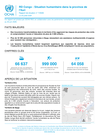
Country: Democratic Republic of the Congo Source: UN Office for the Coordination of Humanitarian Affairs Please refer to the attached file. Ce rapport est produit par OCHA RDC en collaboration avec les partenaires humanitaires. Il couvre la période du 1ᵉʳ au 30 juin 2026. FAITS MAJEURS • Des incursions transfrontalières dans le territoire d’Aru aggravent les risques de protection des civils et compromettent l’accès à l’éducation de plus de 3 000 enfants ; • Plus de 34 000 personnes retournées à Djugu nécessitent une assistance multisectorielle d’urgence pour soutenir leur réintégration ; • Les besoins humanitaires restent largement supérieurs aux capacités de réponse, alors que l’insécurité et l’épidémie d’Ebola due au virus Bundibugyo (MVB) compliquent l’accès aux populations. CHIFFRES CLÉS 66 637 personnes ont reçu une assistance alimentaire dans les territoires d’Aru et Djugu (Source : Cluster SECAL, le 30/6/2026) 999 000 personnes déplacées internes au 31 mai en Ituri (Source : CMP Ituri, le 11/6/2026) 64 058 personnes ont reçu une assistance monétaire dans le territoire de Djugu (Source: Cluster SECAL et SI, le 30/6/2026) APERÇU DE LA SITUATION Territoire d’Aru Les incursions d’acteurs armés présumés en provenance du Soudan du Sud se sont poursuivies dans la zone de santé (ZS) d’Adi, entraînant une recrudescence des enlèvements de civils, selon des sources locales. Au moins 25 personnes, dont des enfants, auraient été enlevées dans les villages d’Okabe, Zebhele Gabhu et Liga au mois de juin, tandis que du bétail et des biens auraient été pillés selon les sources locales. Depuis mai, plus de 70 personnes auraient été kidnappées par ces mêmes acteurs. Ce climat d’insécurité a également entraîné la fermeture de neuf écoles, privant près de 3 000 enfants d’accès à l’éducation. Les acteurs de protection appellent à un renforcement urgent de la sécurité des populations locales et des réfugiés Sud-Soudanais. Territoire de Djugu Une accalmie précaire est observée depuis la mi-juin, malgré des tensions persistantes entre un groupe armé et les forces congolaises. Le 9 juin, un enfant déplacé aurait été tué et un autre grièvement blessé à Lodhinga, près du site de Plaine Savo (ZS Fataki). Parallèlement, la réouverture de l’axe Djadju–Lenga–Bule devrait améliorer l’accès humanitaire au site de Plaine Savo et renforcer la cohésion intercommunautaire.

DR Congo: RD Congo : Situation humanitaire dans la province de l’Ituri – rapport de situation #7, 20 juillet 2026 Read More »