
Cameroon : North-West and South-West regions – Humanitarian Access Severity Overview | July 2026
Country: Cameroon Source: UN Office for the Coordination of Humanitarian Affairs Please refer to the attached Infographic.

Country: Cameroon Source: UN Office for the Coordination of Humanitarian Affairs Please refer to the attached Infographic.
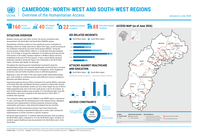
Country: Cameroon Source: UN Office for the Coordination of Humanitarian Affairs Please refer to the attached Infographic.
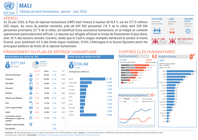
Country: Mali Source: UN Office for the Coordination of Humanitarian Affairs Please refer to the attached Infographic.
Mali : Tableau de bord humanitaire (Janvier – Juin 2026) Read More »
Country: Sudan Source: Solidarités International Please refer to the attached file. As the Sudanese crisis’ front lines continue to shift, over 33.7 million people are now in need of assistance, far exceeding the funds currently available for humanitarian responses (OCHA, July 2026). Especially across the Darfurs and Kordofans, needs continue to grow and NGOs need to plan interventions within these financial constraints, particularly for WASH responses. Solidarités International (SI) is proactively adapting its activities and areas of intervention to provide support to the most vulnerable internally displaced persons (IDPs), host communities, and returnees. This newsletter will focus on: Opening new areas of intervention in East Darfur and West Kordofan Market Support and Cash and Voucher Assistance (CVA) across Sudan SI’s response to the African Horse Sickness epidemic in Tawila Restoring dignity through accessible sanitation in Al Jazira State
Solidarités International Newsletter – August 2026 – Sudan Mission Read More »
Country: Venezuela (Bolivarian Republic of) Source: Association of Medical Doctors of Asia Please refer to the attached file. On 9 August, AMDA dispatched a Japanese nurse for the ongoing quake response efforts in Venezuela. Venezuela suffered extensive damage following two earthquakes measuring 7.2 and 7.5 in magnitude that struck in succession on 24 June 2026. According to the United Nations Office for the Coordination of Humanitarian Affairs (UNOCHA), the earthquakes have claimed 5,546 lives and injured 16,740 people. More than 1,500 aftershocks have also been recorded in the affected areas, as of 31 July. For more than a month, AMDA has been providing medical support in Caraballeda, La Guaira, one of the areas hardest hit by the earthquakes, where numerous buildings collapsed. Following the conclusion of activities by AMDA’s Japanese doctor and nurse on 31 July, the AMDA team, comprising local medical professionals and coordinators, continued to provide care at a temporary clinic in Caraballeda, with local volunteers and other organizations supporting the affected community. Among those who visited the clinic between 27-30 July was a mother who brought her baby in, stating that she was concerned about her child’s cough and diarrhea. The doctors reassured her that symptoms were nothing to worry about after examining the infant. There was also a patient with severe insect bites stemming from sleeping outdoors after losing one’s house. On the afternoon of 30 July, the team met with His Excellency Yasushi Sato, Ambassador Extraordinary and Plenipotentiary of Japan to Venezuela, at the Ambassador’s official residence. During the meeting, they reported on AMDA’s activities to date, the situation on the ground and plans for future assistance. On 31 July, 208 patients (well above the usual number) visited the temporary clinic, including 127 who received dental care at a special dental clinic set up that day. After the weekend, the clinic returned to its regular schedule on 3 August, seeing 74 patients that day, 37 on 4 August, and 93 on 5 August. Respiratory conditions and symptoms, including cough, bronchospasm, and bronchitis, were particularly common. There were also cases in which chronic conditions such as hypertension and diabetes had worsened. A patient with suspected cholecystitis was referred to a nearby hospital for further evaluation and treatment. Although numerous natural disasters have been occurring in different locations around the world, AMDA will continue doing what it can to save those affected by them.
AMDA Emergency Relief #6: Earthquakes in Venezuela – 10 August 2026 Read More »
Country: Colombia Source: Direct Relief A 7.4-magnitude earthquake has struck western Colombia, causing severe damage and casualties. Direct Relief is monitoring health needs and prepping medical aid. Update at 1:30 p.m. PST: Colombia has declared a national emergency following the 7.4-magnitude earthquake, according to the BBC. President Abelardo De La Espriella said at least 111 people have died and 87 are injured. These numbers are expected to continue to rise. Alejandro Eder, the mayor of Cali, said that 32 buildings have collapsed, including a significant portion of a hospital. A 7.4-magnitude earthquake reverberated through Colombia today, the largest earthquake to impact the country in a decade, according to the Associated Press. The earthquake shook the country at 7:34 a.m. local time on Monday, and the epicenter was recorded about three miles outside of San José del Palmar, a town in western Colombia with a population of about 5,000 people. Shaking was felt in major cities, including Bogota and Cali. Aftershocks were recorded at 2.8- and 4.8-magnitude, and the series of quakes has forced thousands to evacuate their homes as buildings immediately toppled over, crushing people beneath the debris. At least 80 people have died, though that number may rise as damage assessments continue. Thousands more are expected to be affected as dozens of buildings and structures are being reported to have severe damage. National news outlets have shared that people were running from debris and finding safe places to take shelter as buildings shook. The Colombian Geological Service reported that the quake had a depth of 107 kilometers (66 miles) and affected neighboring cities such as El Cairo and El Aguila. The USGS reported that a significant portion of the areas surrounding the earthquake are at risk of landslides and flooding. The disaster follows a 5.5-magnitude earthquake in the Pacific just seven hours before, and affected three cities in Ecuador, Colombia’s neighbor. Stipo, Peru, also experienced a 4.6-magnitude earthquake nearly a day before. Direct Relief Monitoring Health Needs in Colombia Direct Relief is monitoring medical needs in the region and was in communication with local and regional organizations on Monday to assess immediate health requests. The organization maintains emergency medicines commonly requested during earthquake events, including wound care, surgical supplies, antibiotics, field medic packs to equip first responders and search and rescue crews, and more. Direct Relief has an extensive history of medical support in South America and the Caribbean, and the organization has sent more than $27 million in medical aid to health organizations in Colombia since 2015. Colombia’s earthquake comes less than two months after two devastating earthquakes rattled neighboring Venezuela, causing major destruction and resulting in mass casualties. Medical support from Direct Relief is ongoing for that response, and the organization is working to help meet immediate health needs and strengthen the country’s health system over the long term. Earthquakes and Health Risks Major earthquakes of 7.0-magnitude or higher cause severe impacts to regional health. Crush injuries and physical traumas are widespread during the event, aftershocks, and recovery period. Local health systems are often overwhelmed by the influx of injuries, and chronic conditions and other health issues can go unmanaged, quickly spiraling into health crises. Displacement after an earthquake often causes exposure, waterborne illnesses, infectious diseases, and nutritional impacts, as people are crowded together in unsanitary conditions and separated from healthcare access and their regular food sources. Earthquakes can cause a cascade of medical issues, including acute traumas and crush injuries from falling debris during the initial event, aftershocks, and during rescue and recovery efforts. Local health systems can be strained by an influx of trauma patients to emergency rooms, even as others can end up in medical crisis from unmanaged chronic conditions and other health needs neglected during the immediate crisis. Massive displacement can also cause health risks, including exposure, waterborne illnesses, and more. Direct Relief will continue to respond to requests in the region as they become known.
Colombia Earthquake: Direct Relief Mobilizing Medical Aid for Immediate Health Needs Read More »
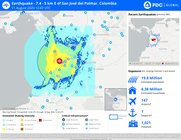
Country: Colombia Source: Pacific Disaster Center Please refer to the attached Map.
Earthquake – 7.4 – 5 km E of San José del Palmar, Colombia – 11 August 2026 12:47 UTC Read More »
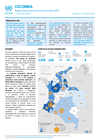
Country: Colombia Sources: 3iS, El Equipo Humanitario País Colombia, UN Office for the Coordination of Humanitarian Affairs Please refer to the attached file. Entre enero y junio de 2026, se registraron 248 eventos de restricciones al acceso humanitario en Colombia (incluidos 188 barreras de acceso y 72 incidentes directos documentados), lo que representa un incremento del 9,7% respecto al mismo período de 2025 (226 eventos). La concentración regional del impacto se evidenció principalmente en las regiones del Pacífico (46,4%) y el Noroccidente (20,6%). A nivel departamental, los más afectados fueron Cauca (72 eventos), Antioquia (26), Norte de Santander (23), Nariño (22) y Bolívar (12). Afectación poblacional y territorial: Aproximadamente 539.106 personas sufrieron las consecuencias de las restricciones de acceso en 24 departamentos y 176 municipios —un incremento del 8% en personas afectadas frente al mismo período de 2025—, siendo Antioquia, Cauca, Chocó, Nariño y Norte de Santander los departamentos con mayor número de personas e impactos acumulados. El 43% de los eventos afectó directamente a la población civil mediante restricciones a la movilidad y barreras de acceso a servicios y asistencia básica (Categoría 9: 106 eventos). En cuanto a los actores humanitarios y la Misión Médica, las mayores barreras provinieron de amenazas y actos de violencia (Categoría 5: 18%), interferencias e impedimentos a la movilidad de agencias/bienes (Categoría 3: 17%) y operaciones militares u hostilidades (Categoría 4: 13,7%).
Colombia: Balance Semestral de Acceso Humanitario 2026, Enero a junio de 2026 Read More »
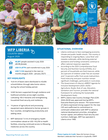
Country: Liberia Source: World Food Programme Please refer to the attached file.
WFP Liberia Country Brief, August 2026 Read More »
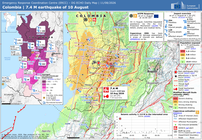
Country: Colombia Source: European Commission’s Directorate-General for European Civil Protection and Humanitarian Aid Operations Please refer to the attached Map.
Colombia | 7.4 M earthquake of 10 August – DG ECHO Daily Map | 11/08/2026 Read More »