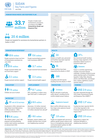
Sudan Key Facts and Figures (July 2026)
Country: Sudan Source: UN Office for the Coordination of Humanitarian Affairs Please refer to the attached Infographic.
Sudan Key Facts and Figures (July 2026) Read More »

Country: Sudan Source: UN Office for the Coordination of Humanitarian Affairs Please refer to the attached Infographic.
Sudan Key Facts and Figures (July 2026) Read More »
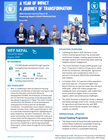
Country: Nepal Source: World Food Programme Please refer to the attached file.
WFP Nepal Country Brief, August 2026 Read More »
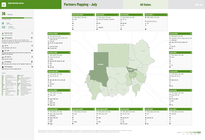
Country: Sudan Source: Nutrition Cluster Please refer to the attached file.
Sudan Nutrition Sector – Partner Presence – July 2026 Read More »
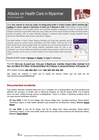
Country: Myanmar Source: Insecurity Insight Please refer to the attached file. Using data collected by Insecurity Insight, the Safeguarding Health in Conflict Coalition (SHCC) identified 259 incidents of violence against or obstruction of health care in Myanmar in 2025. Health facilities, including clinics, hospitals, pharmacies, and rural health centers, were reportedly damaged or destroyed on at least 110 occasions. Most damage or destruction involved MAF military jets using rockets and cannons that hit facilities and killed and injured health workers and patients. MAF air strikes frequently damaged or destroyed health facilities, including makeshift clinics operated by CDM-affiliated health workers, particularly in Sagaing. Five health facilities in Kachin, Kayah, Magway, Mandalay and Ta’ang were reportedly used by opposition groups as bunkers during confrontations with MAF soldiers. These are five of the rarely reported cases where damaged health care buildings were not functioning facilities at the time and therefore had lost their special protection guaranteed under the rules of war. Combatants’ use of former health care buildings as bunkers reduces access to health care for the civilian population and as such is a further example of how violence affects health care during conflict. Documented incidents The publicly reported incidents below are not a complete nor a representative list of all incidents that affected the provision of health care in Myanmar between 22 July-04 August 2026. The incidents have not been verified through ground investigations. There is a delay in reporting incidents due to our open-source verification protocol. 20 July 2026: In Sin Pu Hnit village, Myo Haung village tract, Launglon township, Dawei district, Tanintharyi region, a male health assistant was arrested by the Myanmar military. Source: Dawei Watch 27 July 2026: In Aye Ka Ni village, Aye Ka Ni village tract, Yebyu township, Dawei district, Tanintharyi region, a sub-rural health centre and two houses were torched by the Myanmar military. Source: Dawei Watch Our work in the media A recent Guardian feature on Myanmar’s health system drew on Insecurity Insight’s data to document the scale of attacks on health since the 2021 military coup. The article highlights how violence against health workers and facilities has contributed to the country’s deepening health crisis, underscoring the importance of systematic monitoring to inform public understanding and humanitarian advocacy.
Attacks on Health Care in Myanmar: 22 July – 04 August 2026 Read More »
Country: Colombia Source: World Vision Death toll continues to rise, with more than 180 people confirmed dead and 1,300 injured, as search efforts for missing people remain underway World Vision reports that children amongst most vulnerable Communications and access to the hardest-hit areas remain challenging World Vision is identifying urgent needs, with support focused on shelter, safe water, hygiene, and essential items for children and families World Vision are carrying out rapid emergency assessments following the powerful 7.4-magnitude earthquake that struck Colombia on 10 August. World Vison is working with local authorities and organisations to assess needs, identify humanitarian access routes, and determine where assistance is most urgently required. The child-focused humanitarian organisation warns that children are most at risk following the deadly earthquake, which was felt across several major cities, including Bogotá, Manizales, Pereira and Cali, with its epicentre located in the department of Chocó. “Children are particularly vulnerable when emergencies disrupt homes, essential services, and the systems that normally protect them,” says Peter Gape, Bi-national Director for Colombia and Venezuela. “Ensuring their safety and wellbeing will remain central to our response. Our teams are working directly with communities, authorities and humanitarian partners to understand where the greatest needs are and how assistance can reach families safely and quickly.” World Vision is focusing on the immediate needs of children and families. Planned assistance includes emergency shelter and essential household items such as tarpaulins, tools, blankets, sleeping mats, mosquito nets, kitchen utensils and lamps, along with water filters, hygiene kits, purification tablets and community water storage solutions to address water, sanitation and hygiene (WASH) needs. World Vision also plans to establish Child-Friendly Spaces to provide safe environments and activities for children and adolescents affected by the emergency, alongside ready-to-eat food for the most vulnerable. The full impact of the earthquake is still unfolding, with several areas remaining without electricity and water, and communication systems are disrupted and overwhelmed. The earthquake, which had a depth of 88 kilometres, was felt as far as Ecuador and Panama, where metro service was suspended as a precaution following the seismic alert. As the scale of the disaster becomes clearer, attention is turning to the immediate needs of children and families affected. World Vision New Zealand National Director, TJ Grant, says, “New Zealanders know too well how suddenly an earthquake can turn lives upside down. Our teams are already on the ground, working with local partners to understand where the needs are greatest and help ensure children and families get the support they urgently need.” ENDS For more information, or to arrange an interview with a spokesperson in Colombia, contact: Ashley Miln | Media and PR Advisor, World Vision Email: ashley.miln@worldvision.org.nz +64-204-051-3769
World Vision rapidly assessing emergency needs following powerful Colombia earthquake Read More »
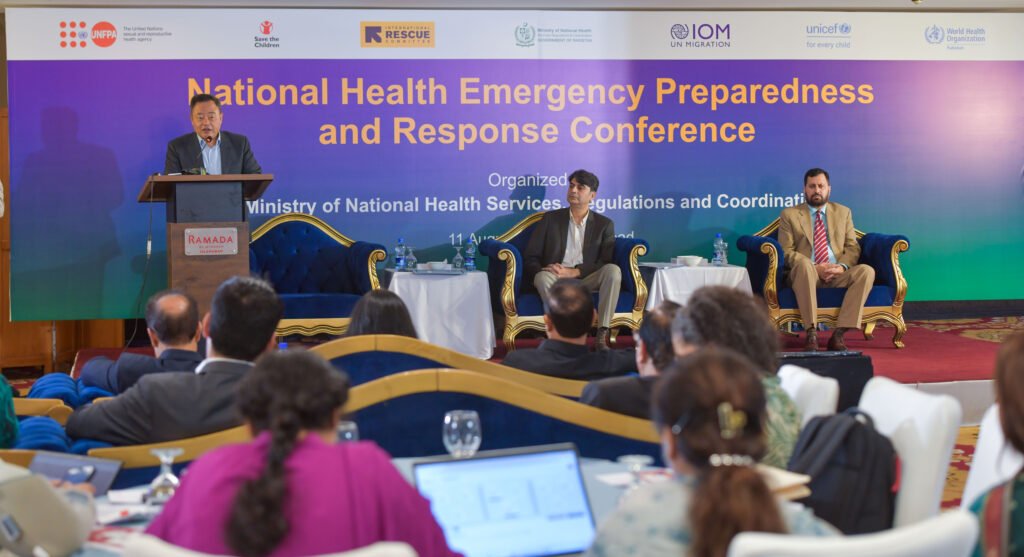
Country: Pakistan Source: World Health Organization Please refer to the attached file. Original publication on WHO Pakistan website. 12 August 2026, Islamabad, Pakistan – As the health sector stands ready to activate the Monsoon and Flood Contingency Plan 2026 to assist 1.8 million people in high-risk areas, the World Health Organization (WHO) joined the Government of Pakistan, provincial authorities and partners in a national conference to strengthen health emergency preparedness and response to climate-driven hazards over the long term Under the leadership of the Ministry of National Health Services, Regulations and Coordination, the objective of the National Health Emergency Preparedness and Response Conference was to reinforce short- and long-term emergency preparedness, health sector coordination, timely and efficient data sharing for evidence-based decision-making, resource optimization, and the uninterrupted delivery of essential health services during emergencies, particularly for the most vulnerable, regardless of social or economic status. The conference was organized by the Ministry of National Health Services, Regulations and Coordination and supported by WHO – as co-chair of the Health Sector –, the United Nations Population Fund (UNFPA), the International Organization for Migration (IOM), United Nations Children’s Fund (UNICEF), the International Rescue Committee, and Save the Children. “Pakistan’s geographical location means that we are among the first to experience the effects of climate change. From Gilgit all the way down along the banks of the Indus River we can see an entire belt being affected. It is estimated that approximately 60 million people are affected by hazards associated with climate change across this entire area. What we need to discuss today is what our preparedness should look like before we have to respond. In this context marked by climate change, how we cater to and protect vulnerable populations is extremely important,” said Federal Minister of State for Health Dr Malik Mukhtar Ahmad Bharath. According to the World Risk Report 2024, Pakistan is among the 10 countries most vulnerable to climate change and other overlapping crisis factors, including extreme weather events such as heatwaves, floods that lead to an increase in waterborne diseases, droughts, and air pollution. The Global Climate Index 2026 also ranked Pakistan among the 15 countries most affected by extreme weather events during the period 1995–2024. “The evidence is clear. Preparedness and timely health emergency responses save lives. In a context marked by increasing climate-driven natural disasters, investing in preparedness and a science-based health emergency response is not only the right thing to do to protect lives; it is also the smartest and most cost-effective decision,” said WHO Representative in Pakistan Dr Luo Dapeng. “When we are able to ensure predictable funding, strong leadership and coordination, and timely science-based interventions, we are in a better position to save lives while also reducing economic costs, since a late intervention is usually more expensive and less effective intervention and takes a greater toll on human lives.” About WHO Founded in 1948, the World Health Organization (WHO) is the United Nations agency that connects nations, partners and people to promote health, keep the world safe and serve the vulnerable. We work with over 190 Member States across more than 150 locations to ensure everyone, everywhere, can attain the highest level of health. WHO has maintained a permanent presence in Pakistan since its country office was established in 1960. For more information, visit WHO Pakistan website. For additional information, please contact: José Ignacio Martín Galán, Head of Communications, WHO Pakistan, jomartin@who.int Maryam Yunus, National Professional Officer – Communications, WHO Pakistan, yunusm@who.int
![ukraine: rehabilitation technical working group (rtwg) meeting minutes, july 17, 2026 [en/uk]](https://blhlfoundation.org/wp-content/uploads/2026/08/96bc3a0a-e283-483e-b2f9-1a4abe9d8083-2oUoxh.png "Ukraine: Rehabilitation Technical Working Group (RTWG) - Meeting Minutes, July 17, 2026 [EN/UK]")
Country: Ukraine Source: World Health Organization Please refer to the attached files. Chairs: World Health Organization (WHO), Momentum Wheels for Humanity Ukraine (MWH) Participants: Momentum Wheels for Humanity, GIZ, CF ‘ZDOROVI’, MSF OCB, Central Project Management Agency (CPVA), NGO ‘Fight for Right’, National Committee of Red Cross of Ukraine, CF “Save Ukraine”, NGO “SHDC”, International Medical Corps, Direct Relief, IREX, Enabel, MEHAD, , Care Ukraine, Ukraine-Norwegian project, Soleterre, Ukrainian Society of Ergotherapist, Ukrainian Association of Physical Therapy, WHO and others Agenda: • Introduction of new partners (If any) • Update on supporting the enhancement of OT bachelor’s education programs (Enabel) • Partner updates • AOB
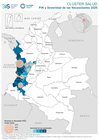
Country: Colombia Sources: 3iS, Pan American Health Organization, World Health Organization Please refer to the attached file. Clúster Salud Colombia – PiN y Severidad 2026, datos de antes del terremoto. Producido por 3iS a fecha de 12 de agosto de 2026.
Clúster Salud Colombia – PiN y Severidad 2026 (pre-terremoto) Read More »
Country: Colombia Source: World Food Programme Please refer to the attached file.
WFP Colombia External Situation Report, 12 August 2026 Read More »
![dignity kit guidance note for sudan [en/ar]](https://blhlfoundation.org/wp-content/uploads/2026/08/519236b6-43ea-4d8d-836f-277515610cf5-wzQtOI.png "Dignity Kit Guidance Note for Sudan [EN/AR]")
Country: Sudan Sources: Gender Based Violence Area of Responsibility, United Nations Population Fund Please refer to the attached files. The GBV Area of Responsibility (AoR) in Sudan led the development of this guidance, with critical technical and operational contributions from the Dignity Kit Task Force. This collaborative effort brought together key partners, including the International Rescue Committee, International Medical Corps, CARE International, NADA El Azar, UNICEF, UNFPA, and the Inclusion Task Force – HelpAge International. Their collective expertise and sustained engagement were instrumental in ensuring the relevance, quality, and applicability of this document. The development of this guidance was deeply informed by the perspectives and lived realities of women and girls across Sudan, as well as the communities and GBV service providers who support them. Insights gathered through their active engagement formed the foundation for both the design and content of these materials, ensuring alignment with existing GBV response and prevention interventions. By prioritizing their voices, this guidance reinforces that dignity kits are not standalone items, but an integral component of GBV service delivery supporting safe access to services, enhancing outreach, and contributing to the overall well-being and protection of those affected. In doing so, dignity kits are designed to be not only practical and culturally appropriate, but also responsive to the complex and evolving needs of the populations they serve. By placing women and girls at the center of this process, this guidance reaffirms a commitment to upholding their dignity, safety, and rights, while supporting service providers to deliver assistance that is both respectful and empowering.
Dignity Kit Guidance Note for Sudan [EN/AR] Read More »