Uncategorized

beyond emergency care: why sudan's humanitarian response must also protect essential health services

Beyond Emergency Care: Why Sudan’s Humanitarian Response Must Also Protect Essential Health Services

Country: Sudan Source: Qatar Charity Please refer to the attached file. More than three years into Sudan’s war, the humanitarian response has rightly focused on the basics of survival: food, shelter, water, and emergency medical care. But another crisis is unfolding quietly alongside it, one that gets far less attention: the slow collapse of the essential health services people rely on every day. Across the country, millions of people are losing access to the essential healthcare services that sustain health and everyday life. Children born with entirely treatable conditions are waiting months, sometimes years, for surgery; cancer patients see their treatment interrupted mid-course; people with kidney disease can’t reliably get dialysis; pregnant women travel long distances for a functioning maternity ward, and the hospitals still operational are stretched thin, overwhelmed by demand, short on medicine and staffed by health workers working under extreme pressure. The World Health Organization calls Sudan one of the largest and most complex humanitarian emergencies in the world right now: an estimated 33.7 million people require humanitarian assistance, including 21 million who need health assistance, while the health system keeps deteriorating under the weight of conflict, mass displacement, disease outbreaks, and funding that never quite covers the need. In many conflict-affected areas, most health facilities have stopped functioning, leaving entire communities without even basic care. The fallout goes well beyond emergency medicine. When people think of humanitarian crises, they usually picture trauma care: treating war wounds, responding to outbreaks. But long and drawn-out crises also break the routine health services that quietly prevent disability, manage chronic illness, and stop avoidable deaths. Sudan, now in its third year of conflict, is entering this second, less visible emergency. Children make the case most starkly. A child born with a cleft lip, a congenital urological problem, or another surgically correctable condition doesn’t have the luxury of waiting for the conflict to end. Every month of delay narrows the window for recovery, raises the risk of lifelong disability and developmental harm, and adds another burden onto families already stretched thin by displacement and economic hardship. Some humanitarian organizations are responding by folding specialized medical care into their broader relief work. On a recent medical mission, Qatar Charity sent in a multidisciplinary team of pediatric specialists who performed dozens of surgeries for children with congenital and complex conditions. For many of these families, the surgery offered renewed hope after months of waiting and interrupted care. Qatar Charity has also helped deliver specialized medicines and supplies for kidney disease and cancer patients, keeping treatment going for thousands who would otherwise have seen it interrupted and has supplied intravenous solutions and essential medicines to hospitals operating under enormous strain, alongside its wider work on water, sanitation, and other basic services. These interventions are saving lives and helping preserve essential health services at a time when Sudan’s health system is under unprecedented strain. Yet humanitarian organizations cannot, and were never intended to, replace a functioning national health system. Medical missions and emergency supplies provide vital lifelines, but they cannot substitute for resilient hospitals, trained health workers, reliable supply chains and accessible primary healthcare. Without greater investment in protecting these systems, Sudan risks emerging from today’s humanitarian crisis with a generation facing preventable illness, disability and diminished prospects for recovery. Protecting essential health services must therefore become a central pillar of Sudan’s humanitarian response. Alongside food, water, shelter and emergency medical assistance, greater attention must be given to sustaining maternal and child health services, chronic disease management, specialized surgery, rehabilitation and access to essential medicines. Preserving these services is not only about meeting immediate health needs, it is also about safeguarding the country’s capacity to recover when the conflict ends. *End*
Beyond Emergency Care: Why Sudan’s Humanitarian Response Must Also Protect Essential Health Services Read More »

colombia: análisis preliminar de daños e impactos potenciales del terremoto en los medios de vida agropecuarios. 17 de agosto de 2026

Colombia: Análisis preliminar de daños e impactos potenciales del terremoto en los medios de vida agropecuarios. 17 de agosto de 2026

Country: Colombia Source: Food and Agriculture Organization of the United Nations Please refer to the attached file. Análisis preliminar de la FAO sobre los daños e impactos potenciales del sismo de 7,4 Mw del 10 de agosto de 2026 en los medios de vida agropecuarios de Colombia. Incluye el análisis de afectación por intensidad, los activos productivos expuestos, las brechas prioritarias de respuesta y recomendaciones estratégicas.

Colombia: Análisis preliminar de daños e impactos potenciales del terremoto en los medios de vida agropecuarios. 17 de agosto de 2026 Read More »

colombia: flash update 002 confinamientos, desplazamientos masivos, restricciones al acceso y riesgos para la población civil en los municipios de el bagre, segovia, remedios (antioquia) y santa rosa del sur (bolívar), 13 de agosto de 2026

Colombia: Flash Update 002 – Confinamientos, desplazamientos masivos, restricciones al acceso y riesgos para la población civil en los municipios de El Bagre, Segovia, Remedios (Antioquia) y Santa Rosa del Sur (Bolívar), 13 de agosto de 2026

Country: Colombia Sources: El Equipo Humanitario País Colombia, UN Office for the Coordination of Humanitarian Affairs Please refer to the attached file. La situación humanitaria continúa agravándose. Entre enero y julio de 2026, se han reportado 1.229 personas desplazadas (481 familias), 7.996 personas confinadas (3.198 familias) y 2.328 personas con restricciones a la movilidad, pertenecientes a cinco comunidades indígenas y seis afrocolombianas. Asimismo, 1.332 niños, niñas y adolescentes resultaron afectados por limitaciones en el acceso a la educación, servicios esenciales, medios de vida y mecanismos de protección, particularmente en zonas rurales dispersas y de difícil acceso, mientras que cinco comunidades indígenas y seis comunidades afrocolombianas resultaron afectadas, lo que refleja una tendencia sostenida al agravamiento de la crisis en la zona limítrofe entre Antioquia y Bolívar. Sumado a lo anterior, la población civil se encuentra expuesta a múltiples riesgos de protección, incluyendo reclutamiento, uso y utilización de niños, niñas y adolescentes, amenazas, afectaciones por minas antipersonal (MAP) y otros artefactos explosivos improvisados (AEI) y el uso de vehículos aéreos no tripulados (VANT) o drones con capacidad de generar explosiones no controladas.

Colombia: Flash Update 002 – Confinamientos, desplazamientos masivos, restricciones al acceso y riesgos para la población civil en los municipios de El Bagre, Segovia, Remedios (Antioquia) y Santa Rosa del Sur (Bolívar), 13 de agosto de 2026 Read More »

burkina faso: بيان صحفي : اليوم العالمي للعمل الانساني 2026 : مع تصاعد فتك النزاعات وظهور تقنيات حرب جديدة تزيد من مخاطرها على الماليين، يدعو مكتب الأمم المتحدة لتنسيق الشؤون الانسانية إلى تعزيز حماية المدنيين والعاملين في المجال الانساني في غرب ووسط أفريقيا

Burkina Faso: بيان صحفي : اليوم العالمي للعمل الانساني 2026 : مع تصاعد فتك النزاعات وظهور تقنيات حرب جديدة تزيد من مخاطرها على الماليين، يدعو مكتب الأمم المتحدة لتنسيق الشؤون الانسانية إلى تعزيز حماية المدنيين والعاملين في المجال الانساني في غرب ووسط أفريقيا

Countries: Burkina Faso, Benin, Cameroon, Central African Republic, Chad, Congo, Côte d’Ivoire, Democratic Republic of the Congo, Mali, Niger, Nigeria, Togo Source: UN Office for the Coordination of Humanitarian Affairs Please refer to the attached file.

Burkina Faso: بيان صحفي : اليوم العالمي للعمل الانساني 2026 : مع تصاعد فتك النزاعات وظهور تقنيات حرب جديدة تزيد من مخاطرها على الماليين، يدعو مكتب الأمم المتحدة لتنسيق الشؤون الانسانية إلى تعزيز حماية المدنيين والعاملين في المجال الانساني في غرب ووسط أفريقيا Read More »

burkina faso: communique de presse: journée mondiale de l'aide humanitaire 2026:alors que les conflits deviennent plus meurtriers et que les nouvelles technologies de guerre exposent des millions de personnes à des risques accrus, ocha appelle à renforcer la protection

Burkina Faso: COMMUNIQUE DE PRESSE: Journée mondiale de l’aide humanitaire 2026:Alors que les conflits deviennent plus meurtriers et que les nouvelles technologies de guerre exposent des millions de personnes à des risques accrus, OCHA appelle à renforcer la protection

Countries: Burkina Faso, Benin, Cameroon, Central African Republic, Chad, Congo, Côte d’Ivoire, Democratic Republic of the Congo, Mali, Niger, Nigeria, Togo Source: UN Office for the Coordination of Humanitarian Affairs Please refer to the attached file.

Burkina Faso: COMMUNIQUE DE PRESSE: Journée mondiale de l’aide humanitaire 2026:Alors que les conflits deviennent plus meurtriers et que les nouvelles technologies de guerre exposent des millions de personnes à des risques accrus, OCHA appelle à renforcer la protection Read More »

flash update: no. 1 – flooding in ayeyarwady and kayin, myanmar – 19 august 2026

Flash Update: No. 1 – Flooding in Ayeyarwady and Kayin, Myanmar – 19 August 2026

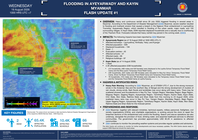
Country: Myanmar Source: ASEAN Coordinating Centre for Humanitarian Assistance Please refer to the attached file. OVERVIEW: Heavy and continuous rainfall since 30 July 2026 triggered flooding in several areas in Myanmar. According to the Department of Disaster Management (DDM) Myanmar, severe weather resulted to flooding and riverbank erosion that caused a breach in the Ngawun River embankment in Laymyethna Township, Ayeyarwady Region, which resulted in flooding of five urban wards, major roads, and 150 surrounding villages. In Kayin State, DDM reported displaced households and a casualty due to overflowing of the Thanlwin River. Forecasts indicate that heavy rainfall may persist in the coming week (DMH). IMPACTS: The following impacts have been reported by DDM Myanmar: Ayeyarwady Region (as of 18 August 2026 at 1630 HRS UTC+7) Affected townships: Laymyethna, Hinthada, Yekyi, and Kyangin 63K affected population 15K displaced households 1 dead 45 evacuation centres 47 affected schools 66 affected roads 97 religious buildings Kayin State (as of 14 August 2026) 1 dead 2.4K affected population (538 households) 212 households, (485 males and 520 females) were displaced to the Leytha School Temporary Flood Relief Camp and the Moe Leylon Temporary Flood Relief Camp. 248 households, (523 males and 598 females) were relocated to Mya Kyi Hmun Temporary Flood Relief Camp, Shwe Yai Myaw Temporary Flood Relief Camp and Temporary Flood Relief Camp. Data collection and assessments are ongoing. HAZARDS & ANTIPICATED RISKS: Heavy Rain Warning: According to DMH Myanmar, as of 07000H UTC+7, due to the strong monsoon winds in the Andaman Sea and the southern Bay of Bengal and the strong development of clusters of rain clouds, strong winds, flash floods and landslides may occur along with heavy rains. There may be scattered showers and thunderstorms in Nay Pyi Taw, Yangon Region, Mandalay Region, Bago Region, Magway Region, Sagaing Region, Ayeyarwady Region, Tanintharyi Region, Kachin State, Kayin State, Chin State, Mon State, Rakhine State and Shan State from this morning to 23 August 2026, while scattered heavy rains may occur in Nay Pyi Taw, Yangon Region, Mandalay Region, Bago Region, Upper Sagaing Region, Ayeyarwady Region, Tanintharyi Region, Kachin State, Kayin State, Mon State, Rakhine State and Shan State for this forecast period. PREPAREDNESS AND RESPONSE: DDM Myanmar, together with relevant ministries, technical experts, military personnel, firefighters, civil society organisations (CSOs), and charitable organisations, is working around the clock to repair the breached sections of the embankment and control the flooding. Search and rescue operations are also underway, alongside the provision of food, drinking water, and essential healthcare services to affected communities. The Government of Myanmar has provided approximately USD 85.2K in assistance to affected communities. DMH continues to monitor the prevailing weather systems and provides regular updates and advisories. The AHA Centre will continue to monitor for further developments and issue necessary updates. The AHA Centre stands ready to support DDM Myanmar should the need arises. DATA SOURCES ASEAN Disaster Monitoring & Response System (DMRS), ASEAN Disaster Information Network (ADINet); ASEAN Specialised Meteorological Centre (ASMC); Myanmar: DDM, DMH; Verified news media agencies

Flash Update: No. 1 – Flooding in Ayeyarwady and Kayin, Myanmar – 19 August 2026 Read More »

disaster management reference handbook (august 2026) republic of fiji august 2026

Disaster Management Reference Handbook (August 2026) – Republic of Fiji – August 2026

Country: Fiji Source: Center for Excellence in Disaster Management and Humanitarian Assistance Please refer to the attached file. EXECUTIVE SUMMARY The Republic of Fiji (hereafter Fiji) is a diplomatic, economic, and logistics hub in the South Pacific. It hosts many international organizations’ regional and sub-regional headquarters. However, its archipelagic geography and complex socioeconomic landscape create significant vulnerabilities to natural hazard impacts. Disasters routinely damage the critical coastal tourism sector, wipe out subsistence agricultural yields, and force an already over-leveraged state to finance recovery operations. While the country holds upper-middleincome status, national averages mask severe localized hardship, with nearly 30% of Fijians living below the basic needs poverty line. Informal urban squatter settlements are exceptionally prone to flooding and waterborne disease outbreaks due to insufficient municipal infrastructure. Meanwhile, remote maritime and rural farming communities frequently experience cyclonic and rainfall-driven damage to their livelihoods. For responders, a primary operating challenge is logistical access. Damaged unsealed rural roads, washedout bridges, and limited domestic shipping capacity sever supply lines and make the rapid deployment of route clearance and maritime assets essential to reaching isolated populations. Fiji manages crises through one of the most mature, whole-of-society disaster frameworks in the Pacific Islands region. It was modernized by the National Disaster Risk Management Act (NDRMA) of 2024. This landmark legislation transitioned the country from a reactive emergency response model to a proactive disaster risk reduction (DRR) and resiliencefocused governance framework. Disaster management (DM) is multi-tiered but strictly civilian-led. Strategic policy formulation and centralized coordination originate in Suva under the National Disaster Risk Management Council (NDRMC), under leadership from the Ministry for Rural and Maritime Development and Disaster Management (MRMDDM), and the National 8 Disaster Risk Management Office (NDRMO). Operational execution relies heavily on a decentralized network of Divisional Commissioners, Provincial Administrators, District Officers, and local Community Disaster Risk Management Committees (CDRMC) to manage the crucial first hours of a crisis. Because civilian logistics commonly cannot meet the demands of an emergency due to the country’s dispersed geography, civil-military coordination is a key component of the national response architecture. The Republic of Fiji Military Forces (RFMF) serves as a critical operational partner, providing the ground logistics, engineering, and maritime capabilities required to restore mobility. When domestic capacities are exhausted, Fiji integrates international assistance through formal diplomatic channels, coordinated by the Ministry of Foreign Affairs in close coordination with the NDRMO. To manage the influx of external assistance efficiently, the government utilizes the Single Window International Facilitation Team (SWIFT) to expedite customs clearances and route international responders directly into the government-led Fiji Cluster System. Under the NDRMA, international humanitarian actors seeking to work in the country must register under the formal Humanitarian Actors Registry and Volunteer Organisations Registry to ensure legal recognition and regulatory compliance. This international integration is further strengthened by Pacific regional humanitarian coordination efforts. Successfully integrating into this sophisticated national and regional response architecture requires comprehensive preparation by incoming responders. To facilitate this understanding, this Fiji Disaster Management Reference Handbook serves as a foundational planning guide. It provides baseline information on Fiji’s hazard profile, socioeconomic vulnerabilities, critical infrastructure capabilities, and multi-tiered governance structures.

Disaster Management Reference Handbook (August 2026) – Republic of Fiji – August 2026 Read More »

wfp algeria country brief, august 2026 (reporting period: july 2026)

WFP Algeria Country Brief, August 2026 (Reporting Period: July 2026)

Country: Algeria Source: World Food Programme Please refer to the attached file. IN NUMBERS 133,672 rations provided in July 2,227 mt food distributed in July USD 180,987 cash transferred in July USD 12.3 M required in the next six months (August 2026 – January 2027) KEY HIGHLIGHTS WFP faces imminent funding constraints, with a pipeline break expected by September 2026, threatening the continuity of general food assistance. Urgent donor support is needed to sustain critical food and nutrition assistance. The distribution of Lipid-based Nutrient Supplements – Medium Quantity (LNS-MQ) for children aged 6-23 months and Multi-Nutrient Tablets (MNT) for pregnant and breastfeeding women and girls (PBWGs) under the malnutrition prevention programme could not be carried out during the reporting period due to a temporary delay in commodity procurement.

WFP Algeria Country Brief, August 2026 (Reporting Period: July 2026) Read More »

world humanitarian day: nearly one humanitarian worker detained every day as inso and protect humanitarians call for stronger protection and support

World Humanitarian Day: Nearly one humanitarian worker detained every day as INSO and Protect Humanitarians call for stronger protection and support

Country: World Sources: International NGO Safety Organisation, Protect Humanitarians Please refer to the attached file. New data highlights the rising threat of arrest and detention facing humanitarian workers, with locally recruited staff accounting for 88% of those affected. INSO and PH call for greater investment in prevention, Duty of Care, psychological and legal support for humanitarian workers and affected family members. Brussels, The Hague, 19 August 2026 — On World Humanitarian Day, the International NGO Safety Organisation (INSO) and Protect Humanitarians (PH) are drawing attention to the growing risks faced by humanitarian workers. In 2025 alone, 1,187 humanitarian workers were victims of major security incidents1, underscoring the increasingly dangerous environments in which humanitarian personnel operate. INSO’s Conflict and Humanitarian Data Centre (CHDC) recorded 959 incidents of arrest, detention or custodial confinement of humanitarian personnel by States between 2020 and June 2026, affecting more than 1,700 staff. Deprivation of liberty has become a major threat to humanitarian workers. While kidnapping has remained a persistent risk over the past decade, detention by State actors is an increasing concern in many operating environments. “I experienced arbitrary detention because of my humanitarian work. It was a traumatic experience. Attempts to intimidate humanitarian workers and force them to suspend their activities only validate their mission and strengthen their resolve. In the face of these injustices and the turmoil of today’s world, taking action is a duty. We need them. Let’s protect them.” – Humanitarian worker, arbitrarily detained for 19 months, and member of Protect Humanitarians’ Global Survivor Network. Unfortunately this experience is far from uncommon: “Our data shows that since January 2020, on average almost one humanitarian worker has been detained by State Authorities each day. This only includes countries INSO monitors and as such the true number is likely to be higher. Whilst the reasons for detention are diverse and not all are arbitrary, approximately a third of the detention incidents we analysed were directly related to the humanitarian activity of the detained individual, whether due to the enforcement of administrative impediments, attempted interference with programme implementation or the criminalisation of humanitarian action itself” – Anthony Neal, INSO Director of Policy, Advocacy & Communications “Humanitarian workers should never have to choose between helping civilians and protecting themselves. When they are detained or attacked, our responsibility does not end with calling for their release or condemning the attack. We must stand by them and their families before, during and after. Protecting humanitarians is protecting the lifeline to civilians in need.” – Olivier Vandecasteele, Founder and Director, Protect Humanitarians On World Humanitarian Day, INSO and Protect Humanitarians call on governments, donors and humanitarian organisations to make the protection and support of humanitarian personnel a concrete priority. Humanitarian action must not be criminalised or obstructed, and organisations must have the resources and systems necessary to prepare for serious incidents and support affected colleagues and their families. Strengthening physical protection and psychological safety Through a project funded by the Belgian Federal Public Service Foreign Affairs, Foreign Trade and Development Cooperation, INSO and PH are combining their complementary expertise to strengthen both the physical and psychological protection of humanitarian personnel. INSO contributes security data, analysis, crisis-management expertise and personal safety training, while Protect Humanitarians brings survivor-informed expertise in Mental Health and Psychosocial Support (MHPSS), legal support and institutional Duty of Care. Together, the organisations are delivering global activities including advocacy, knowledge sharing, direct psychological support and open-access training materials, while piloting tools in contexts such as Ukraine. INSO will develop and pilot a Stress Exposure Personal Safety Training (SEPST) course specifically designed for national and frontline staff, ensuring practical tools reach those most exposed to risk. Protect Humanitarians will work with local partners to strengthen their capacity to provide psychosocial support to humanitarians affected by detention and torture. The NGO is also developing a practical good practice handbook to strengthen support for humanitarian workers and their families before, during and after arbitrary detention. The partnership reflects a simple principle: without protected and supported humanitarian personnel, humanitarian assistance cannot be delivered to the people who depend on it. About INSO International NGO Safety Organisation (INSO) is an NGO founded to support NGO programming in high-risk countries. We support NGOs across 24 countries with access to standardised incident data, context-specific training, crisis management support, real-time safety information, and analysis and advice. We support NGOs at every level of their work but with one overarching goal: to help them safely stay and deliver aid to people in need. Learn more: https://ngosafety.org/ About Protect Humanitarians Protect Humanitarians is a survivor-led independent NGO advocating for better protection of humanitarian workers worldwide. We promote good practices in Duty of Care for staff and volunteers working on the frontlines. We provide Mental Health and Psychosocial Support (MHPSS) and legal advice to humanitarian personnel and NGOs. We advocate for justice alongside victims and survivors of incidents. Learn more: www.protecthumanitarians.org

World Humanitarian Day: Nearly one humanitarian worker detained every day as INSO and Protect Humanitarians call for stronger protection and support Read More »