
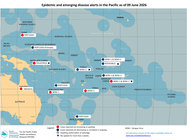

Please refer to the attached Map.
Highlights/updates since the last map was sent on PacNet on 02 June 2026:
Dengue
• New Caledonia: As of 03 June 2026, dengue transmission remains ongoing in New Caledonia, with 2,003 cases reported since 01 January 2026 and the most recent case dated 3 June 2026. DENV-1 remains the only circulating serotype. Transmission stays comparatively low in Greater Nouméa, where the Wolbachia programme continues to limit spread, while activity continues outside this area, with the highest incidence among children and adolescents, mainly in school settings. The red alert for DENV-1 remains in effect. – Sources: Alerte DASS – Épidémie de dengue (24 May 2026) shared with PPHSN Coordinating Body Focal point on 29 May 2026 and La dengue | Direction des Affaires Sanitaires et Sociales de Nouvelle-Calédonie accessed on 09 June 2026.
• Samoa: As of EpiWeek 22 (25–31 May 2026), dengue transmission continues in Samoa, with 157 new cases reported, representing a 6% decrease compared with the previous week, and three new hospital admissions with no new ICU admissions or deaths. DENV-1 (54) and DENV-2 (46%) continue to co-circulate, with most cases reported from Upolu (92%), followed by Savai‘i (7%) and the Manono and Apolima Islands (1%). Children under 15 years account for the majority of cases (73%). Since 01 January 2025, a cumulative total of 19,482 clinically diagnosed cases and 5,475 laboratory-confirmed cases have been reported, with nine dengue-related deaths to date, while public health measures continue to focus on community awareness, vector control and early healthcare seeking. The blue alert for DENV-1 and DENV-2 remains in effect. – Source: Dengue Fever Outbreak Situation Report in Samoa, Issue No. 59 accessed on 09 June 2026.
Measles
• Australia: Measles activity continues in Australia, with cases linked to imported infections and subsequent local transmission. On 05 June 2026, New South Wales Health issued a public exposure alert after a confirmed case from Queensland visited several locations across the Sydney central business district while infectious, with exposure locations published and updated regularly. A total of 49 measles cases has been confirmed in NSW since 1st January 2026. National surveillance data show that cases continue to occur across several jurisdictions, with New South Wales and Victoria reporting the highest numbers, predominantly among under-vaccinated individuals or those with unknown vaccination status, and authorities are urging the public to ensure they have received two doses of a measles-containing vaccine, particularly before overseas travel. The red alert for measles remains in effect. – Sources: Measles alert for Sydney Airport and Sydney CBD, NSW Health (5 June 2026) and National Communicable Disease Surveillance Dashboard accessed on 09 June 2026.
Pertussis/Whooping cough
• Guam: As of 08 June 2026, pertussis transmission continues in Guam, with 17 cases reported in 2026 to date, including one newly identified laboratory-confirmed case since 26 May 2026. Four cases have been previously or are currently hospitalised, and three cases have an identified epidemiological link. No pertussis-related deaths have been reported. Cases continue to affect a wide age range, with a notable proportion among unvaccinated or partially vaccinated individuals, and DPHSS continues to promote vaccination across all age groups, including through upcoming immunisation clinics, and to encourage early care-seeking for compatible symptoms. The red alert for pertussis remains in effect. – Sources: DPHSS Pertussis Update (8 June 2026) and Epi Reports | Epidemiology and Laboratory Capacity (ELC) Guam – DPHSS accessed on 09 June 2026.
• New Zealand: Pertussis activity in New Zealand continues as part of the ongoing national epidemic, with transmission persisting nationwide. As of the week ending 25 May 2026, 40 cases were reported, a decrease compared with 52 cases in the previous week. Case numbers in the four-week period 2–29 May 2026 were higher than in the previous four weeks, with 183 cases reported compared with 104 cases over the preceding four weeks. Nine cases were hospitalised and no deaths were reported. The cumulative total for 2026 stands at 825 cases as of 25 May 2026, while since the start of the national epidemic in October 2024 a total of 4,583 cases have been notified, including 420 hospitalisations and one death. Notification rates remain highest among children aged 1–4 years and infants under one year The blue alert for pertussis remains in effect. – Sources: Pertussis dashboard and Pertussis Report 2–29 May 2026 accessed on 09 June 2026.
Other Information:
Dengue
• New Zealand: In New Zealand, during EpiWeek 22 (30 May – 5 June 2026), four dengue cases were reported, comprising two confirmed and two under investigation. Both confirmed cases had been to Samoa during the incubation period. Given the known serological cross-reactivity between dengue and other flaviviruses, some reported dengue cases may ultimately be reclassified as other flavivirus infections as epidemiological and laboratory investigations continue. – Source: NZ Arbovirus Notifications by Country (22: 30/05/2026–05/06/2026) shared with PPHSN Coordinating Body Focal point on 08 June 2026.
• Vanuatu: As of EpiWeek 22, 2026, a total of 10 dengue cases have been reported in Vanuatu, including two new confirmed cases since EpiWeek 20, with no hospitalisations or deaths recorded. Cases remain concentrated in the Pango Area Council (80%), with the remainder reported in Port Vila. 70% of cases are female and the majority (60%) are aged over 26 years. Epidemiological investigations have identified links between several cases, with some individuals reporting recent travel to Fiji within the incubation period. Case numbers remain below the alert threshold, and no outbreak has been declared, although a slight increase has been noted and the surveillance team continues to monitor the situation closely. – Source: Vanuatu Dengue Situation Update 02 shared with PPHSN Coordinating Body Focal point on 03 June 2026.
Measles
• Americas: Measles transmission continues across the Region of the Americas. Between EpiWeek 01 and EpiWeek 21 of 2026 (ending 30 May 2026), 21,431 confirmed cases and 31 deaths were reported from 17 countries and territories, a 234% increase compared with the same period in 2025. Mexico (11,184), Guatemala (6,655), the United States (1,983) and Canada (1,042) accounted for the majority (97%) of confirmed cases. During EpiWeek 19 and 20, 1,040 new confirmed cases were reported, a 16.2% decrease on the previous two-week period, with declines driven mainly by the United States, Canada and Mexico, while Peru continued to increase, concentrated in Puno. The outbreak continues to disproportionately affect young children, with the highest incidence among infants under one year, and approximately 85% of confirmed cases are unvaccinated or of unknown vaccination status. – Source: Situation Report No. 4 – Measles in the Region of the Americas, PAHO/WHO (4 June 2026) accessed on 09 June 2026.