
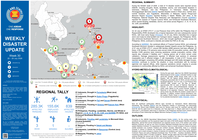

Please refer to the attached Infographic.
REGIONAL SUMMARY:
During the thirtieth week of 2026, a total of 13 disaster events were reported across ASEAN, including droughts, floods, landslides, storms, and wind-related disasters in Indonesia, Malaysia, and the Philippines. In Indonesia, Badan Nasional Penanggulangan Bencana (BNPB) reported disaster events in West Java, Central Java, Central Sulawesi, and Yogyakarta. Meanwhile, in Malaysia, Agensi Pengurusan Bencana Negara (NADMA) reported flooding in Sabah, Melaka, and Johor. In the Philippines, National Disaster Risk Reduction and Management Council (NDRRMC) reported the impacts of Tropical Cyclone NOUL and Enhanced Southwest Monsoon, which caused flooding, landslides, storms, and winds across Regions I, II, III, VI, IX, XI, XII, CAR, and BARMM.
HIGHLIGHT:
On 22 July at 0700H UTC+7, a Low Pressure Area (LPA) within the Philippine Area of Responsibility (PAR) developed into a tropical depression and was subsequently named NOUL, with local name Kiyapo (PAGASA). On 24 July, NOUL intensified into a tropical storm and made its initial landfall over Camiguin Island, Cagayan, the Philippines. NOUL also enhanced Southwest Monsoon, which also brought significant impacts across the Philippines. NOUL continued to intensify and exited the PAR on 25 July.
According to NDRRMC, the combined effects of Tropical Cyclone NOUL and enhanced Southwest Monsoon resulted in widespread disaster impacts across the Philippines. As of 27 July at 0700H UTC+7, around 58K families (269K persons) had been affected. Of these, 2.5K families (11K persons) were served inside 54 evacuation centres, while 29K families (144K persons) were receiving assistance outside evacuation centres. Initial reports also indicated 3 fatalities and 1 missing person (all of which remain under validation). Damage assessments reported 14 affected road sections (5 remained impassable) and 5 affected bridges (1 still impassable). A total of 671 houses were reported damaged, comprising 425 partially damaged and 246 totally damaged houses. NDRRMC continues to monitor the situation in close coordination with its member agencies and regional offices, while response operations remain ongoing to provide assistance to communities affected by NOUL and enhanced Southwest Monsoon.
HYDRO-METEO-CLIMATOLOGICAL:
During the past week, data from the ASEAN Specialised Meteorological Centre (ASMC) indicated medium to high seven-day average rainfall across areas north of the Equator, with the highest rainfall observed over the Philippines, associated with TC NOUL and the enhanced Southwest Monsoon. As of 27 July, a Low Pressure Area (INVEST 93B) located over the Bay of Bengal, approximately 800 km west of Rakhine, Myanmar, is forecast to move north-northwestwards towards the Indian coast. Based on the current forecast, landfall in Myanmar is not expected. However, heavy rainfall and strong winds may still affect the western coastal areas of Myanmar. In addition, another tropical disturbance over the western Pacific Ocean is currently being monitored for its potential development (DMH, PAGASA, JTWC).
GEOPHYSICAL:
Nine (9) significant earthquakes (M>5.0) were recorded by Indonesia’s Badan Meteorologi, Klimatologi, dan Geofisika (BMKG) and the Philippines Institute of Volcanology and Seismology (PHIVOLCS). Mount Anak Krakatau (alert level III), Semeru (alert level III), Lewotobi Laki-laki (alert level III), and Ibu (alert level II) in Indonesia, and Taal (alert level 1), Mayon (alert level 3), Bulusan (alert level 1), and Kanlaon (alert level 2) volcanoes in the Philippines reported recent volcanic activity according to Pusat Vulkanologi dan Mitigasi Bencana Geologi (PVMBG) and PHIVOLCS.
OUTLOOK:
According to the ASEAN Specialised Meteorological Centre (ASMC), for the coming week, drier conditions are predicted over the equatorial region and parts of the south-western Maritime Continent. Meanwhile, warmer-than-normal temperatures are expected across much of the western and central Maritime Continent, as well as over most of southern Mainland Southeast Asia and parts of the north-eastern Maritime Continent. For assessment of extreme, there is a small increase in chance of extreme rainfall predicted over southern Thailand and northern Sumatra. Meanwhile, there is a moderate increase in chance of extreme hot conditions over southern Sumatra, southern Borneo, southern Sulawesi, and a small increase in chance of extreme hot conditions over much of the central Maritime Continent, Papua and parts of Mainland Southeast Asia. The El Niño – Southern Oscillation (ENSO) monitoring system state is “El Niño Conditions”. Models strongly agree that the El Niño conditions will continue through the second half of 2026, with strong conditions very likely from August-September 2026. During El Niño, it is typically drier for much of the Maritime Continent.
Sources:
ASEAN Disaster Monitoring & Response System (DMRS); ASEAN Disaster Information Network (ADINet); ASEAN Specialised Meteorological Centre (ASMC); ASEAN Earthquake Information Centre (AEIC); Joint Typhoon Warning Centre (JTWC);
Indonesia: BNPB, BMKG, PVMBG;
Malaysia: NADMA;
Myanmar: DMH;
Philippines: NDRRMC, PHIVOLCS, PAGASA;
Various news agencies.