
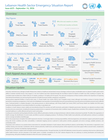

Please refer to the attached file.
Situation Update
Insecurity, restricted access, damage to health infrastructure, attacks on healthcare and persistent resource shortages continue to place considerable strain on Lebanon’s health system and its ability to maintain essential services. Since August 31, two new incidents have been reported through the Surveillance System for Attacks on Health Care (SSA), resulting in 6 injuries. The cumulative total recorded since 2 March 2026 are 215 attacks, resulting in 135 deaths and 416 injuries. The scale and consequences of these incidents reinforce the importance of respecting International Humanitarian Law and ensuring the protection of health personnel, facilities, ambulances, and patients.
Among partner-supported facilities in hard-to-reach areas, 21 Primary Health Care Centers (PHCCs) and 3 hospitals remain closed, although most facilities continue to function through permanent or temporary arrangements. In the South, the rehabilitation and restoration of several facilities have yet to proceed because insecurity and access limitations prevent work in aected areas. Continued partial or complete disruption is also placing pressure on referral pathways, with Primary Health Care Centres (PHCC) and Primary Health Care Satellite Unit (PSU) teams sometimes directing patients to more distant facilities for secondary or specialized care.
Conditions in South Lebanon remain volatile and intermittently disrupt PSU activities and sta movements, particularly in Nabatieh governorate. Operations are adjusted according to daily security and access assessments, including the temporary postponement or suspension of movements when conditions require. Despite these constraints, PSUs continue to support access to essential healthcare in conict-aected and hard-to-reach communities.
Locating and consistently reaching displaced families remains dicult, particularly as families are dispersed between collective shelters and private households. This aects the organization of health coverage, the identication of unmet needs, and eorts to prevent overlapping assistance. The Ministry of Public Health, local authorities, and health partners continue to coordinate service coverage and address identied gaps.
Work is also progressing to strengthen the health response for returnees. Current gaps relate to screening responsibilities, referral arrangements, and medication support, particularly for people living with chronic conditions and other vulnerabilities. A dedicated mapping exercise is planned to clarify partner activities, geographic and service coverage, available assistance, and outstanding needs.
Preparatory work continues on an assistive-device intervention for vulnerable individuals in South Lebanon, Beirut and Mount Lebanon, and the Bekaa. The intervention is expected to cover mobility, hearing, and visual aids. Coordination with the national authorities, Health Sector and relevant partners will be required to ensure that support reects assessed needs, complements existing services, and does not duplicate ongoing assistance.
Health Sector continues to address both immediate and forward-looking priorities. Through December, the 2026 LRP Addendum remains focused on sustaining critical services, delivering key public health functions, and the restoration of the health system. In parallel, consultations for the 2027 Lebanon Response Plan are underway on activity prioritization and funding and reprogramming, with partner feedback intended to inform the sector’s priorities, targets.