
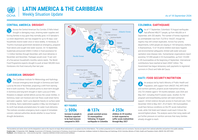

Please refer to the attached Infographic.
KEY FIGURES
- 500K increase in people in Honduras expected to be food-insecure compared to 2025
- 137K people assisted across 53 municipalities following 10 August earthquake in Colombia
- 253K children (6-59 months) in Haiti expected to suffer acute malnutrition through May 2027
CENTRAL AMERICA: DROUGHT
Across the Central American Dry Corridor, El Niño-linked drought is damaging crops, straining water supplies and forcing families to buy grain they normally grow. In El Salvador’s La Unión department, rain has stopped for up to 45 days; rural households receive water once or twice weekly. In Honduras, El Triunfo’s municipal government declared an emergency, prepared food rations and sought new water sources. On 16 September, Guatemala announced US$65.5 million in food assistance for 1.2 million families through December, with most deliveries in November and December. Packages would cover 73 per cent of a five-person household’s monthly calorie needs. The World Food Programme expects drought to push at least 500,000 more Hondurans into food insecurity than last year.
CARIBBEAN: DROUGHT
The Caribbean Institute for Meteorology and Hydrology forecast emergency-level drought in Dominica and Saint Lucia by the end of November, projecting a shift from warning level in both countries. The outlook points to short-term drought in Dominica and long-term drought in Saint Lucia as El Niño threatens to deepen rainfall deficits across the Lesser Antilles. In Dominica, lower soil moisture and river flows could strain farms and water supplies. Saint Lucia depends heavily on surface water for drinking. Rains replenished supplies in May, but shortages in its north had already prompted plans for water truck deliveries. The institute considers emergency level a signal of immediate concern; national authorities decide whether to issue formal drought declarations.
COLOMBIA: EARTHQUAKE
As of 17 September, Colombia’s 10 August earthquake had affected 486,917 people, up from 466,606 on 4 September, with 335 deaths. The number of homes registered as uninhabitable rose from 73,378 to 104,037, though the registry may still contain duplicates. Across four priority departments, 6,903 people are staying in 105 temporary shelters. In Buenaventura, 13 of 18 active shelters lack basic hygiene and environmental safeguards; limited safe water and poor sanitation raise disease risks. Humanitarian organizations report assisting 137,000 people in 53 municipalities, up from 123,000 in 49 municipalities at the beginning of September. International contributions have reached at least US$47 million. The Government has begun temporary cash payments to registered survivors in Chocó and Valle del Cauca.
HAITI: FOOD SECURITY/NUTRITION
An analysis led by Haiti’s Ministry of Public Health and Population, with support from UNICEF, FAO, WFP, WHO and nutrition partners, projects acute malnutrition among 253,725 children aged 6–59 months between June 2026 and May 2027, including 93,873 severe cases. Another 25,750 pregnant and breastfeeding women will need nutritional support. Armed violence disrupts access to food and care. From December 2026 to May 2027, 29 of Haiti’s 140 municipalities could face Serious conditions on the IPC acute malnutrition scale, while Cité Soleil and Cabaret could reach Critical, the second-highest phase. The analysis warns that rising needs will put further pressure on nutrition services that many families already struggle to reach.