
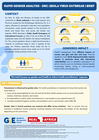

Please refer to the attached file.
On May 15, 2026, the Ministry of Health of the DRC confirmed an Ebola outbreak in the north-eastern Ituri Province caused by the Bundibugyo ebolavirus [1]. In a region affected by persistent insecurity and population movements, cases quickly spread to the provinces of North and South Kivu, and across the border into Uganda. WHO declared a Public Health Emergency of International Concern on May 17 [2]. As of May 29, 906 suspected cases and 223 deaths are being investigated [3]. The current epidemic shows a slight trend towards a majority of confirmed cases in men. A quarter of the cases are children, especially those under five [4]. In previous outbreaks women have made up to two thirds of cases [5]. Getting ahead of this is key.
KEY FINDING
Transmission is influenced by gender roles. For health practitioners is important to know that women are more likely to:
-
have caring responsibilities for the sick and be frontline health workers such as community health workers, midwives, cleaners, and nurses;
-
be responsible to collect water and firewood or cross borders to buy essential items [7];
-
manage household hygiene, laundry, and sanitation use in rural and peri-urban DRC [8].
Gender roles in funeral practices are nuanced and differ across locations. Men or women may be involved in traditional funeral practices involving dressing and touching the bodies of the deceased depending on the community