Uncategorized

9e35a2d2 3084 419d 9f7c 4ba791070f80 K3mp6S

World: GHO Mid-Year 2026

Country: World Source: UN Office for the Coordination of Humanitarian Affairs Please refer to the attached file. Dear colleagues, I would ask that the ERC’s foreword is used in the Reliefweb coverpage. It is on page 4 of the document. Could I please request that the following line is added at the bottom of the page ” Explore the report and interactive content through humanitarianaction.info.” thank you Ysabel

World: GHO Mid-Year 2026 Read More »

38661bcc 7c0a 4f2a 9137 E4e01cc59193 RPKb8k

Sudan – Market Prices and Availability Report 16: Essential Commodities Prices, Availability, and Market Actors’ Perceptions (May 2026)

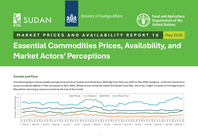
Country: Sudan Source: International Food Policy Research Institute Please refer to the attached file. Cereals and Flour The following figure shows weekly average local prices of cereals and wheat flour (SDG/kg) from February 2025 to May 2026. Sorghum, millet and wheat flour prices increased slightly in May compared to April 2026. Wheat prices remained stable during April and May, with only a slight increase at the beginning of May before returning to previous levels by the end of the month.Summary: This report, produced by the IFPRI’s Sudan Strategy Support Program, presents updated trends in prices, availability, and market conditions for essential food and non-food commodities across Sudan. Sudan’s essential commodity markets remained under pressure in May 2026, with prices rising for many food items and traders reporting declining availability across several commodity groups. Prices of staple cereals, including sorghum, millet, and wheat flour, increased slightly during May, while wheat prices remained broadly stable. Traders reported a continued decline in the availability of cereals and flour compared with earlier months. Prices for lentils, rice, and pigeon peas also increased, accompanied by a reduction in the share of traders reporting high availability. Vegetable markets showed mixed trends. Tomato and potato prices continued to rise during April and May, while onion prices remained relatively stable. Prices of most animal-source foods, including beef, lamb, chicken, and milk, increased in May, and traders reported lower availability of meat and animal products. Among other food commodities, sugar and fava bean prices increased, whereas cooking oil and oilseed prices remained relatively stable. Availability declined for most commodities in this category, except fava beans. Agricultural input markets also experienced changes. Prices of improved wheat seeds rose sharply, while fertilizer prices fluctuated modestly. Fuel prices in regular markets continued their upward trend, and prices in parallel markets remained consistently higher. However, traders reported improved fuel availability compared with April. The gap between official and parallel exchange rates persisted, despite some decline in parallel market exchange rates during May. Market actors continued to face operational challenges. Twenty-three percent of surveyed merchants reported supply chain and logistical constraints, while financial and liquidity challenges increased compared with the previous month. Despite these challenges, storage constraints remained minimal. Most traders reported stable or improved profit margins, and market sentiment remained relatively positive: 70 percent of surveyed merchants indicated they expect to continue trading as usual over the next one to three months, while 20 percent plan to increase trade volumes. Citation: Rakhy, Tarig; Mohamed, Shima; Abushama, Hala; Nigus, Halefom Yigzaw; Suliman, Gotada; and Siddig, Khalid. 2026. Essential commodities prices, availability, and market actors’ perceptions: May 2026. Sudan Market Prices and Availability Report 16. Washington, DC: International Food Policy Research Institute. https://hdl.handle.net/10568/183435

Sudan – Market Prices and Availability Report 16: Essential Commodities Prices, Availability, and Market Actors’ Perceptions (May 2026) Read More »

10c76203 90e0 47cb A692 B053244df15a TAgM4u

oPt: QRCS, JHCO distribute vegetable parcels to displaced families in Gaza [EN/AR]

Country: occupied Palestinian territory Source: Qatar Red Crescent Society Please refer to the attached files. June 28th, 2026 ― Doha, Qatar: A new relief project has been launched by Qatar Red Crescent Society (QRCS), in collaboration with Jordan Hashemite Charity Organization (JHCO), to enhance food security in Gaza, where the latest war left hundreds of thousands of displaced families struggling to find food and other everyday life needs. Dr. Akram Nassar, head of QRCS’s representation office in Gaza, explained, “This food aid is part of a project co-implemented by QRCS and JHCO to distribute vegetable parcels and hygiene kits in Gaza. The current distributions include a total of 11,942 food parcels for the benefit of 71,652 internally displaced people (IDPs) in Gaza and Khan Yunis Governorates, with a special focus on women, children, patients, and older persons”. “Regarding the other component of the project, coordination is in progress to get the hygiene items into the blockade,” he added. “Our aim is to reduce the health risks resulting from the lack of hygiene supplies, thus helping protect displaced families and prevent communicable diseases inside the overcrowded IDP camps and shelters”. According to Dr. Nassar, QRCS will continue to work closely with partners to reach out to the most vulnerable people in Gaza and meet their basic food, shelter, and health care needs, towards the ultimate goal of enabling them to rebuild their lives and develop their potential. Valued at $1,111,000 in total, the project is a new episode of QRCS’s ongoing efforts to improve living conditions and secure essential services for Gaza’s population of more than two million. Over the coming months, QRCS is going to launch more humanitarian projects to provide vital food parcels, hot meals, infant formula, therapeutic food, and bread for over 500,000 beneficiaries, at a total cost of more than QR 20 million. These ambitious plans can become a reality only with generous contributions by the benevolent people of Qatar, who can donate via QRCS’s website (www.qrcs.org.qa), mobile app (QRCS), donor service (66666364), home donation collection (33998898), or donation desks/agents at malls and shopping centers. QRCS reaffirms its commitment to delivering life-saving humanitarian aid to the most vulnerable families and strengthening the resilience of affected communities in the face of persisting humanitarian crisis. ##End of Text## About Qatar Red Crescent Society (QRCS) Established in 1978, Qatar Red Crescent Society (QRCS) is Qatar’s first humanitarian and volunteering organization that aims to assist and empower vulnerable individuals and communities without partiality or discrimination. QRCS is a member of the International Red Cross and Red Crescent Movement, which consists of the International Federation of Red Cross and Red Crescent Societies (IFRC), the International Committee of the Red Cross (ICRC), and 191 National Societies. It is also a member of several GCC, Arab, and Islamic organizations, such as the Islamic Committee of International Crescent (ICIC) and the Arab Red Crescent and Red Cross Organization (ARCO). In this legally recognized capacity, QRCS has access to disaster and conflict zones, thus serving as an auxiliary to the State of Qatar in its humanitarian and social efforts — a role that distinguishes it from other local charities and NGOs. Both locally and internationally, QRCS has relief and development operations in numerous countries throughout the Middle East, Asia, Africa, Europe, and Central and South America. Its humanitarian mandates include disaster preparedness, response, recovery, and risk reduction. To mitigate the impact of disasters and improve the livelihoods of affected populations, QRCS provides medical services, food, water, shelter, and other needs of local communities. It is also active at the humanitarian diplomacy and advocacy front. With the help of a vast network of trained, committed staff and volunteers, QRCS aspires to improve the lives of vulnerable people by mobilizing the power of humanity, inspired by the seven Fundamental Principles of humanitarian action: humanity, impartiality, neutrality, independence, voluntary service, unity, and universality.

oPt: QRCS, JHCO distribute vegetable parcels to displaced families in Gaza [EN/AR] Read More »

Acted Scales Up Emergency Response Following Earthquakes in Venezuela

Country: Venezuela (Bolivarian Republic of) Source: Agency for Technical Cooperation and Development Already present near the epicentre in Caracas, Miranda, Falcón and Yaracuy, Acted rapidly deployed emergency teams to assess needs and prepare life-saving assistance for affected communities. Venezuela is facing a major humanitarian emergency after two powerful earthquakes struck the north-central region of the country on 24 June. The disaster has caused widespread destruction across several states, including Caracas, Miranda, Falcón, Yaracuy and La Guaira, leaving communities without access to essential services and forcing thousands of people from their homes. More than 1,500 people have reportedly lost their lives, while over 50,000 people remain missing in the aftermath of the disaster. Acted was already present in areas close to the epicentre, including Caracas, Miranda, Falcón and Yaracuy, enabling the organisation to react immediately. An emergency team from Acted Headquarters arrived in Venezuela yesterday to reinforce national teams and conduct rapid assessments in the hardest-hit communities. As one of the first humanitarian organisations on the ground, Acted is already identifying urgent needs and preparing life-saving assistance for affected families. Initial assessments reveal a devastating situation. Homes, schools, health facilities and vital infrastructure have suffered extensive damage, while telecommunications, water networks and other essential services remain severely disrupted. Many families have lost everything and are currently sleeping outdoors, exposed to the elements and growing protection risks. Most Urgent Needs Clean water damaged water infrastructure has left communities without access to safe drinking water. Food assistance access to food is severely limited as markets and shops have been destroyed or are no longer functioning. Hygiene supplies affected households require hygiene kits, including soap, sanitary products and baby care items. Emergency shelter families who have lost their homes urgently need tents, bedding and other essential household items. Healthcare and medicines hospitals are overwhelmed and access to medical supplies remains critically constrained. With needs continuing to grow and access to essential services severely compromised, rapid humanitarian action is critical. Based on its emergency assessment, Acted is preparing to deliver assistance focused on shelter, food security, water, sanitation and hygiene (WASH), and protection, helping affected families meet their immediate needs and begin rebuilding their lives Acted teams are on the ground. The needs are immense, and immediate support is urgently needed to help affected communities survive and recover. Support Acted in Venezuela

Acted Scales Up Emergency Response Following Earthquakes in Venezuela Read More »

A27d5a5e 50c4 4972 Ab32 095a8daa5c67 G9gP0h

South Sudan Humanitarian Update as of 26 June 2026

Country: South Sudan Source: UN Office for the Coordination of Humanitarian Affairs Please refer to the attached file. HIGHLIGHTS Latest seasonal forecasts indicate a high likelihood of below-average rainfall and above-average temperatures across much of South Sudan during the June–September rainy season. A substantial number of IDPs have reportedly returned to Akobo following an improvement in the security situation. An estimated 22,000 people in Udier Payam, Longochuk County, Upper Nile State, are in urgent need of humanitarian assistance, according to a recently concluded Inter-Agency Rapid Needs Assessment. The Emergency Relief Coordinator, Tom Fletcher, has announced an allocation of US$6 million for Ebola operational readiness in South Sudan.

South Sudan Humanitarian Update as of 26 June 2026 Read More »