Uncategorized

Sudan: “Drone attacks in El Obeid are impacting basic services, rising transport costs, and limiting access to safe drinking water and healthcare”

Country: Sudan Source: Médecins Sans Frontières We highlight the humanitarian situation in El Obeid, North Kordofan, a home to around 500,000 people. Based on a recent field visit by our teams, who witnessed firsthand how the conflict is affecting people’s daily lives. The frontline is less than 40 kilometers from the city, and drone strikes have increased in recent weeks, targeting both El Obeid and the main road leading to the city. These attacks are adding a lot of pressure on already weak essential services, increasing fuel and transport costs, and making it difficult for people to access safe drinking water, shelter and lifesaving care. We spoke with Liesbeth AELBRECHT, MSF Emergency Coordinator and here are the excerpts: Why is El Obeid attracting attention now? The vast Kordofan region, in south-central Sudan, has remained one of the most volatile and active conflict zones of the three-year-old long war in Sudan. North Kordofan state is at the centre of the hostilities and its capital, El Obeid, with about half a million inhabitants, has become a refuge for about 100,000 displaced civilians fleeing violence elsewhere1. This is coupled with being one of the least accessible regions for humanitarian organisations. ​ The frontline is less than 40 kilometres away. In June, the UN sounded alarms on the potential consequences of a large-scale attack by the Rapid Support Forces (RSF) following reports about the mobilisation of troops2. Drone attacks by the RSF have intensified in recent weeks in and around the city. According to data from the International NGO Safety Organisation (INSO), North Kordofan has been the state receiving the highest number of drone strikes in 2026, with at least 141 recorded attacks until 8 July. More than half of these attacks (51%) have taken place since June, and the vast majority hit El Obeid, followed by the main road leading to the city from the east. How is the situation in the city? There is a real sense of fear among people in El Obeid. Drone strikes are not limited to military targets. They very often hit civilian areas, killing and injuring civilians. Since June, strikes hit schools, a market, fuel stations and supplies, water points and the main power station of El Obeid, causing major disruption to the city’s electricity supply and blackouts, although the network has been somehow reestablished. Drone attacks are impacting basic services, rising transport and fuel costs, and limiting access to safe drinking water and healthcare. There are almost no remaining functional fuel stations and the price of one litre of gasoline has reached nearly 15 USD, and it can be even higher in the black market. The water situation is also critical with many people waiting for hours to collect water, and the prices of the barrels are skyrocketing too. El Obeid now depends mainly on seasonal dams and a small number of urban boreholes. In one of the camps for displaced people I recently visited, families are surviving on a little over one litre of water per person per day, there is too few latrines and widespread open defecation. People are struggling to afford even basic healthcare. Hospitals running without reliable backup power are suffering from power rationing and are at risk of having to close some life-saving services. They are in need of more generators and depend on fuel, which is no longer available. In addition, they also suffer from lack of water. Access to medicines remains a challenge and is costly, the referral of patients can be difficult because of insecurity and transport costs and delays in seeking care often result in patients arriving in more severe condition. The repeated attacks are making humanitarian operations increasingly difficult. Insecurity limits the ability of teams to move safely, and restrictions on travel permits, and road movements can cause further delay. ​ Are people leaving El Obeid? We observe that regular bus movements are still running and that the road remains passable. However, many people cannot afford to leave or are possibly afraid to move because the main road out of the city is frequently targeted by drones. We are not currently observing a large-scale movement of people leaving El Obeid towards neighbouring White Nile state, situated about 100 kilometres away. However, should people decide to leave El Obeid, they must be granted safe passage and access to shelter, safety and medical care whenever they need it. What is MSF concerned about? The situation is very difficult, especially for displaced people. Many families are struggling to meet their basic needs and live in crowded places with poor shelter, and very little access to water and sanitation, leading to poor hygiene. We are particularly worried about access to safe drinking water as many people are using unsafe water sources. With the rainy season starting, conditions will get worse and the risk of diseases like cholera will increase. Cholera was first reported in neighbouring West Kordofan state in late May. In North Kordofan, dozens of suspected cholera cases have since been reported, raising serious concerns that the outbreak may be spreading into the state. Malnutrition is already high, especially among children, making people more vulnerable to illness. ​ The recent escalation once again places civilians in the middle of the conflict. After more than three years of violence, displacement, and loss, people are simply exhausted. In one of the camps, I met a lady who had fled from El Fasher last year. She walked 21 days to reach El Obeid. She arrived barefoot after witnessing unimaginable suffering along the way and now she is again on the brink of an extremely difficult situation here. Her story is just one of many stories of this unbelievable, incredible resilience, but it is also a reminder of the immense human cost of this conflict. As fighting intensifies in and around El Obeid, we call on RSF and the Sudanese Armed Forces to ensure the protection of civilians, as well as of aid workers trying to support the population. What is MSF
Sudan: “Drone attacks in El Obeid are impacting basic services, rising transport costs, and limiting access to safe drinking water and healthcare” Read More »

opt: seven ways the water crisis in gaza is hurting women

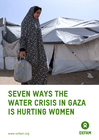
oPt: Seven ways the water crisis in Gaza is hurting women

Country: occupied Palestinian territory Source: Oxfam Please refer to the attached file. Introduction The destruction of water, sanitation and hygiene (WASH) systems in Gaza today constitutes a humanitarian catastrophe with profound gendered impacts. Israel’s genocide against Palestinians in the Gaza Strip has involved the systematic destruction of water infrastructure and a continued humanitarian blockade, drawing widespread international attention and condemnation. However, the specific impacts of this water collapse on women, and the actions needed to address them, have not been so well documented. This paper foregrounds in gendered dimensions of water, sanitation and hygiene deprivation in Gaza, and examines the urgent actions required to address them. This paper draws on powerful testimonies from women in Gaza themselves to spell out their experiences of the destruction of WASH systems. It sets out key themes from their accounts, such as: how in Gaza today women must walk to distant water points and face the threat of gender-based violence conditions for just a few litres of water; how pregnant and menstruating women cannot get the water they need to keep clean and hydrated; how the lack of water adds to the workload of care still largely done by women, whether that is laundry, cleaning or caring for children at constant risk of disease and dehydration; how widows and female-headed households are struggling without the extra support they need; or how elderly and disabled women are sometimes not bathing for days, faced with services that do not adapt to their needs. The briefing draws on interviews with 21 displaced women and girls across Gaza, as well as a literature review of humanitarian reports, to document the gendered impacts of the WASH collapse. It also looks at the coping strategies women are being forced to adopt to survive. Finally, we call for urgent action on this water emergency. Humanitarian actors, donors, and states must shift immediately from short-term emergency delivery to gender-responsive, protection-centred and rights-based WASH recovery. Restoring safe and sufficient water access, ensuring truly inclusive sanitation, supporting women-led initiatives, and strengthening accountability are essential to protecting lives and re-establishing water and sanitation as a fundamental human right for the people of Gaza.

oPt: Seven ways the water crisis in Gaza is hurting women Read More »

localisation of environment in humanitarian action (leha) localised training material for colombia

Localisation of Environment in Humanitarian Action (LEHA) Localised Training Material for Colombia

Country: Colombia Sources: UN Environment Programme, UN Office for the Coordination of Humanitarian Affairs Please refer to the attached files. The contextualized training material for Colombia was developed based on the Global Training Template and adapted to the national context through a collaborative process, thanks to the valuable contributions of specialists in the environment and humanitarian action. The materials include a total of 11 technical modules and 1 training-of-trainers module, covering key topics related to the environment in humanitarian action (EHA). The download links include the contextualized documents in text format and ready-to-use presentations in PPT format. Module 1: Introduction to the Environment in Humanitarian Action Module 2: Environmental Assessment in Humanitarian Action Module 3: Sustainable Waste Management in Humanitarian Contexts Module 4: Sustainable Water Resources Management in Humanitarian Action Module 5: Climate Change Adaptation and Disaster Risk Reduction Module 6: Sustainable Land Management in Humanitarian Action Module 7: Greenhouse Gas Emissions and Sustainable Energy Management Module 8: Managing the Environmental Impacts of the Supply Chain and Logistics in Humanitarian Action Module 9: Integrating and Financing the Environmental Dimension in Humanitarian Programs Module 10: Intersectoral Collaboration and Knowledge Sharing Module 11: Community Participation and Capacity Building in Humanitarian Action Module 12: Training of Trainers Training-of-Trainers (ToT) Module 12 was created to ensure the continued development of environmental capacity in humanitarian action (EHA), with a focus on building the capacity to deliver sustainable training courses. The download links also include the Preliminary Note for the LEHA Colombia Training—a short document containing acknowledgments, an overview, and a glossary of key terms related to the content—and the Introduction to the LEHA Colombia Training, which provides a detailed description of all the components of this training and its deliverables. This training material is open source and is available to any organization or individual for use or reference in developing and delivering training courses on the environment in humanitarian action tailored to the Colombian context.

Localisation of Environment in Humanitarian Action (LEHA) Localised Training Material for Colombia Read More »

DR Congo: DRC Ebola outbreak response needs urgent scale-up after two months

Country: Democratic Republic of the Congo Source: Médecins Sans Frontières The Ebola disease outbreak in Democratic Republic of Congo continues to outpace response efforts. In two months, this outbreak has become the third largest, and fastest growing, Ebola disease outbreak on record. Expanded international support is urgently needed to ensure the response is adequately resourced. BUNIA — Two months after the Ebola disease outbreak was officially declared in Democratic Republic of Congo (DRC), there have more than 2,000 confirmed cases and 750 deaths. Médecins Sans Frontières (MSF) is calling for an urgent scale-up of the medical response. The epidemic continues to spread at an unprecedented pace and into new areas, while efforts to control it remain insufficient. “Every delay costs lives. We are still chasing the outbreak instead of staying ahead of it,” says Trish Newport, MSF emergency programme manager. “More people become infected, more families lose loved ones, and the epidemic becomes harder to contain. We need stronger, more coordinated international action to move faster and improve access to both Ebola care and other essential health services.” In just two months, the current Ebola disease outbreak, caused by the Bundibugyo virus, has become the third largest, and the fastest growing, Ebola outbreak on record. In less than five weeks, the number of confirmed cases has tripled, from 650 to nearly 2,000 as of 12 July. The number of deaths has increased more than fivefold, from 130 to over 700. The epidemic has already exceeded half the number of cases recorded during DRC’s 2018–2020 Ebola outbreak, which lasted almost two years. The situation is particularly alarming, as the outbreak continues to expand geographically. Limited access to medical care, an overstretched surveillance system, and increasing pressure on treatment centres mean that entire communities outside of major urban areas remain without adequate support. MSF is calling on health authorities and humanitarian organisations to swiftly increase resources across all aspects of the Ebola response, including community engagement, surveillance, testing and diagnosis, patient care, survivor support, and the safe and dignified management of bodies and burials. This must be done while ensuring that other urgent health needs are also addressed. Ituri province, the epicentre of the outbreak, accounts for approximately 90 per cent of all confirmed cases. “In Mongbwalu [in Ituri], we are seeing the deadly human consequences of these gaps every day,” says Ayokunnu Raji, doctor and MSF medical program manager. “At the ebola treatment centre, we continue to see patients arriving in critical condition, little chance of survival.” “Since MSF started its Ebola response activities, we have treated 57 survivors, but more than 110 patients have died,” says Raji. “Increased national and international resources would help prevent further transmission and loss of life.” “In Bunia, the 90-bed Elikiya Ebola treatment centre is almost always operating at full capacity. People regularly tell us they prefer to wait at home and come only when a bed becomes available,” says Sylvie Kaczmarczyk, MSF emergency coordinator in Bunia. “As a result, we continue to receive patients who arrive late and are already critically ill.” “It is devastating to know that many of these deaths could have been prevented through earlier diagnosis and timely access to care and treatment,” says Kaczmarczyk. Bringing the response closer to communities While other medical organisations are working alongside the Ministry of Health in eastern DRC, significant gaps remain. DRC’s surveillance system is designed to detect cases early through strong community networks and the local health system. However, the current Ebola disease outbreak, combined with multiple other disease threats, has pushed the system to its limits. The key to slowing and ultimately stopping the spread of the epidemic is to bring the response closer to communities while boosting the medical response and surveillance system, so that cases can be identified and isolated as early as possible. Efforts to expand testing, contact tracing, and community engagement must also continue. The authorities in DRC and other countries are applying movement restrictions, including border closures, self-monitoring requirements and measures affecting humanitarian personnel, that create additional challenges for placing and rotating specialised Ebola staff. MSF currently runs seven Ebola treatment centres and more than 15 isolation units across Ituri, North Kivu, South Kivu, and Tshopo provinces, with a combined capacity of more than 430 beds. Since the beginning of the outbreak and up to 14 July, our teams had admitted more than 968 patients, including 357 confirmed cases. We have also supported the recovery of 116 survivors, following treatment and care. In addition, MSF supports the Ministry of Health with surveillance and detection activities, community engagement, training, and efforts to ensure safe access to other essential healthcare services. Ebola: a crisis amid multiple emergencies The Ebola outbreak is unfolding in a context of armed conflict, displacement, and multiple concurrent health emergencies. Insecurity continues to restrict access to some communities, while MSF teams are simultaneously responding to other urgent medical needs, including cholera and malaria. The approaching rainy season is also expected to drive a surge in malaria cases, placing further strain on an already overstretched health system. It is crucial to accelerate efforts to improve access to Ebola care while ensuring the provision of other basic humanitarian assistance, including healthcare and water and sanitation services. “We cannot continue responding to the epidemic with the same limited resources while it continues to outpace us,” says Newport. “Only a robust, adequately resourced medical response that truly reflects the scale of needs on the ground can prevent this outbreak from becoming a crisis beyond our ability to contain. To achieve that, expanded international support is urgently needed. MSF’s Ebola disease outbreak response in DRC Since the start of the outbreak, MSF teams in Ituri, North Kivu, South Kivu, and Tshopo provinces have established Ebola treatment centres in Bunia, Mongbwalu, Komanda, Goma, Butembo, Bukavu, and Lwiro, as well as more than 15 isolation units. Additional isolation and treatment facilities are being prepared across the affected provinces. MSF has also strengthened infection prevention and control measures in health facilities we

DR Congo: DRC Ebola outbreak response needs urgent scale-up after two months Read More »

dr congo: africa cdc and simba integrate biological security into the response to the bundibugyo virus disease (bvd) outbreak

DR Congo: Africa CDC and SIMBA integrate Biological Security into the Response to the Bundibugyo virus disease (BVD) Outbreak

Countries: Democratic Republic of the Congo, Uganda Source: Africa Centres for Disease Control and Prevention Please refer to the attached file. Biological risks, whether naturally occurring, accidental, or deliberate, do not respect geopolitical borders. The current Bundibugyo Virus Disease (BVD) outbreak in the Democratic Republic of the Congo and Uganda once again demonstrates how rapidly highly infectious diseases can evolve into regional and international health security threats, particularly in contexts marked by insecurity, population mobility, cross-border trade, disinformation, fragile health systems, weak early warning surveillance and limited laboratory capacity underscoring the importance of coordinated, effective preparedness and response efforts. For the Global Partnership Against the Spread of Weapons and Materials of Mass Destruction (GP), outbreaks caused by high consequence pathogens such as Orthoebola viruses must also be understood and managed as biological security and potential bio-proliferation risks. Lessons from previous Ebola disease outbreaks, including in West Africa a decade ago, have shown that effective outbreak response requires not only rapid detection and robust clinical care, but also strong biological security systems that reduce biological risks from high consequence pathogens throughout the response cycle. Safe, secure, and accountable management of patient samples, laboratory facilities including biobanks and processes, Ebola treatment centres, data, waste streams, and transport systems is therefore an essential component of preparedness, response, and long-term resilience. The Signature Initiative to Mitigate Biological Threats in Africa (SIMBA) provides a framework for integrating biosecurity in public health response to outbreaks of high consequence pathogens. Through its established partnerships, trusted relationships, technical expertise, and sustained capacity-building efforts, SIMBA is well positioned to support the current BVD outbreak response activities, develop local context-centred preparedness capabilities to respond to future outbreaks, while ensuring that biological security considerations are integrated into public health operations from the outset. In partnership with WHO, Africa CDC, and the International Criminal Police Organization (INTERPOL), as well as other African partners, international organizations and donors, and in line with the Biological and Toxin Weapons Convention (BTWC), SIMBA is willing to support sustainable and nationally owned approaches to managing biological risks and strengthening preparedness for outbreaks of epidemic-prone diseases such as Ebola disease. The GP recognizes the unpredictable and evolving nature of biological threats and supports efforts to prevent, detect, and mitigate biological risks that could contribute to proliferation, accidental release, loss, theft, or misuse. In response to the current outbreak, and with the objective of strengthening sustainable preparedness and response capacities, we are committed to: supporting national and regional initiatives in providing the safe, secure, and accountable management of Bundibugyo virus-related patient samples throughout their full lifecycle, in alignment with national and regional policies; supporting the operation, maintenance and security of facilities and equipment, and sustained government stewardship of biological materials and associated infrastructure so that capacities remain functional beyond the current outbreak response; strengthening the security of Ebola treatment centers, laboratories and sample transportation through effective cooperation with law enforcement; supporting characterization of samples and promoting the use of accurate sample inventories, access-control measures, chain-of-custody procedures, secure cold-chain logistics, and incident-reporting mechanisms, including law enforcement; supporting proper waste management, the safe and verified inactivation and/or destruction of residual samples and the consolidation of retained Bundibugyo virus samples and other high consequence biological materials in secure, quality-assured national repositories or biobanks, where appropriate. Long-term storage in decentralized facilities that do not meet agreed biosafety and biosecurity standards should be avoided; promoting safe, secure, and responsible scientific use of Bundibugyo virus-related samples, ensuring that research activities are ethically reviewed, nationally owned, scientifically justified, transparent, and accompanied by appropriate access and benefit-sharing and safeguards against misuse, including dual-use risks; enhancing frontline and laboratory workforce capacities through deployment, routine simulation exercises, open sharing of training resources and targeted training in biorisk management and best practice with train-the-trainer approaches that ensure preparedness, sustainability and national ownership; strengthening national and regional laboratory networks with quality assurance systems for secure sample referral and management, data management, and responsible laboratory information sharing; supporting multisectoral coordination among public health, veterinary, security, law enforcement, customs, border management, transport, research, and community actors to ensure that biosecurity measures are practical, trusted, and embedded within outbreak response structures; strengthening cross-border cooperation between affected and at-risk countries, including harmonized procedures for sample referral, laboratory confirmation, contact tracing, case notification, safe transport, and management of human remains, in line with the International Health Regulations (2005); supporting effective communication strategies to prevent, counter and raise awareness on mis- and disinformation and reduce their impact on biosecurity efforts. Building on the progress already achieved, SIMBA can play a central role in connecting immediate outbreak response efforts with longer-term investments in biosecurity, biosurveillance, non-proliferation, and enforcement capacities across Africa. Its multisectoral and partnership-based approach enables rapid coordination, promotes interoperability across institutions and borders, and leverages trusted regional relationships and existing training networks to support effective, sustainable, and nationally owned responses to biological incidents. Continued cooperation through SIMBA can therefore help ensure that the current Bundibugyo virus disease outbreak, and future outbreaks caused by highly dangerous pathogens is addressed not only as a public health emergency, but also as a broader health security challenge requiring coordinated measures to reduce risks, strengthen resilience, raise awareness and prevent future biological threats of all origins.

DR Congo: Africa CDC and SIMBA integrate Biological Security into the Response to the Bundibugyo virus disease (BVD) Outbreak Read More »