

Please refer to the attached file.
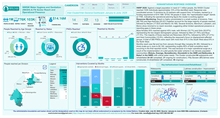
HNRP 2026: Against a target population in need of 1 million people, the WASH Cluster reached 103K individuals, approximately 10% of the identified need. The response was coordinated across 13 divisions by 22 partners with support from 14 funders, backed by a funding requirement of $14.16M. Of the 1M people in need, the “reprioritisation target” stands at 776K, indicating the operational planning figure the cluster is working against.
Response Monitoring: Reach is highly concentrated in a small number of divisions. Fako (68,155) and Ngo-Ketunjia (20,021) together account for the large majority of people reached, followed by Mezam (17,823) and Meme (16,168). Several divisions, Menchum, Lebialem, and Momo, show minimal to no reach recorded, suggesting either limited operational presence or reporting gaps in these areas.
More females 55% reached against 45% male, with Women (33.7%) and Girls (26.97%) representing the two largest demographic groups, followed by Men (21.78%) and Boys (17.5%). The majority of those reached are Returnees (56.81%), followed by IDPs (27.21%) and Host Communities (15.9%), reflecting the response’s focus on displacement-affected groups. A total of 389 PWDs were reached, with more than 91% in the South West and about 8% in the North West.
Monthly reach was flat and low from January through May (ranging 2K–8K), followed by a sharp scale-up in June to 82,182, representing roughly 80% of total cumulative reach occurring in the final reported month. This was because of a major operational surge as a result of the implementation of a pilot gravity-fed water scheme in six densely populated communities (Wotutu, Ewongo, Bonadikonbo, Ekondotiti in the SWR and Balikumba, & Baba1 in the NWR) with critical water needs. The Cluster constructed 84 waterpoints and rehabilitated 24 (63 completed, 21 ongoing for construction). Fifty-seven (57) latrines were constructed, 4 were rehabilitated (21 completed, 36 ongoing).