
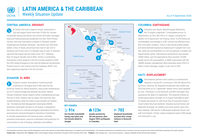

Please refer to the attached Infographic.
KEY FIGURES
- 91K Dry Corridor households facing crop failure and lost income linked to drought
- 123K people assisted by UN and partners after August 2026 earthquake in Colombia
- 702 displaced households assisted after armed violence in Kenscoff, Haiti
CENTRAL AMERICA: DROUGHT
An Oxfam and Action Against Hunger assessment in July and August found more than 91,000 Dry Corridor households facing crop failure, lost income and water shortages. Nearly all maize-producing households lost their 2026 Primera harvest, with near-total failure in eastern El Salvador, eastern Guatemala and southern Honduras. Two-thirds now hold three weeks or less of maize, and prices have risen 67 per cent in Honduras and 32 per cent in El Salvador year-on-year. El Salvador reported that August was the driest since 1971, following their 25 August red alert over El Niño. OCHA is coordinating Anticipatory Action projects in the Dry Corridor backed by CERF, the UN’s Global Emergency Fund, with the Regional Humanitarian Pooled Fund for Latin America and the Caribbean (RHPF LAC) also supporting response in the Dry Corridor.
ECUADOR: EL NIÑO
Ecuador’s oceanic-atmospheric monitoring body confirmed on 28 August that El Niño had met the technical criteria for official presence, citing ocean temperatures up to 4°C above average and elevated sea levels. NOAA’s Climate Prediction Center expects further strengthening through the end of 2026. Impacts vary by region: the coast has seen isolated flooding, while the interior faces drought and wildfire risk. The National Risk Management Secretariat (SNGR) declared a nationwide red alert on 29 August, a designation that stops short of a national emergency declaration but directs provincial and cantonal Emergency Operations Committees to activate preparedness and response plans, including preventive evacuations, resource mobilization and protection for communities at risk of flooding, landslides and wildfires.
COLOMBIA: EARTHQUAKE
Colombia now reports 466,606 people affected by the 10 August magnitude 7.4 earthquake across 16 departments, up from 282,709 on 21 August, including 331 deaths, 4,519 injured and 136 missing. Some 73,378 homes are uninhabitable, and damage to 4,287 schools has affected more than one million students. Chocó is also facing armed clashes and drone-delivered explosives displacing 912 people from rural Sipí, while rain and landslides hit 2,814 households in Quibdó, the departmental capital. International contributions have passed US$40 million, and 29 organizations have assisted 123,000 people across 49 municipalities. A UNDP assessment with the UNGRD disaster management office estimates about US$13.4 billion in direct damage, roughly 2.3 per cent of GDP.
HAITI: DISPLACEMENT
Humanitarian partners have scaled up a multisectoral response in Kenscoff, a commune in the hills above Port-au-Prince, reaching 702 displaced households with shelter and non-food items as of 2 September. Mobile clinics have operated at Lotin, Thomassin 25 and Kenscoff, and WFP will begin food assistance the week of 6 September. The response follows an armed group attack overnight on 23 August that killed at least 47 people and injured 22, with more than 20 executed inside a church where they had sheltered. Attackers burned homes and abducted 50 people; six children and seven women have since been released. IOM reports 4,238 people displaced, 80 per cent with host families. Similar violence displaced nearly 6,000 people from Kenscoff in July.