
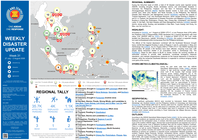

Please refer to the attached Infographic.
REGIONAL SUMMARY:
During the thirty-first week of 2026, a total of 30 disaster events were reported across ASEAN, including droughts, floods, landslides, storms, and wind-related disasters in Indonesia, the Philippines, Thailand, and Viet Nam. In Indonesia, Badan Nasional Penanggulangan Bencana (BNPB) reported disaster events in East Java, Gorontalo, Central Java, West Java, Banten, and North Sumatra. In the Philippines, the National Disaster Risk Reduction and Management Council (NDRRMC) reported the impacts of Tropical Depression “Luis” and Southwest Monsoon, which caused flooding in Regions V and IX. In Thailand, the Department of Disaster Prevention and Mitigation (DDPM) reported flooding in Chiang Rai, Phetchabun, Phayao, Nan, Chiang Mai, Chanthaburi, and Ranong. Lastly, in Viet Nam, Viet Nam Disaster and Dyke Management Authority (VDDMA) reported storms, strong winds, flooding, and landslides in Dien Bien, Tuyen Quang, Lam Dong, Ca Mau, Lao Cai, and Son La.
HIGHLIGHT:
According to PAGASA, on 1 August at 2200H UTC+7, a Low Pressure Area (LPA) within the Philippine Area of Responsibility (PAR) developed into a tropical depression with local name “Luis” (INVEST 94W by JTWC). On 3 August at 1630H UTC+7, the “Luis” made landfall over Maconacon, Isabela. According to PAGASA, this system is expected sharply turn east northeastward while moving away from the Philippine landmass.
The effects of the tropical depression combined with the Southwest Monsoon brought heavy rainfall that triggered flooding in parts of Regions V and IX, particularly in Albay and Zamboanga City (DSWD). As of 2 August 2026 at 1700H UTC+7, the DSWD reported that approximately 4K people (1.6K families) have been affected, including more than 3.6K people taking temporary shelter in an evacuation centre in Zamboanga City. The NDRRMOC raised its alert status to BLUE to closely monitor the evolving situation as authorities continue to provide relief assistance, coordinate emergency response operations, and maintain preparedness measures as the tropical depression is forecast to weaken, while the enhanced Southwest Monsoon is expected to continue bringing rainfall over parts of the country.
HYDRO-METEO-CLIMATOLOGICAL:
During the past week, data from the ASEAN Specialised Meteorological Centre (ASMC) indicated medium to high seven-day average rainfall across areas north of the Equator. High average rainfall observed across northern Philippines due to the combined influence of INVEST 94W, which developed into a tropical depression (Philippines local name: “Luis”, and the Southwest Monsoon. Meanwhile, Tropical Cyclone DOLPHIN is also being monitored approximately 2,650 km east-northeast of Extreme Northern Luzon. Based on the latest forecast, “Luis” is expected to remain a tropical depression for most of the forecast period before weakening into a remnant low by 5 August, after which it is forecast to be fully absorbed into the circulation of Tropical Cyclone DOLPHIN, which is then expected to further enhance the Southwest Monsoon in the coming week. (PAGASA, JTWC).
GEOPHYSICAL:
Six (6) significant earthquakes (M>5.0) were recorded by Indonesia’s Badan Meteorologi, Klimatologi, dan Geofisika (BMKG) and the Philippines Institute of Volcanology and Seismology (PHIVOLCS). Mount Marapi (alert level II), Semeru (alert level III), Lewotobi Laki-laki (alert level III), Ili Lewotolok (alert level II), and Ibu (alert level II) in Indonesia, and Taal (alert level 1), Mayon (alert level 3), Bulusan (alert level 1), and Kanlaon (alert level 2) volcanoes in the Philippines reported recent volcanic activity according to Pusat Vulkanologi dan Mitigasi Bencana Geologi (PVMBG) and PHIVOLCS.
OUTLOOK:
According to the ASEAN Specialised Meteorological Centre (ASMC), for the coming week, wetter-than-usual conditions are expected across much of the northern ASEAN region, with the highest likelihood over the northwestern areas. In contrast, drier-than-usual conditions are forecast across much of the southern ASEAN region. Warmer-than-usual temperatures are expected over much of ASEAN, except across most of Mainland Southeast Asia and the southern Maritime Continent. There is a slight increase in the likelihood of extreme rainfall over parts of northern and central Myanmar, as well as central Philippines. Meanwhile, a moderate likelihood of extreme heat is forecast over southern Sumatra and eastern and southern Borneo, while a slight increase in the likelihood of extreme hot conditions is expected across southeastern Mainland Southeast Asia, southern Thailand, Malay Peninsula, Sumatra, northeastern Borneo, southern Philippines, and parts of Sulawesi and Papua. El Niño conditions are expected to persist throughout the second half of 2026, with models indicating a high likelihood of strong El Niño conditions from August to September. During El Niño, it is typically drier for much of the Maritime Continent.
Sources:
ASEAN Disaster Monitoring & Response System (DMRS); ASEAN Disaster Information Network (ADINet); ASEAN Specialised Meteorological Centre (ASMC); ASEAN Earthquake Information Centre (AEIC); Joint Typhoon Warning Centre (JTWC);
Indonesia: BNPB, BMKG, PVMBG;
Philippines: NDRRMC, DSWD, PHIVOLCS, PAGASA;
Thailand: DDPM;
Viet Nam: VDDMA;
Various news agencies.