
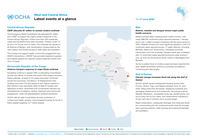

Please refer to the attached Infographic.
Central African Republic
CERF allocates $1 million to contain cholera outbreak
The Emergency Relief Coordinator has allocated $1 million from CERF to support the urgent cholera response in the Central African Republic, where more than 400 suspected cases and 36 deaths have been recorded. Children under 10 account for 44 per cent of cases. The outbreak has spread to all districts of Bangui, with transmission compounded by the rainy season and limited access to safe water and sanitation. The funding will support health, community engagement and WASH interventions. UNICEF has provided treatment supplies and helped expand the national cholera treatment centre from 40 to 70 beds.
Democratic Republic of the Congo
Violence hampers response to major Ebola outbreak
Escalating violence in eastern DRC is disrupting humanitarian access and efforts to contain the world’s third-largest recorded Ebola outbreak. At least 2,124 cases have been confirmed across five provinces, including in 16 displacement sites hosting more than 270,000 people in Ituri. Recent attacks in Beni territory have reportedly killed at least 22 people and displaced civilians. Authorities and humanitarian partners are strengthening surveillance, testing, treatment and community engagement, while UN peacekeepers reinforce protection. OCHA calls for safe humanitarian access, protection of civilians and health workers, and increased funding for the $2.3 billion appeal targeting 10.7 million people.
Mali
Malaria, measles and dengue remain major public health concerns
Malaria remains Mali’s leading public health concern, with nearly 888,000 confirmed cases reported between 1 January and 5 July, a slight increase compared with the same period in 2025. Measles remains the most significant epidemic, with 215 confirmed cases reported across 17 health districts, including Bamako, Mopti and Tombouctou, indicating continued transmission and risk of spread. Dengue cases also increased, with 12 confirmed cases reported during the week ending 5 July, up from six the previous week, mainly in Bandiagara and Bamako. So far no yellow fever or cholera cases has been reported this year. Health authorities continue to prioritize surveillance, monitoring and data quality.
Gulf of Guinea
Climate change increases flood risk along the Gulf of Guinea
Severe rainfall caused widespread flooding across Côte d’Ivoire, Ghana, Togo, and Nigeria between 20 to 22 June 2026, killing more than 90 people, displacing hundreds and damaging infrastructure and livelihoods. According to World Weather Attribution, comparable three-day rainfall events now occur every two to four years, with observations indicating a 23 per cent rise in intensity since records began. Rapid urbanization, inadequate drainage, and rising sea levels are compounding the risk, underscoring the need for stronger early-warning systems, safer housing and improved drainage and sanitation.